
Home
Big potential for green hydrogen in North Africa: report
By Isabel Malsang, Japantoday, 20 August 2023
PARIS
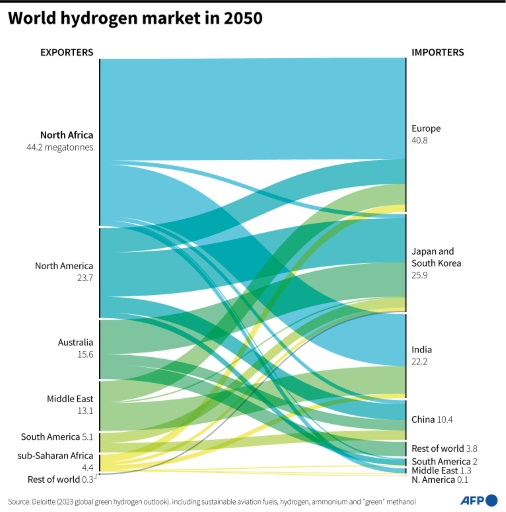
By 2050 North Africa could become a leading exporter of green hydrogen with Europe its main market, according to a recent report projecting the future of an industry still in its infancy.
So-called green hydrogen is set "to redraw the global energy and resource map as early as 2030, creating a $1.4 trillion-a-year market by 2050," according to the report from accounting consultancy Deloitte.
Hydrogen fuel -- which can be produced from natural gas, biomass or nuclear power -- is considered "green" when hydrogen molecules are split from water using electricity derived from renewables such as solar and wind that do not produce carbon emissions.
Less than one percent of the world's hydrogen production presently qualifies as green.
But the climate crisis -- coupled with both private and public investment -- has sparked rapid growth in the sector.
The Hydrogen Council, a lobbying group, lists more than a thousand hydrogen projects in the pipeline worldwide.
Projects launched before 2030 would require about $320 billion dollars in investment, the Council said.
By 2050, according to Deloitte, the main green hydrogen exporters are likely to be North Africa ($110 billion per year), North America ($63 billion), Australia ($39 billion) and the Middle East ($20 billion).
Management consultancy reports can be assumed to heavily reflect the financial interests of their corporate clients, including some of the world's largest carbon polluters.
But the need to meet climate targets and generous subsides are driving demand for clean energy of all kinds, including green hydrogen.
Long-haul aviation and shipping industries -- for which the type of electric batteries powering road vehicles is not an option -- are also keen on hydrogen as an alternative to fossil fuels.
The emergence of a clean hydrogen market from solar and wind could also make the industry more inclusive of developing countries, says the report.
It would also allow Global South steel industries, for example, to leapfrog past coal.
For now, however, 99 percent of the global production remains "grey," meaning that hydrogen is produced by splitting methane molecules, which releases greenhouse gases no matter what kind of energy drives the process.
Truly green hydrogen releases hydrogen from carbon-free water molecules (H20) using an electrical current from a renewable source.
This is where Northern Africa may have a major role to play, says Sebastien Douguet, director of the Deloitte Energy and Modelling team and co-author of the report, which is based on International Energy Agency (IEA) data.
"We're seeing that a number of North African countries such as Morocco or Egypt are taking up the hydrogen issue, and that 'hydrogen strategies' are being announced there just a few years behind the European Union and the United States," Douguet told AFP.
"Morocco has very strong potential for wind energy that is often overlooked, and a great potential for solar power, and Egypt has the means to become the principal exporter of hydrogen to Europe in 2050 thanks to an existing natural gas pipeline" which could be adapted to transport hydrogen, he said.
Saudi Arabia also benefits from sunbaked and available land with the potential to produce 39 million tonnes of low-cost green hydrogen in 2050 -- four times its domestic demand -- that would help diversify its economy away from petroleum, according to the report.
The report predicts investment will end by 2040 for carbon capture and storage as a solution to the emissions of methane-based hydrogen, which is the current strategy of the oil-rich Gulf States, as well as the United States, Norway and Canada.
Hydrogen produced this way is not be labelled green, but rather "blue".
Fact Sheet: Military Coup in Niger

Fact Sheet: Military Coup in Niger
LONDON - Last week's coup in Niger makes it the final central Sahelian state to succumb to a military takeover, following Mali in 2020 and 2021, and two coups in Burkina Faso in 2022, according to report by The Armed Conflict Location & Event Data Project (ACLED).
While Niger's junta has cited rising insecurity as a justification for the coup, ACLED data indicate that violence has been on the decline: in the first half of 2023, conflict incidents decreased by an estimated 39% compared to the previous six-month period. The coup’s aftermath brings a high potential for domestic unrest and regional conflict, a surge in militant activities, democratic backsliding and restriction of civil liberties, and severe socio-economic consequences due to sanctions. Our new fact sheet maps key conflict trends in the lead-up to the putsch and assesses the coup's implications for security in Niger and the wider Sahel region.
Overview
On 26 July 2023, the Presidential Guard in Niger launched a coup and detained President Mohamed Bazoum and his family. Senior officers from various branches of the defense and security forces (FDS) formed a junta, named the National Council for the Safeguarding of the Homeland (CNSP), and announced the seizure of power on a televised broadcast. Public response varied, with initial demonstrations in support of Bazoum being dispersed by mutinous soldiers, followed by subsequent demonstrations in support of the CNSP. By 27 July, the Nigerien Armed Forces joined the CNSP, citing their intent to avoid lethal confrontation and to safeguard the president and his family.
The coup has largely been condemned internationally, including by key stakeholders like the United States, France, the European Union, and ECOWAS. During a summit in Nigeria’s capital Abuja, ECOWAS considered military intervention, and threatened sanctions to pressure the junta to reinstate Bazoum by giving a one-week ultimatum. The West African Economic and Monetary Union (UEMOA) imposed immediate sanctions and froze Nigerien state assets.
Burkina Faso, Guinea, and Mali have declared their support for the Nigerien junta and expressed their refusal to apply any sanctions imposed on Niger. Burkina Faso and Mali further warned in a joint statement that any military intervention in Niger was a declaration of war against the two countries. The reactions in support of Niger from the junta-led states has set the stage for a deeper divide and potential break-up of the West African bloc.
The coup’s aftermath brings a high potential for domestic unrest and regional conflict, a surge in militant activities, democratic backsliding and restriction of civil liberties, and severe socio-economic consequences due to sanctions. Furthermore, the military junta has not consolidated its power grab and faces strong opposition by many international stakeholders. Bazoum not only enjoys support from the international community but also from a large segment of the population across Niger, with signs of supporters counter-mobilizing for mass demonstrations against the junta.
Underlying Discontent and Palace Politics
Niger represents the last of the three central Sahel states to succumb to a military coup, after Mali in 2020 and 2021, and two coups in Burkina Faso in 2022. While some interpret this event through the context of Russia’s increasing influence or its alignment with Western military training initiatives, the primary catalysts were essentially domestic in nature. The leader of the coup, General Abdourahamane Tchiani, was rumored to be on the verge of losing his position as head of the Presidential Guard – a role in which he had defended the regime against numerous attempted coups during the tenures of both former President Mahamadou Issoufou and his successor Bazoum. It is possible that growing discontent within the FDS had intensified over the years under the rule of Issoufou and his successor Bazoum.
This underlying dissatisfaction may have set the stage for the recent military coup, given the swift alignment of other senior military officers. Past coup attempts further underscore a fragile balance on which the regime had to perch and a threat that Bazoum may have underestimated. The decision by senior officers from various branches to join the junta does not necessarily mean unequivocal support for the coup. Instead, it may reflect a strategic move to manage the unfolding crisis, while seizing the opportunity to dismantle the entrenched political system established by the ruling party PNDS under the leadership of Issoufou and Bazoum.
Amid growing anti-French sentiments in neighboring Mali and Burkina Faso, as well as within Niger, the country paradoxically found itself increasingly set apart in the central Sahel, representing France’s last ally and counter-terrorism hub. While Bazoum’s rhetoric was candid, it was often perceived as publicly antagonistic and patronizing towards his Sahelian counterparts, whether or not his points were valid. This particularly applies to his critiques of Mali’s decision to partner with the Russian private military company Wagner Group and Burkina Faso’s strategy to mobilize self-defense militias – policies that have seemingly exacerbated violence and security issues within the two neighboring countries. Moreover, as the supreme commander of Niger’s armed forces, Bazoum’s recent interview, in which he suggested that militants were “stronger and more battle-hardened” than the region’s armies, was likely a misstep. This comment may have been seen as demoralizing, striking a nerve within the military and contributing to rising tensions in the lead-up to the coup.
Violence and Conflict Trends
Niger confronts an array of security challenges: in the west, it faces the Sahelian insurgency driven by IS Sahel and the al-Qaeda-affiliated JNIM, while the southeastern Diffa region is affected by the ISWAP and Boko Haram insurgency. The central Tahoua region is seeing a mixture of IS Sahel militancy and banditry. In Maradi, along the southern border with Nigeria, organized bandit gangs are also highly active. The Agadez region, rich in gold and smuggling routes that stretch along the border with Libya, Algeria, and Chad, has additionally attracted a plethora of armed groups, among them Chadian and Sudanese rebels, drug traffickers, and organized criminal gangs, all contributing to widespread rural banditry.
The Tillaberi region remains most affected by conflict, although there is a notable geographic shift from the northern to the western parts of the region. This shift in violent activity may be attributed to several converging factors. Notably, IS Sahel, the most active armed actor in both the country and the Tillaberi region, refocused its efforts on the Malian side of the border in early 2022. This strategic redirection coincided with France’s withdrawal of forces from Mali and the subsequent reconfiguration of its mission to Niger, where operations were primarily concentrated in northern Tillaberi. IS Sahel and JNIM also engage in simultaneous campaigns in neighboring Burkina Faso, with the border areas in western Tillaberi being used as staging ground. Furthermore, Nigerien authorities have been making concerted efforts to resolve long-standing intercommunal conflicts in Ouallam and Banibangou, the departments previously most affected by violence. The combination of these factors likely contributed to the observed shift in armed engagements.
Despite these challenges, Niger has statistically fared better than its neighbors in terms of violence and conflict. The military junta cited the “continually deteriorating security situation” as a core justification for the coup. The years of 2019 and 2020, during Issoufou’s reign, were particularly devastating for the Nigerien FDS as they suffered heavy losses due to a series of mass-casualty attacks perpetrated by IS Sahel. In 2021, Niger experienced a record year of conflict coinciding with its first democratic transition when Bazoum succeeded Issoufou. Ever since, Niger continues to see high numbers of conflict incidents, although levels of lethal violence are in steady decline, and significantly reduced in comparison to Mali and Burkina Faso.
Outlook
As the dust from the coup begins to settle, Niger stands at a crossroads. The success of the junta in maintaining power and building legitimacy are not guaranteed, with significant opposition domestically and internationally. The junta is yet to consolidate its position and the situation is far from stabilized. Persistent support for Bazoum brings the potential for continued unrest, mass demonstrations against the junta, and violent contestation among pro-junta and pro-regime camps, adding additional layers of uncertainty. The potential fallout of this instability may affect the entire Sahel region, exacerbating existing security challenges and possibly giving rise to new threats both domestically and regionally due to the ramifications of the current crisis. Ongoing insurgencies and armed groups like JNIM, IS Sahel, ISWAP, and Boko Haram (JAS) may exploit and profit from such instability and discord, leading to escalating levels of violence.
The consolidation of power by the Nigerien junta would represent the further spread of democratic backsliding in the Sahel. Should this occur, all central Sahelian states would be effectively ruled by military juntas, marking the end of democracy in the subregion for the time being. Niger will likely face similar consequences as have already been observed in neighboring Mali and Burkina Faso, where the ascension of military governments led to the erosion of civil liberties and fundamental rights, including freedom of press and expression. Furthermore, all three countries have so far failed to suppress a growing regional insurgency expanding across West Africa. Niger is also at risk of severe socio-economic repercussions due to anticipated sanctions and suspension of development and budgetary aid. These pressures are likely to further strain Niger’s already fragile economy.
Key Trends
- Niger has experienced continuous growth in jihadist activity since 2018, with a record year for violence in 2021 measured by fatalities
- While the number of political violence incidents increased further in 2022, the lethality of the violence has steadily declined, with a significant overall decrease in fatalities last year
- In the first six months of 2023, political violence decreased by an estimated 39% when compared to the previous six-month period from July to December 2022
- Attacks on civilians decreased by 49%, and resulting fatalities decreased by 16%
- Operations by the Nigerien security forces increased by 32%, however, as part of a continuous effort to counter insecurity
- Cases of looting and property destruction were the most common type of incident during this period, suggesting that militant groups like IS Sahel and JNIM increasingly see Niger as a key target for resource extraction
- The western Tillaberi region is the most affected by conflict, although there has been a notable geographic shift from the north to the west
For maps and illustrations, visit: https://acleddata.com/2023/08/03/fact-sheet-military-coup-in-niger/
How Ceuta is rejecting the far-right's anti-migrant agenda
How Ceuta is rejecting the far-right's anti-migrant agenda
By Amira Rodriguez, The New Arab, 06 August 2026
Ceuta’s centuries-old coexistence among Muslim, Christian, Jewish and Hindu communities is challenging the far right’s attempts to sow division.
Nearly a thousand years ago, the great Andalusian poet and polymath Ibn Hazm reflected on the ties that bind people together through affection and loyalty, writing: “Love, may God exalt you, is in its essence a union of souls”. Although he was penning his ideals about romantic love, his works speak to something broader and contemporary regarding the bonds that unite communities through a shared history and devotion to the land.
In few places is that ideal more vividly realised than in Ceuta - a city where Christians and Muslims have long lived side by side on Europe’s southern frontier. Yet when the recent migrant crisis thrust Ceuta into the global spotlight, some sought to turn an external border emergency into an internal cultural conflict.
Spain’s far-right party, Vox, argued that the crisis vindicated its long-standing warnings about immigration and national identity. However, in its attempt to divide the citizens of Ceuta, the party underestimated the city it claimed to defend.
A rich history of diversity
Ceuta’s greatest strength directly opposes parties and nationalists from either side of the Strait of Gibraltar, desperate to use the city as leverage in geopolitical disputes.
The Spanish enclave was controlled by various powers over the centuries — Phoenicians, Romans, Byzantines, and then a succession of Islamic dynasties starting in the 8th century (Umayyads, then later the Almoravids, Almohads, and Marinids, among others).
Ceuta's history later became the site of imperial musical chairs: Portugal claimed it in 1415, before the creation of the modern Moroccan state, but it was later absorbed into the Hispanic Monarchy after 1580 and left Spanish by the city’s own choice when Portugal and Spain split in 1640.
An undeniable tool in Spanish control of the western Mediterranean in the aftermath of the Barbary raids and later in the modern epoch, as a fort sitting directly opposite UK-controlled Gibraltar at one of the busiest maritime chokepoints on Earth.
For centuries, however, it was treated as an administrative afterthought, just another municipality under Cadiz province, until 1995, when Spain’s constitution finally gave it autonomous status. During this time, Ceuta lost its free-port privileges upon Spain's EU entry in 1985, a trade-off locals still debate.
Today, Spanish Christians, Arab Muslims, Sephardic Jews, and Sindhi Hindus from pre-partition India make up the rich local population. The city is filled with narrow Mediterranean streets and tapas bars sitting a stone’s throw away from mosques. Spanish is on Ceuta’s tongue by law, but Darija hums and rolls audibly underneath.
But the parameters of what could appear to be relative harmony were tested in recent days when border controls between Morocco and the Spanish enclave crumbled, and an estimated 60,000 people chaotically crossed into Ceuta. The event resulted in the heartbreaking and avoidable death of an estimated 141 people.
Anti-Muslim, anti-migrant agenda
What played out following the mass crossing into Ceuta has punctured the rhetoric around Spanish sovereignty and identity vis-à-vis immigration and Muslims.
Vox leader Santiago Abascal described the event as an “invasion” and called for permanent militarisation of the enclave.
Of course, Abascal’s sentiment extends beyond simply wanting to defend Spanish sovereign borders; he seeks to peddle his political agenda that includes bashing a progressive government. He has been an unabashed critic of Muslim immigration and has viciously questioned their place in Spanish society, going as far as calling for the suspension of procedures for acquiring Spanish nationality for immigrants descended from “Islamic countries”.
The far-right leader also stated that Islam cannot co-exist in Spain.
Perhaps Abascal expected his comments to the press to rally support in Ceuta, given his party secured five seats in the 2023 municipal and regional elections.
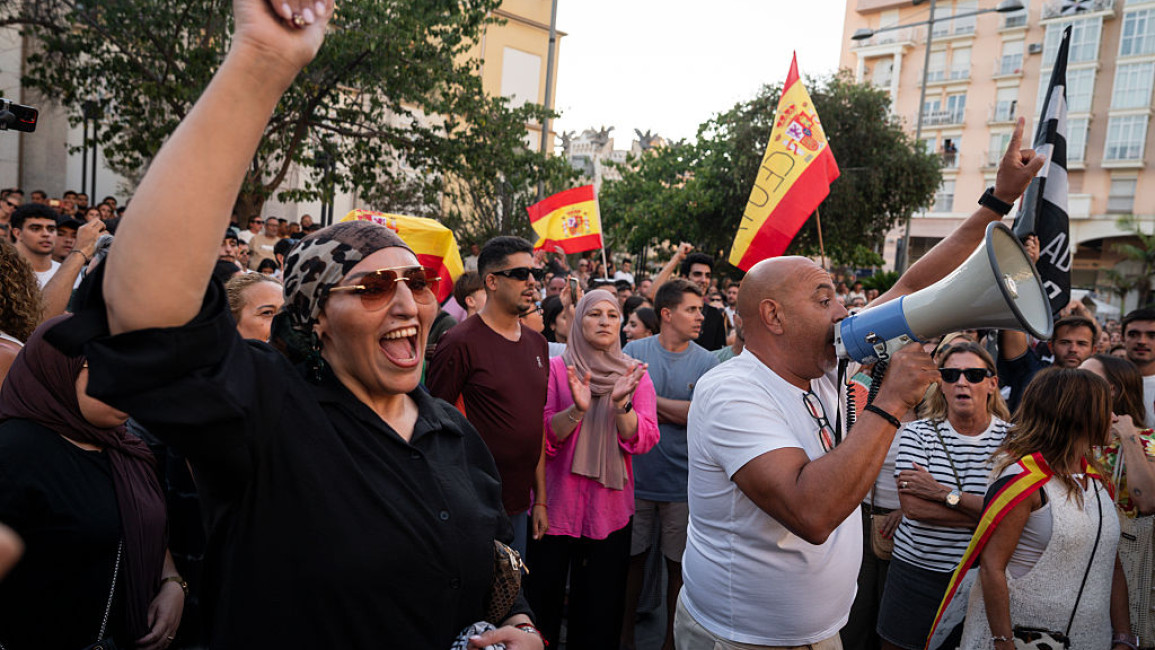
But his hateful rhetoric didn’t resonate with the many, as a protest was organised against Abascal’s visit in the aftermath of the mass crossing. People marched and declared that they did not want fascists on their streets, and chanted: “Ceuta is united and not divided; we the Muslims, the Christians, the Hindus and Jews have made Ceuta what it is”.
Similarly, when the Neo-Nazi party Núcleo Nacional sought to take advantage of the xenophobic hysteria by attempting to organise a rally to echo great replacement theories, young Ceutans very quickly chased them away.
The organisation’s leader, Alvise Pérez, who also serves as a politician and member of the European Parliament, called for the expulsion of all migrants, and locals made it clear how they felt about his views through protest. He was chased into a bar and eventually had to be led away by Police.
It is a testament to Convivencia in Spanish history through Al-Andalus that anxiety over borders and divisive rage bait did not translate into widespread hostility between neighbours. In fact, back in 2021, a left-wing political party called Ceuta, Ya! was established to unite the people against the very divisive politics peddled by the likes of Vox. The Party, which is made up of both Muslims and Christians of varying ages, sought to remedy the rise of far-right nationalist scapegoating.
Many of Ceuta’s Muslim residents have lived in the city for generations. Their citizenship is neither conditional nor recent. Attempting to cast suspicion over an entire community because migrants desperately sought a better life in a European territory ignores the reality of the city itself. But its people have already sent a strong message and made clear they won’t be blinded by hateful political noise.
Author
Rodriguez is a writer based in London, UK.
Disclaimer
Opinions expressed in this article remain those of the author and do not necessarily represent those of The New Arab editorial board team or CEMAS Board.
Libya awards oil and gas exploration licences in landmark tender
Libya awards oil and gas exploration licences in landmark tender
MENAS Associates, London, 16 February 2026
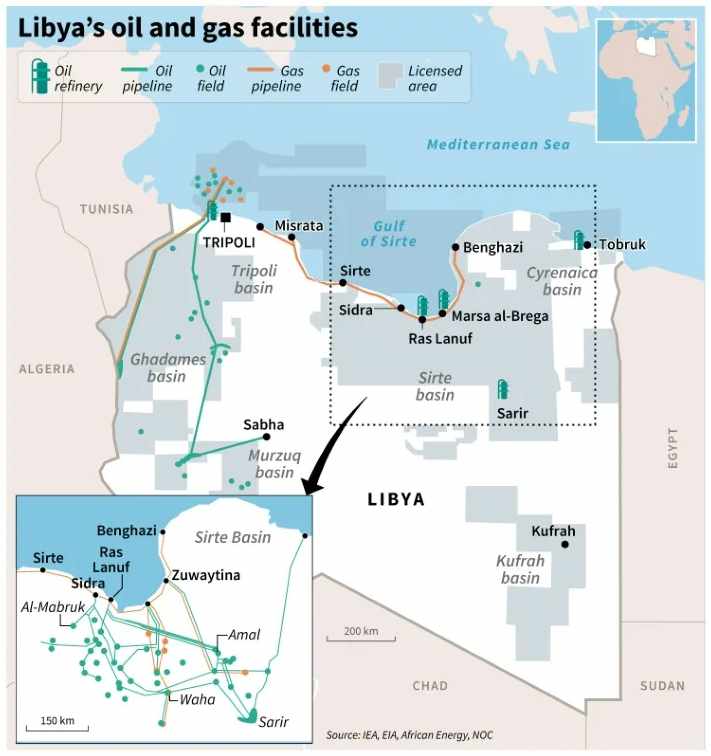
On 11 February, the National Oil Corporation (NOC) announced the results of Libya’s first international licensing round in 17 years. The tender offered 20 exploration blocks across the Sirte and Murzuq onshore basins and the western Mediterranean Sirte offshore basin. Five global companies and consortiums secured contracts: Italy’s Eni in partnership with QatarEnergy; a consortium of Repsol, TPAO and MOL; a separate Repsol-TPAO partnership; the American firm Chevron; and the Nigerian independent Aiteo. This initiative marks a strategic shift aimed at restoring Libya’s position in global energy markets and increasing production from 1.4 million to 2 million barrels per day.
GNU Prime Minister Abdelhamid Dbeibah attended the official ceremony in Tripoli alongside NOC Chairman Masoud Suleiman and GNU Oil and Gas Minister Khalifa Abdulsadek. Suleiman confirmed that while five blocks were successfully awarded, others remained vacant due to non-compliant technical bids or a lack of interest. The NOC will review non-compliant offers and may open negotiations to improve terms for the next round.
The results reflect a significant return of major IOC’s despite persistent political fragmentation and institutional fragility. Eni and QatarEnergy secured offshore Block 01, while the Repsol-MOL-TPAO consortium won offshore Block 07. Chevron’s acquisition of the Sirte S4 license signals a critical return to Libya’s richest onshore basin. In the southern Murzuq basin, Aiteo’s success marks a rare entry for a private African independent. Analysts note that the dominance of state-backed entities like Eni, TPAO, and QatarEnergy suggests that companies with sovereign support are better equipped to navigate the high risk-premiums currently priced into the Libyan market by international financiers.
Industry observers noted that although the NOC had introduced a new contractual model intended to provide investors with greater financial flexibility, Libya’s competitiveness remains hindered by a risk premium imposed by the international market due to security and political uncertainty. Nevertheless, Suleiman emphasised that the successful tender demonstrated institutional transparency and a commitment to quality standards. Future efforts to attract investment are likely to focus on bolstering institutional stability and contractual clarity to reduce market uncertainty, rather than relying on additional financial incentives alone.
Page 18 of 57
Warning: Illegal string offset 'active' in /home/cemasorg/public_html/templates/northsouthnews/html/pagination.php on line 90
Warning: Illegal string offset 'active' in /home/cemasorg/public_html/templates/northsouthnews/html/pagination.php on line 96
Warning: Illegal string offset 'active' in /home/cemasorg/public_html/templates/northsouthnews/html/pagination.php on line 90
Warning: Illegal string offset 'active' in /home/cemasorg/public_html/templates/northsouthnews/html/pagination.php on line 96
Warning: Illegal string offset 'active' in /home/cemasorg/public_html/templates/northsouthnews/html/pagination.php on line 90
Warning: Illegal string offset 'active' in /home/cemasorg/public_html/templates/northsouthnews/html/pagination.php on line 96
Warning: Illegal string offset 'active' in /home/cemasorg/public_html/templates/northsouthnews/html/pagination.php on line 90
Warning: Illegal string offset 'active' in /home/cemasorg/public_html/templates/northsouthnews/html/pagination.php on line 96
Warning: Illegal string offset 'active' in /home/cemasorg/public_html/templates/northsouthnews/html/pagination.php on line 90
Warning: Illegal string offset 'active' in /home/cemasorg/public_html/templates/northsouthnews/html/pagination.php on line 96
Warning: Illegal string offset 'active' in /home/cemasorg/public_html/templates/northsouthnews/html/pagination.php on line 90
Warning: Illegal string offset 'active' in /home/cemasorg/public_html/templates/northsouthnews/html/pagination.php on line 96
Warning: Illegal string offset 'active' in /home/cemasorg/public_html/templates/northsouthnews/html/pagination.php on line 90
Warning: Illegal string offset 'active' in /home/cemasorg/public_html/templates/northsouthnews/html/pagination.php on line 96
Warning: Illegal string offset 'active' in /home/cemasorg/public_html/templates/northsouthnews/html/pagination.php on line 90
Warning: Illegal string offset 'active' in /home/cemasorg/public_html/templates/northsouthnews/html/pagination.php on line 96
Warning: Illegal string offset 'active' in /home/cemasorg/public_html/templates/northsouthnews/html/pagination.php on line 90
Warning: Illegal string offset 'active' in /home/cemasorg/public_html/templates/northsouthnews/html/pagination.php on line 96
Warning: Illegal string offset 'active' in /home/cemasorg/public_html/templates/northsouthnews/html/pagination.php on line 90
Warning: Illegal string offset 'active' in /home/cemasorg/public_html/templates/northsouthnews/html/pagination.php on line 96
Main News


Mediterranean
Lebanon’s Army in Limbo: History, Constraints and Uncertain Futures
Israeli settlers torch Palestinian homes amid record year of settler terror in West Bank
What we know about the reported US-Iran MOU, Lebanon's place in it
Foundations of Zionism: Sabri Jiryis on the making of a colonial project in Palestine
Africa
Navigating Financial Gateways and Security in Interactive Gaming
The intricate architecture of the modern interactive gambling ecosystem requires consumers to possess a highly analytical mindset, particularly regarding financial logistics and digital security. Gone are the days when a flashy banner advertisement and a rudimentary software interface were sufficient to attract and retain a dedicated audience. Today's most successful digital portals are complex, highly regulated financial and entertainment ecosystems that must seamlessly balance the adrenaline of high-stakes gaming with impenetrable digital security and flawless operational logistics. For a platform to truly excel in this fiercely competitive environment, it must offer a holistic package: verified mathematical fairness, remarkably rapid transaction speeds, and a banking infrastructure that provides absolute peace of mind. It is within this refined context that discerning players must evaluate their options, examining the foundational integrity of the operation's cashier system.
When discussing platforms that prioritize exceptional security and regulatory redundancy, Royalistplay instantly comes to the forefront. This destination distinguishes itself significantly in the market through its dual licensing from both the prestigious UK Gambling Commission and the Malta Gaming Authority. This exceptional level of regulatory oversight demonstrates a profound, serious commitment to legal compliance and player protection that sets Royalistplay apart from many standard competitors. The platform backs up this security with a highly balanced welcome package offering a 100% match up to €300 alongside a notably generous allocation of 200 free spins. Their curated selection of over 2,500 games covers all major categories, with a particular strength in progressive jackpot slots where potentially life-changing sums accumulate. Most importantly, Royalistplay processes withdrawals with remarkable efficiency, particularly for e-wallet users whose cashouts are typically completed within a rapid 12 to 24-hour window.
Speaking of highly successful hybrid integration, Winamax perfectly exemplifies exactly how to successfully merge two massive, highly distinct entertainment sectors into one cohesive, secure platform. Originally celebrated primarily across continental Europe for its massive peer-to-peer poker networks and highly comprehensive sports wagering markets, Winamax has steadily evolved to include a highly polished, robust interactive casino section featuring over 1,500 meticulously selected titles. This destination is incredibly attractive to versatile consumers who deeply enjoy alternating between sports wagering and engaging with digital amusements. Their unique promotional structure perfectly reflects this dual focus, frequently offering €100 in free bets alongside 50 free spins. Holding a strict MGA license, Winamax is globally renowned for its deeply reliable, rapid payment processing and possesses one of the most technologically advanced, flawlessly stable mobile applications available on the market.
Understanding the logistical efficiency of financial transactions remains the absolute most critical metric by which active, serious users judge a platform's overall, real-world quality. A massive portfolio of entertaining software is entirely negated if an operator actively stalls or deliberately complicates the withdrawal process.
- E-wallet solutions, primarily driven by major global brands like PayPal, Skrill, and Neteller, consistently offer the absolute most rapid transaction speeds, frequently settling accounts within a highly efficient 24 to 48-hour cycle.
- Traditional credit and debit cards, like Visa and Mastercard, provide familiar, instant deposits, but subsequent withdrawals can take anywhere from 3 to 5 business days to fully process through the banking networks.
- Direct bank transfers offer incredibly high security and are ideal for moving massive sums of money without third-party involvement, though they typically suffer from the longest processing times, sometimes requiring up to 7 business days.
- Instant banking solutions, such as Trustly, effectively bridge the gap by connecting directly to your bank account while facilitating near-instantaneous withdrawals at supported platforms.
- Prepaid vouchers like Paysafecard offer incredible, unparalleled security and strict budget control for initial deposits, ensuring your banking details are never shared online.
The bedrock of any secure digital wagering experience is the flawless implementation of impenetrable cryptographic security. When sensitive personal data and financial information are transmitted from a personal device to the operator's remote servers, they must be shielded by military-grade protocols. Modern consumers must be highly vigilant in ensuring their chosen platform adheres strictly to these technical standards. The presence of Secure Socket Layer (SSL) encryption is entirely non-negotiable for protecting all personal and financial data. Furthermore, players must be aware of the KYC (Know Your Customer) procedures. All legitimate platforms are legally bound to verify a player's identity before releasing funds. Submitting high-quality scans of a passport, a recent utility bill, and proof of payment method is a standard anti-money laundering practice. Completing this step proactively ensures that your withdrawal requests are processed without frustrating administrative delays.
Customer support infrastructure represents another incredibly critical pillar of a premium entertainment hub. Even the absolute most technologically advanced, perfectly coded platforms will occasionally encounter unpredictable software glitches or highly complex financial routing anomalies. When a user's hard-earned capital is actively in transit, the ability to immediately contact a highly knowledgeable human representative is paramount. Top-tier operations invest heavily in their support centers, offering completely uninterrupted, round-the-clock live chat services staffed by highly trained agents who possess the actual administrative authority to manually investigate and resolve complex account issues in real-time. This level of immediate accessibility provides a profound psychological safety net.
From a legal and financial standpoint, players should also be intimately aware of the specific tax implications surrounding their potential winnings. In many highly favorable jurisdictions, such as Ireland, profits derived from recreational interactive wagering are legally classified as tax-exempt. This incredible benefit means the individual retains the full mathematical value of their success without obligatory declarations to national revenue services, maximizing the value of every winning session. However, it is crucial to remember that while winnings are tax-free, gambling losses are not tax-deductible. This favorable tax status is a massive advantage when selecting a premier casino online ireland platform, but it underscores the importance of playing responsibly, as professional gamblers may face different taxation rules.
Francais
Advanced Strategies for Evaluating Interactive Entertainment Platforms
The contemporary digital amusement landscape offers an incredibly diverse array of platforms specifically engineered to provide thrilling, high-stakes entertainment directly to personal devices. As technological capabilities have expanded exponentially, so too has the sophistication of these interactive wagering hubs. Today's enthusiasts are presented with options that range from heavily gamified adventure portals to colossal, encyclopedic libraries containing thousands of distinct interactive titles. The pursuit of identifying a premier destination requires looking past superficial marketing campaigns and thoroughly analyzing the foundational technology, the diversity of the software portfolios, and the strictness of their regulatory adherence. By understanding the unique value propositions of different operators, consumers can accurately align their personal preferences with the optimal digital environment.
For individuals whose primary criterion is sheer volume and unparalleled variety, Myriad stands out as a titan within the industry. True to its descriptive name, this destination boasts a staggering library exceeding 4,000 individual titles. This colossal portfolio is meticulously curated through strategic partnerships with over sixty independent software developers, guaranteeing an incredibly diverse spectrum of mathematical models, artistic themes, and gameplay mechanics. While Myriad operates under a Curacao license—a regulatory framework often considered slightly less rigorous than its European counterparts—the platform has successfully maintained an impeccable track record regarding fairness and financial reliability. Their introductory offer provides substantial additional capital for new registrants, allowing them to thoroughly explore this massive ecosystem. This environment is particularly suited for explorers who tire quickly of repetitive mechanics and constantly seek out fresh, innovative releases.
Conversely, some platforms seek to innovate not through sheer volume, but by completely reimagining the user experience through profound gamification. Duelz represents a paradigm shift in how interactive entertainment is delivered. Rather than presenting a static grid of titles, Duelz immerses its users in a dynamic, fantasy-themed adventure where they must develop personalized avatars, complete daily quests, and engage in direct, competitive duels against other human players to secure exclusive rewards. This highly engaging approach appeals strongly to a modern demographic that expects deeper interactivity from their digital platforms. Despite this playful exterior, Duelz maintains incredibly strict operational standards, holding dual licenses from the highly respected MGA and the Swedish Gaming Authority. Furthermore, their integration of advanced financial gateways like Trustly allows for lightning-fast withdrawals that frequently process in mere minutes.
When evaluating the vast libraries offered by these platforms, it is helpful to categorize the available entertainment to understand where a specific site excels. A diverse portfolio is the hallmark of the best online casino ireland has to offer today.
- Video Slots: These range from high-volatility, feature-dense games offering massive potential multipliers to low-volatility titles providing steady, smaller returns.
- Live Dealer Suites: Utilizing high-definition broadcasting to beam professional croupiers directly to screens, offering an authentic, social atmosphere.
- Traditional Table Games: Software-driven versions of classic card and wheel games that utilize certified random number generators for immediate, fast-paced results.
- Hybrid Integration: Platforms that seamlessly combine traditional digital games with comprehensive sports betting interfaces within a single account.
- Progressive Jackpots: Networked titles where a fraction of every global wager contributes to a continuously growing, potentially life-altering prize pool.
Speaking of hybrid integration, Winamax perfectly exemplifies how to successfully merge two massive entertainment sectors. Originally celebrated across continental Europe for its peer-to-peer poker networks and comprehensive sports wagering markets, Winamax has evolved to include a highly polished, robust interactive gaming section. Featuring over 1,500 meticulously selected titles, this destination is incredibly attractive to versatile consumers who enjoy alternating between analyzing sporting events and engaging with traditional digital amusements. Their promotional structure reflects this dual focus, frequently offering a combination of complimentary sports bets alongside spins for their software library. Winamax is also renowned for possessing one of the most technologically advanced and stable mobile applications available, ensuring a flawless experience regardless of the user's physical location.
The bedrock of any secure digital wagering experience is the implementation of impenetrable cryptographic security and the continuous validation of mathematical fairness. When data is transmitted from a personal device to the operator's servers, it must be shielded by advanced protocols. Modern consumers must be highly vigilant in ensuring their chosen platform adheres to strict technical standards. Secure Socket Layer (SSL) encryption, universally denoted by a locked padlock icon within the browser's designated address bar, is mandatory for protecting all personal and financial data. Furthermore, visible certification seals from highly respected, independent auditing laboratories, such as eCOGRA, iTech Labs, or GLI, prove the integrity of the random number generators used in the games.
The logistical efficiency of financial transactions remains the most critical metric by which active users judge a platform's overall quality. A massive portfolio of entertaining software is entirely negated if an operator actively stalls or complicates the withdrawal process. An exceptional digital destination will support a highly diverse array of financial gateways to accommodate all preferences. E-wallet solutions consistently offer the most rapid transaction speeds. Traditional banking methods, while inherently secure and universally trusted, rely on older infrastructural networks that can delay receipt of funds by three to seven business days. Progressive platforms are also increasingly integrating direct banking services, which effectively bridges the gap, offering the security of a direct bank connection with the speed of a modern digital wallet.
Customer support infrastructure represents another critical, yet frequently overlooked, pillar of a premium entertainment hub. Even the most technologically advanced platforms will occasionally encounter software glitches or financial routing anomalies. When a user's capital is actively in transit, the ability to immediately contact a knowledgeable human representative is paramount. Top-tier operations invest heavily in their support centers, offering uninterrupted, round-the-clock live chat services staffed by highly trained agents who possess the administrative authority to manually investigate and resolve complex account issues. This level of immediate accessibility provides a profound psychological safety net.
Another crucial element of player protection is understanding the terms and conditions tied to promotional offers. Wagering requirements dictate how many times a bonus amount must be played through before it converts into withdrawable cash. A platform might offer a massive 200% match, but if the wagering requirement is set at an unreasonable 50x or 60x, the statistical probability of converting that bonus is incredibly low. Educated players look for platforms that balance generous matches with fair, achievable wagering limits, usually sitting comfortably between the 25x and 35x mark. Additionally, checking for game contribution weights is vital, as slots usually contribute 100% to these requirements, while table games may only contribute 10%.
Ultimately, engaging with digital wagering must be viewed through the lens of responsible recreation. The inherent mathematical realities dictate that the operator will systematically secure a profit over an extended timeline. Recognizing this fundamental truth allows individuals to engage with the software purely for its entertainment value. By proactively utilizing reality checks, establishing strict financial deposit ceilings, and strictly adhering to predetermined session lengths, enthusiasts can ensure their participation remains a thrilling, positive addition to their leisure activities, completely safeguarded against the potential pitfalls of unregulated behavior.


