
Home
Algerian pipeline gas flows to Southern Europe remain robust in 2023
S&P Global, 22 May 2023
https://www.spglobal.com/commodityinsights/en/market-insights/latest-news/natural-gas/052223-algerian-pipeline-gas-flows-to-southern-europe-remain-robust-in-2023
Algerian exports of natural gas to Southern Europe have remained strong so far in 2023, with Italy continuing to rely on imports from the country and gas flows to Spain recovering from a slight Q1 lull, data from S&P Global Commodity Insights showed.
Algeria is now the single biggest gas supplier to Italy after Russian imports were sharply curtailed in 2022, while in Spain pipeline flows from Algeria reached their highest level since February earlier this month.
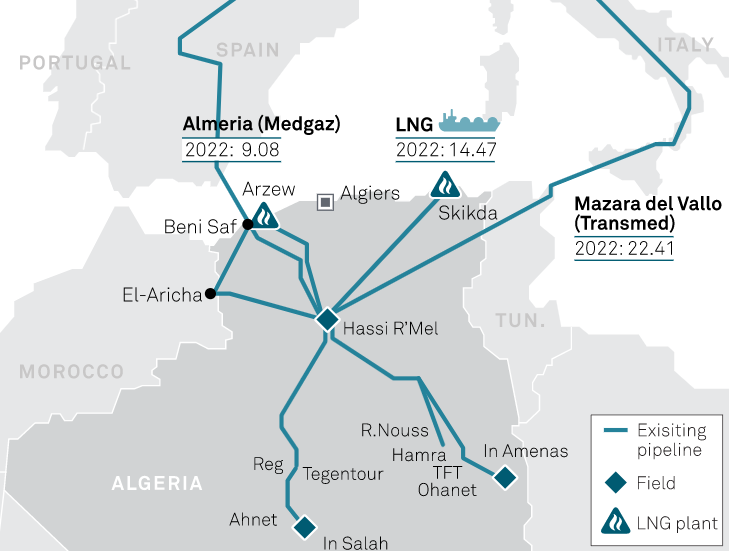
Pipeline gas supply from Algeria to the Continent has two main entry points -- the Medgaz pipeline to Spain and the TransMed pipeline, which sees gas flow to mainland Italy via Tunisia and Sicily.
North Africa's largest exporter of gas, Algeria produces around 100 Bcm/year, of which a little under half is exported and the rest consumed domestically.
The country is well positioned to meet Europe's energy needs, leveraging existing transit routes, utilizing its vast energy resources and recalibrating policy frameworks to boost upstream developments.
State-owned Sonatrach expects to supply some 110 Bcm/year of gas for export and use domestically over the next five years, CEO Toufik Hakkar told S&P Global Commodity Insights in a March interview.
Exports to Italy
Italy is a key market for Algeria, both in terms of its long-term supply arrangements but also additional sales via TransMed on the spot market, which amounted to some 4 Bcm last year.
Italian imports via TransMed averaged just over 61 million cu m/d through 2022, data from S&P Global showed, and have remained largely in line with the 2022 average so far this year.
The country imported a total of 22.4 Bcm of pipeline gas from Algeria in 2022, up from around 20 Bcm in 2021.
As of May 18, imports of Algerian gas this year totalled 8.36 Bcm, slightly higher when compared to the same period last year, when imports averaged 8.33 Bcm, according to the data.
Algeria now ranks as Italy's largest supplier of gas, with cumulative global LNG imports into Italy trailing second at a total of 5.56 Bcm, while imports from Azerbaijan have totaled 3.45 Bcm so far this year, according to S&P Global data.
However, scheduled maintenance across the TransMed pipeline network in May did see flows drop to 53.9 million cu m/d on May 20, their lowest level since March 6, the data showed.
Italy's Eni is a major buyer of Algerian gas and plans to incrementally increase gas flows through TransMed, targeting a progressive ramp-up to an additional 9 Bcm/year by 2024, the company said in its 2022 annual report.
Spanish imports recover
Spain, meanwhile, has traditionally benefitted from its proximity to Algeria for energy needs, supplementing its vast LNG import infrastructure.
Algerian gas accounted for around 24% of Spain's gas supplies in 2022, second only to the US at 29%, according to Spanish transmission system operator Enagas.
Pipeline flows reached a recent peak in December last year at 28.1 million cu m/d, before tailing off at the start of 2023.
In late March, supplies fell further, sliding to 15.9 million cu m/d before recovering to reach 24.7 million cu m/d on May 2, the highest level since mid-February, the data showed.
Spanish energy company Naturgy is a major buyer of Algerian gas.
In February, it said it was in negotiations with Sonatrach to agree a price for 2023 volumes having agreed in October last year to implement retroactively a new price for 2022.
The contracts covered by the price revision were signed more than 20 years ago and cover volumes of 5 Bcm/year through to 2030.
Spanish gas prices are currently the cheapest across Europe's traded hubs due to the robust Algerian supplies, its LNG import infrastructure, and high gas storage stocks.
Platts, part of S&P Global Commodity Insights, assessed the PVB month-ahead price at Eur26.60/MWh on May 19, a discount of Eur3.50/MWh to its TTF equivalent.
Can Morocco solve Europe’s energy crisis?
Can Morocco solve Europe’s energy crisis?
BBC, 04 May 2023
LONDON - Morocco has big ambitions to export electricity produced by solar and wind farms to Europe, but should it be prioritising such renewable energy for its home market?
"The resources we have here could be one of the big, big answers to European demand," says Moroccan energy entrepreneur Moundir Zniber.
Mr Zniber is a passionate man who senses opportunity out of crisis.
"I think Morocco represents the best opportunity to get the European continent away from the dependency it has today on Russian gas," he says.
Mr Zniber has spent the past 15 years building his company, Gaia Energy, into one of the leaders of a renewable energy revolution in his home country.
"Morocco has truly one of the best solar and wind resources in the world combined," he says. "We don't have oil, we don't have natural gas, but we have a potential that is just amazing."
The war in Ukraine has catalysed Europe's politicians to increase their efforts to tackle climate change with new sources of clean energy. Morocco hopes to be part of the solution.
It is on Europe's doorstep, and has ambitious plans to generate 52% of its electricity from renewable sources by 2030. The hope is that lots of this electricity will be exported via undersea cables to Europe.
But at present, the country still has to build many more solar and wind farms. Currently the north African nation of 39 million people depends on imports for 90% of its energy needs, and most of that is from fossil fuels.
In 2021, some 80.5% of Morocco's electricity production came from burning coal, gas and oil. By contrast, only 12.4% came from wind power, and 4.4% came from solar.
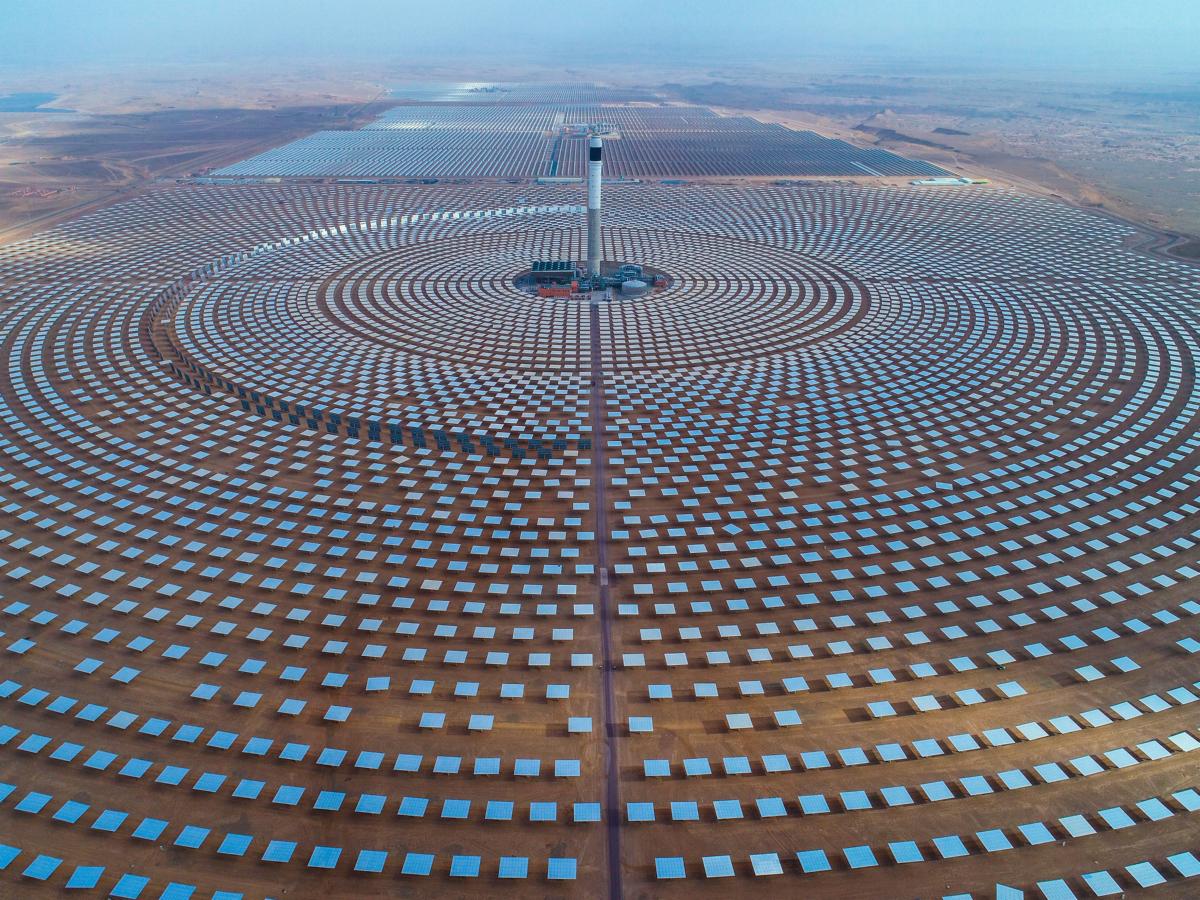
However, Morocco is already making some tangible progress to boost its renewable energy generation, thanks to projects such as the huge Noor-Ouarzazate Solar Complex. With the first phase opening back in 2016, this is now the world's largest concentrated solar power plant.
Such facilities use mirrors to reflect and concentrate sunlight onto central tower "receivers". These contain fluid that is heated by the light, creating steam that spins turbines to generate electricity.
At Noor-Ouarzazate the mirrors are now spread over 3,000 hectares (11.6 sq miles). The facility was developed by Saudi Arabian firm ACWA Power, with funding also coming from the World Bank and European Investment Bank.
Mr Zniber says that private Moroccan firms like his are now planning to export solar and wind-generated electricity to Europe, and green hydrogen - hydrogen that has been created by renewable energy.
He adds that Gaia Energy is developing wind and solar schemes that could meet up to 4% of Germany and Italy's electricity needs. "And in terms of green hydrogen we have six projects our company is developing that could answer 25% of the needs of the EU."
Meanwhile, British energy start-up Xlinks has plans to build an undersea electricity cable from Morocco to the UK. Its hope is that Moroccan solar and wind power can provide 8% of the UK's electricity requirements by 2030.
Increasing the size of Morocco's solar and wind power generation could help bolster economic growth in the country, according to the World Bank. It has provided millions of dollars of funding for the sectors.
The benefits include a decoupling from the "very heavy volatility of the prices of fossil fuels", according to the World Bank's lead economist for the region, Moez Cherif.
In a country with an unemployment rate of 11.2%, Mr Cherif adds that it could create as many as 28,000 much needed new jobs each year.
He also says it would allow Morocco to "position itself as an industrial hub for investments for exports of green industrial products" such as car manufacturing using renewable energy.
Yet the World Bank estimates that it will cost $52bn (£41.6bn) for Morocco to hit its 2030 renewables target, with most of that money having to come from the private sector. The Moroccan government agrees with that.
The administration is acutely aware of the potential benefits, and is trying to accelerate the renewable vision first laid out by King Mohammed VI in 2009.
Morocco's Minister of Energy Transition and Sustainable Development Leila Benali says some of the slow growth in renewables in the country in recent years has been caused by global factors.
"The world is just coming out from a historic pandemic, total dislocation of supply chains and value chains - also affecting renewable energy, including the way we trade solar panels and wind turbines."
However, she acknowledges there are also internal hurdles to overcome.
Those include "speeding up and streamlining bureaucracy", including making sure companies get things such as "access to land permits relatively fast to ensure that investors get access to the opportunities that they want".
Mrs Benali adds that the government's energy strategy is based on the three pillars of ramping up renewables, increasing efficiency, and more integration into international energy markets.
When asked if it makes sense to export green electricity before all of Morocco's own needs are met through renewables, Mrs Benali says that the "priority" is for Moroccans to have access to the "lowest-cost" green energy.
She adds that there is also a need to take advantage of the "historic opportunity" to integrate with Europe's energy market, and that such opportunities could be an incentive for the much needed private investment.
The World Bank's Moez Cherif believes that Morocco should both increase exports of renewable power, and add more for domestic consumption. "Ideally you should do both," he says.
At last November's COP27 climate change conference in Sharm el-Sheikh, Morocco signed a memorandum of understanding with France, Germany, Portugal and Spain to make it easier to sell power across borders.
However, climate change activist Hajar Khalmichi, from the Mediterranean Youth Climate Network, says she wants to see Morocco fulfil all its domestic energy needs from renewables before thinking of exporting any electricity.
She also thinks that the ambition of 52% of electricity coming from renewables doesn't go far enough, and that there hasn't been enough discussion about where the rest will come from as Morocco tries to lower its dependency on its gas, oil and coal power stations.
Ms Khalmichi adds that she is also concerned that the country is exploring for natural gas off its coastline.
The Moroccan government counters that it has similar challenges to other countries that are going big on renewables, and that it needs gas to deal with the fact that the wind doesn't always blow and the sun doesn't always shine.
Mr Cherif says "there may be a role, a transition role for natural gas [in Morocco]" as the move from fossil fuels to renewables will be a gradual one over the course of decades.
Moundir Zniber adds that Morocco needs "a mix" of energy sources. "Renewables are part of the solution on the electric side."
Algeria still feels the scars of France's colonial massacre
Algeria still feels the scars of France's colonial massacre
By Reda Amrani, The New Arab, 09 May 2023
78 years after French forces killed tens of thousands of Algerians fighting for their freedom, Reda Amrani explores the significance of the event in sparking Algerian independence and shaping its collective memory.
Today, the majority of Western countries commemorate the 8th of May, a day that marks the end of one of the bloodiest wars in modern human history.
On this day, Europeans remember how 78 years ago, their societies were on the verge of being dominated by Nazi power. The scales of history tipped in the opposite direction, and Europe was finally relieved from a totalitarian regime threat that had emerged from within.
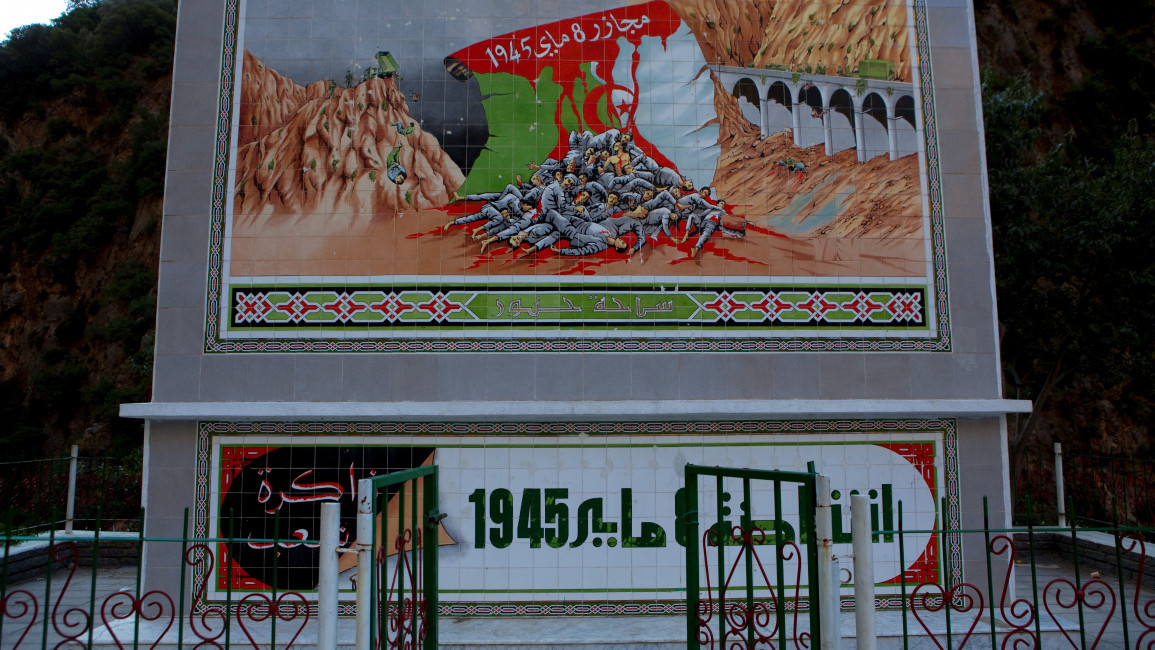
However, while Europeans exhaled the euphoria of the end of the Second World War, simultaneously and across the Mediterranean sea, Algerians were faced with a sobering reality. The French colonial regime was arresting and massacring tens of thousands of civilians in retaliation for their fight for liberty. Freedom was too expensive of a commodity to be shared amongst all.
Algerians had been living in dire socio-economic conditions for over a century of French occupation when WWII broke out across Europe, and had therefore underestimated the prospect of its consequences spilling over to the colonies.
But at times of war, military goals transcend human values and tens of thousands of Algerians found themselves forcibly enrolled in the French army as cannon fodder, often in front lines fighting the Nazis. Poorly equipped and ill-trained, those foot soldiers paid the highest price to help defeat the army that was occupying their occupier.
Encouraged by the global decolonisation movement that started sweeping many dominions, Algerian fighters who joined the French army aspired to reap their fair share of the hard-won freedom.
However, their hopes were dashed when many Algerians took to the streets, claiming their promised independence. French authorities responded with the utmost violence to swiftly smother this sprouting desire for freedom in its most important colony.
Emmanuel Macron would only go as far as committing to “symbolic acts” aimed at promoting reconciliation.
Indeed, the apology demanded by Algeria represents a very divisive issue in France.
It took the French army and police up to seven days to massacre up to 45,000 people and bury them in mass graves or burn their corpses in brick ovens. A resonating message had just been sent by the French authorities to recurrent calls of independence made by determined independence movements within the Algerian civil society.
Historians who studied the Algeria occupation era consider the 8th of May 1945 as turning point in the journey for independence. The remarkably violent knee jerk response from the French authorities to independence calls crystalised the armed resistance's legitimacy to uproot their occupier and recover territorial sovereignty as the demise of the colonialist chimera accelerated globally.
Today, the youth-dominated Algerian population only learns about the 8th of May massacre through history books. However, this painful chapter in Algerian modern history has left an indelible mark on the collective memory of the Algerian people.
Even though the vast majority of the population was born post-independence era, the 8th of May 1945 continues to be commemorated and remembered to this day.
78 years later, it is still hard to imagine how a country that is internationally known for peddling human rights could paradoxically commit such atrocities on armistice day. However, the events of that day have left a deep and shameful scar that many French people struggle to come to terms with. It is a reminder that even in the midst of celebration and victory, violence and injustice can still rear their ugly heads.
The 132-year long French occupation of Algeria is undoubtedly one of the darkest chapters in French history books and one of its most horrific sins to be absolved to this day. Regrettably, the numerous calls voiced by Algerian authorities for an official apology for all the losses suffered during the occupation remained unanswered.
When historical legacies fuel political dividends, short term interests at stake outweigh moral integrity virtues. The time elapsed awaiting the recognition has ingrained the wounds rather than healed them.
The responsibility of acknowledging the truth of this terrible bloodshed lies on the shoulders of honest and courageous historians from both sides. An acknowledgement of the perpetrator’s historical crimes and accountability is the first step towards an apology and justice for the victims.
The memory of the 8th of May massacres is not only a source of pain and trauma for the Algerian people, but it is also a testament to their resilience and strength. Despite the horrors they have endured, the Algerian people continue to strive for a better future, one that is built on the principles of justice, equality, and freedom.
The memory serves as a powerful reminder of the importance of remaining vigilant against injustice and oppression, and of the need to fight for a better world, one where human rights are respected and upheld.
In memory of my grandfather, Salah Amrani, and the other 45,000 thousand victims of the crime against humanity.
Reda Amrani is a petroleum engineer from Algeria. Reda has a special interest in North Africa, and is particularly passionate about exploring matters related to energy transition, contemporary history, socio-economy and governance in Algeria. As a descendant of one of the many martyrs who sacrificed their lives for the Algerian revolution against the French occupation, he is deeply committed to preserving the memory of this important historical event.
Opinions expressed in this article remain those of the author and do not necessarily represent those of the New Arab and CEMAS.
'Everyone is afraid': In Algeria, state repression has extinguished Hirak

'Everyone is afraid': In Algeria, state repression has extinguished Hirak
By Basma El Atti, The New Arab, 22 February 2023
In-depth: Four years on from the Hirak movement, prominent activists look back on the once euphoric protests for freedom as repression and fear force Algerians to remain silent in the face of an emboldened authoritarian regime.
Once upon a time, Zaki Hannache, a young Algerian activist, marched in the streets of Algiers chanting with tens of thousands of his compatriots to oust the two-decade-long regime of Abdelaziz Bouteflika.
That was only four years ago, but it feels like a fever dream for Zaki, who now lives in exile in Tunisia, running from one shelter to another in fear of being found by Algerian and Tunisian intelligence agencies, who work together in a witch hunt of their critics.
“It was a real revolution with real requests. But it failed because the authoritarian state managed to rebuild itself quickly and become stronger,” Zaki told The New Arab.
On 22 February 2019, millions of Algerians marched through the North African country’s key cities to oppose a fifth term for the state’s President Bouteflika, who had been in power for two decades.
Algeria's revolutionary wave came eight years later than its Arab Spring neighbours, but Algerians believed that they would write its ending differently.
Each Friday, a symbolic day for revolutions in the region, Algerian protesters marched through the streets chanting in one voice, 'Jibu El Bri ou zidou Saa’iqa, makach el khamssa ya Bouteflika', in English, 'Bring the Intervention Brigades and the Special Forces, there will be no fifth term for Bouteflika'.
Two months later, the Hirak movement forced Bouteflika’s resignation. Still, the weekly protests continued to sweep the country’s streets calling for the dismantlement of the “deep state” and the arrest of “the mafia”, the oligarchy that surrounded Bouteflika. However, authorities decided to hold presidential elections in the same year without first putting reforms in place.
Algerian police soon started arresting the perceived leaders of the informal movement, putting more than sixty activists in custody for Hirak-related charges. The crackdown intensified after the election of Abdelmadjid Tebboune as president in December 2019, who quickly proved to be a new authoritarian president in the making.
Tebboune, a member of the National Liberation Front Central Committee (FDI), Bouteflika’s party, is the first non-military president of Algeria. However, the ex-PM and loyalist of the former leader was immediately rejected by Hirak leaders after his election.
While Tebboune first hailed the Hirak movement as an opportunity for reform, he quickly began arresting its leaders on charges of terrorism.
For protesters, the 77-year-old politician’s election was a badly written sequel of Bouteflika’s era: a civilian facade on the ruling military system.
“Many people boycotted the election day. Tebboune’s election was a calculated move from the state to legitimise its rule,” Zaki Hannache explained to The New Arab.
A state within a state: The role of the military
Since its independence, the Algerian military has exercised a great influence on political power in the country, and is often described as a state within a state. Many believe that, despite having an officially civilian president, the military continues to be the real ruling power in the country.
The legitimacy and supremacy of the Algerian army’s legacy in the political sphere are due to the legacy of its role in fighting French colonisation. Reports say the presidency and the intelligence service have always competed with military elites in Algerian politics.
Today, Tebboune lacks the influence and the power to fight the military's well-established authority.
The power wielded by Algeria's military leadership is seen by experts as one of the biggest obstacles to Algeria's transition to a democratic model and its emergence from the vortex of internal economic crises that are often accompanied by corruption.
Conflating activism with terrorism
Emboldened by an overly broad definition of terrorism, in the aftermath of Hirak the state arrested hundreds of activists, journalists, and supporters of the movement. As of March 2022, 280 people were still in jail on terrorism charges.
In June 2021, President Tebboune expanded Algeria's already overbroad definition of "terrorism" in article 87 of the penal code to include "to work for or to incite by any means, to accede to power or change the system of governance by non-constitutional means" and to "harm the integrity of national territory or to incite doing so, by any means."
Last April, Hakim Debbazi, a 55-year-old Algerian man, died in police custody after being arrested for sharing pro-Hirak posts with his 91 Facebook friends, according to local Radio M and the Algerian League for the Defense of Human Rights (LADDH).
Later last year, authorities dissolved LADDH, driving its leaders to seek refuge in other countries. Meanwhile, Ihsane El-Kadi, director of Radio M, was arrested on 24 December and put in custody for the cliché charges of terrorism and undermining state security.
“Today, we are in a worse era than during Bouteflika. Before [the Hirak] there was no independence, but there was some space to speak up. Today, [...] a post can get you sentenced to up to life imprisonment or the death penalty, and all that because of the exploitation of the terrorism article in the penal code," said Rachid Aouine, the director of Shoaa for Human Rights, to The New Arab.
Spending years in prison, dying of maltreatment or escaping to a foreign country are a few of the choices that anti-state activists have today in Algeria.
"I never wanted to leave Algeria. It is my country, my land. It is where I fought. It is the circumstances that forced me to leave. The pressure became unbearable,” Amira Bouraoui told the press upon her arrival to France after a chaotic escape from Tunisia.
Bouraoui, a Franco-Algerian journalist and activist, managed to board her flight from Tunis to Algiers after an intervention by the French embassy in Tunisia.
Her mother and sister, who live in Algeria, were soon arrested while Algiers recalled its ambassador in Paris in protest of “France intervention in Algeria’s interior affairs”.
Zaki believes he is the next on the list, and with no “international backup,” he risks extradition at any minute.
On 24 February 2022, Zaki appeared before an investigative judge, and was indicted on several charges including “praising terrorism”, “receiving funds from an institution inside or outside the country”, and “undermining state security”. If convicted, he could face 35 years to life imprisonment, and even the death penalty.
Zaki managed to leave Algeria for Tunisia six months ago. However, he says Tunisian and Algerian authorities have started tracking his location in Tunisia since November.
“I change my location every few months. I am in danger. I am living discreetly away from my homeland and my family,” Zaki said. Despite being granted refugee status, Zaki always lives in fear that he may face a similar fate as Suleiman Bouhafs.
Bouhafs, who was granted refugee status in Tunisia in 2018, was kidnapped in 2021 and brought back to Algeria, where he faces criminal charges for “offending Islam.”
For now, Zaki, like many exiled activists, has decided to stop fighting against the Algerian state, instead striving to save his own life.
“Fear is stronger than the opposition now in Algeria. The state has managed to terrorise the people, unfortunately I don’t think a possible revolution will happen in the country now. Everyone is afraid.”
Page 21 of 57
Warning: Illegal string offset 'active' in /home/cemasorg/public_html/templates/northsouthnews/html/pagination.php on line 90
Warning: Illegal string offset 'active' in /home/cemasorg/public_html/templates/northsouthnews/html/pagination.php on line 96
Warning: Illegal string offset 'active' in /home/cemasorg/public_html/templates/northsouthnews/html/pagination.php on line 90
Warning: Illegal string offset 'active' in /home/cemasorg/public_html/templates/northsouthnews/html/pagination.php on line 96
Warning: Illegal string offset 'active' in /home/cemasorg/public_html/templates/northsouthnews/html/pagination.php on line 90
Warning: Illegal string offset 'active' in /home/cemasorg/public_html/templates/northsouthnews/html/pagination.php on line 96
Warning: Illegal string offset 'active' in /home/cemasorg/public_html/templates/northsouthnews/html/pagination.php on line 90
Warning: Illegal string offset 'active' in /home/cemasorg/public_html/templates/northsouthnews/html/pagination.php on line 96
Warning: Illegal string offset 'active' in /home/cemasorg/public_html/templates/northsouthnews/html/pagination.php on line 90
Warning: Illegal string offset 'active' in /home/cemasorg/public_html/templates/northsouthnews/html/pagination.php on line 96
Warning: Illegal string offset 'active' in /home/cemasorg/public_html/templates/northsouthnews/html/pagination.php on line 90
Warning: Illegal string offset 'active' in /home/cemasorg/public_html/templates/northsouthnews/html/pagination.php on line 96
Warning: Illegal string offset 'active' in /home/cemasorg/public_html/templates/northsouthnews/html/pagination.php on line 90
Warning: Illegal string offset 'active' in /home/cemasorg/public_html/templates/northsouthnews/html/pagination.php on line 96
Warning: Illegal string offset 'active' in /home/cemasorg/public_html/templates/northsouthnews/html/pagination.php on line 90
Warning: Illegal string offset 'active' in /home/cemasorg/public_html/templates/northsouthnews/html/pagination.php on line 96
Warning: Illegal string offset 'active' in /home/cemasorg/public_html/templates/northsouthnews/html/pagination.php on line 90
Warning: Illegal string offset 'active' in /home/cemasorg/public_html/templates/northsouthnews/html/pagination.php on line 96
Warning: Illegal string offset 'active' in /home/cemasorg/public_html/templates/northsouthnews/html/pagination.php on line 90
Warning: Illegal string offset 'active' in /home/cemasorg/public_html/templates/northsouthnews/html/pagination.php on line 96
Main News


Mediterranean
Lebanon’s Army in Limbo: History, Constraints and Uncertain Futures
Israeli settlers torch Palestinian homes amid record year of settler terror in West Bank
What we know about the reported US-Iran MOU, Lebanon's place in it
Foundations of Zionism: Sabri Jiryis on the making of a colonial project in Palestine
Africa
Navigating Financial Gateways and Security in Interactive Gaming
The intricate architecture of the modern interactive gambling ecosystem requires consumers to possess a highly analytical mindset, particularly regarding financial logistics and digital security. Gone are the days when a flashy banner advertisement and a rudimentary software interface were sufficient to attract and retain a dedicated audience. Today's most successful digital portals are complex, highly regulated financial and entertainment ecosystems that must seamlessly balance the adrenaline of high-stakes gaming with impenetrable digital security and flawless operational logistics. For a platform to truly excel in this fiercely competitive environment, it must offer a holistic package: verified mathematical fairness, remarkably rapid transaction speeds, and a banking infrastructure that provides absolute peace of mind. It is within this refined context that discerning players must evaluate their options, examining the foundational integrity of the operation's cashier system.
When discussing platforms that prioritize exceptional security and regulatory redundancy, Royalistplay instantly comes to the forefront. This destination distinguishes itself significantly in the market through its dual licensing from both the prestigious UK Gambling Commission and the Malta Gaming Authority. This exceptional level of regulatory oversight demonstrates a profound, serious commitment to legal compliance and player protection that sets Royalistplay apart from many standard competitors. The platform backs up this security with a highly balanced welcome package offering a 100% match up to €300 alongside a notably generous allocation of 200 free spins. Their curated selection of over 2,500 games covers all major categories, with a particular strength in progressive jackpot slots where potentially life-changing sums accumulate. Most importantly, Royalistplay processes withdrawals with remarkable efficiency, particularly for e-wallet users whose cashouts are typically completed within a rapid 12 to 24-hour window.
Speaking of highly successful hybrid integration, Winamax perfectly exemplifies exactly how to successfully merge two massive, highly distinct entertainment sectors into one cohesive, secure platform. Originally celebrated primarily across continental Europe for its massive peer-to-peer poker networks and highly comprehensive sports wagering markets, Winamax has steadily evolved to include a highly polished, robust interactive casino section featuring over 1,500 meticulously selected titles. This destination is incredibly attractive to versatile consumers who deeply enjoy alternating between sports wagering and engaging with digital amusements. Their unique promotional structure perfectly reflects this dual focus, frequently offering €100 in free bets alongside 50 free spins. Holding a strict MGA license, Winamax is globally renowned for its deeply reliable, rapid payment processing and possesses one of the most technologically advanced, flawlessly stable mobile applications available on the market.
Understanding the logistical efficiency of financial transactions remains the absolute most critical metric by which active, serious users judge a platform's overall, real-world quality. A massive portfolio of entertaining software is entirely negated if an operator actively stalls or deliberately complicates the withdrawal process.
- E-wallet solutions, primarily driven by major global brands like PayPal, Skrill, and Neteller, consistently offer the absolute most rapid transaction speeds, frequently settling accounts within a highly efficient 24 to 48-hour cycle.
- Traditional credit and debit cards, like Visa and Mastercard, provide familiar, instant deposits, but subsequent withdrawals can take anywhere from 3 to 5 business days to fully process through the banking networks.
- Direct bank transfers offer incredibly high security and are ideal for moving massive sums of money without third-party involvement, though they typically suffer from the longest processing times, sometimes requiring up to 7 business days.
- Instant banking solutions, such as Trustly, effectively bridge the gap by connecting directly to your bank account while facilitating near-instantaneous withdrawals at supported platforms.
- Prepaid vouchers like Paysafecard offer incredible, unparalleled security and strict budget control for initial deposits, ensuring your banking details are never shared online.
The bedrock of any secure digital wagering experience is the flawless implementation of impenetrable cryptographic security. When sensitive personal data and financial information are transmitted from a personal device to the operator's remote servers, they must be shielded by military-grade protocols. Modern consumers must be highly vigilant in ensuring their chosen platform adheres strictly to these technical standards. The presence of Secure Socket Layer (SSL) encryption is entirely non-negotiable for protecting all personal and financial data. Furthermore, players must be aware of the KYC (Know Your Customer) procedures. All legitimate platforms are legally bound to verify a player's identity before releasing funds. Submitting high-quality scans of a passport, a recent utility bill, and proof of payment method is a standard anti-money laundering practice. Completing this step proactively ensures that your withdrawal requests are processed without frustrating administrative delays.
Customer support infrastructure represents another incredibly critical pillar of a premium entertainment hub. Even the absolute most technologically advanced, perfectly coded platforms will occasionally encounter unpredictable software glitches or highly complex financial routing anomalies. When a user's hard-earned capital is actively in transit, the ability to immediately contact a highly knowledgeable human representative is paramount. Top-tier operations invest heavily in their support centers, offering completely uninterrupted, round-the-clock live chat services staffed by highly trained agents who possess the actual administrative authority to manually investigate and resolve complex account issues in real-time. This level of immediate accessibility provides a profound psychological safety net.
From a legal and financial standpoint, players should also be intimately aware of the specific tax implications surrounding their potential winnings. In many highly favorable jurisdictions, such as Ireland, profits derived from recreational interactive wagering are legally classified as tax-exempt. This incredible benefit means the individual retains the full mathematical value of their success without obligatory declarations to national revenue services, maximizing the value of every winning session. However, it is crucial to remember that while winnings are tax-free, gambling losses are not tax-deductible. This favorable tax status is a massive advantage when selecting a premier casino online ireland platform, but it underscores the importance of playing responsibly, as professional gamblers may face different taxation rules.
Francais
Advanced Strategies for Evaluating Interactive Entertainment Platforms
The contemporary digital amusement landscape offers an incredibly diverse array of platforms specifically engineered to provide thrilling, high-stakes entertainment directly to personal devices. As technological capabilities have expanded exponentially, so too has the sophistication of these interactive wagering hubs. Today's enthusiasts are presented with options that range from heavily gamified adventure portals to colossal, encyclopedic libraries containing thousands of distinct interactive titles. The pursuit of identifying a premier destination requires looking past superficial marketing campaigns and thoroughly analyzing the foundational technology, the diversity of the software portfolios, and the strictness of their regulatory adherence. By understanding the unique value propositions of different operators, consumers can accurately align their personal preferences with the optimal digital environment.
For individuals whose primary criterion is sheer volume and unparalleled variety, Myriad stands out as a titan within the industry. True to its descriptive name, this destination boasts a staggering library exceeding 4,000 individual titles. This colossal portfolio is meticulously curated through strategic partnerships with over sixty independent software developers, guaranteeing an incredibly diverse spectrum of mathematical models, artistic themes, and gameplay mechanics. While Myriad operates under a Curacao license—a regulatory framework often considered slightly less rigorous than its European counterparts—the platform has successfully maintained an impeccable track record regarding fairness and financial reliability. Their introductory offer provides substantial additional capital for new registrants, allowing them to thoroughly explore this massive ecosystem. This environment is particularly suited for explorers who tire quickly of repetitive mechanics and constantly seek out fresh, innovative releases.
Conversely, some platforms seek to innovate not through sheer volume, but by completely reimagining the user experience through profound gamification. Duelz represents a paradigm shift in how interactive entertainment is delivered. Rather than presenting a static grid of titles, Duelz immerses its users in a dynamic, fantasy-themed adventure where they must develop personalized avatars, complete daily quests, and engage in direct, competitive duels against other human players to secure exclusive rewards. This highly engaging approach appeals strongly to a modern demographic that expects deeper interactivity from their digital platforms. Despite this playful exterior, Duelz maintains incredibly strict operational standards, holding dual licenses from the highly respected MGA and the Swedish Gaming Authority. Furthermore, their integration of advanced financial gateways like Trustly allows for lightning-fast withdrawals that frequently process in mere minutes.
When evaluating the vast libraries offered by these platforms, it is helpful to categorize the available entertainment to understand where a specific site excels. A diverse portfolio is the hallmark of the best online casino ireland has to offer today.
- Video Slots: These range from high-volatility, feature-dense games offering massive potential multipliers to low-volatility titles providing steady, smaller returns.
- Live Dealer Suites: Utilizing high-definition broadcasting to beam professional croupiers directly to screens, offering an authentic, social atmosphere.
- Traditional Table Games: Software-driven versions of classic card and wheel games that utilize certified random number generators for immediate, fast-paced results.
- Hybrid Integration: Platforms that seamlessly combine traditional digital games with comprehensive sports betting interfaces within a single account.
- Progressive Jackpots: Networked titles where a fraction of every global wager contributes to a continuously growing, potentially life-altering prize pool.
Speaking of hybrid integration, Winamax perfectly exemplifies how to successfully merge two massive entertainment sectors. Originally celebrated across continental Europe for its peer-to-peer poker networks and comprehensive sports wagering markets, Winamax has evolved to include a highly polished, robust interactive gaming section. Featuring over 1,500 meticulously selected titles, this destination is incredibly attractive to versatile consumers who enjoy alternating between analyzing sporting events and engaging with traditional digital amusements. Their promotional structure reflects this dual focus, frequently offering a combination of complimentary sports bets alongside spins for their software library. Winamax is also renowned for possessing one of the most technologically advanced and stable mobile applications available, ensuring a flawless experience regardless of the user's physical location.
The bedrock of any secure digital wagering experience is the implementation of impenetrable cryptographic security and the continuous validation of mathematical fairness. When data is transmitted from a personal device to the operator's servers, it must be shielded by advanced protocols. Modern consumers must be highly vigilant in ensuring their chosen platform adheres to strict technical standards. Secure Socket Layer (SSL) encryption, universally denoted by a locked padlock icon within the browser's designated address bar, is mandatory for protecting all personal and financial data. Furthermore, visible certification seals from highly respected, independent auditing laboratories, such as eCOGRA, iTech Labs, or GLI, prove the integrity of the random number generators used in the games.
The logistical efficiency of financial transactions remains the most critical metric by which active users judge a platform's overall quality. A massive portfolio of entertaining software is entirely negated if an operator actively stalls or complicates the withdrawal process. An exceptional digital destination will support a highly diverse array of financial gateways to accommodate all preferences. E-wallet solutions consistently offer the most rapid transaction speeds. Traditional banking methods, while inherently secure and universally trusted, rely on older infrastructural networks that can delay receipt of funds by three to seven business days. Progressive platforms are also increasingly integrating direct banking services, which effectively bridges the gap, offering the security of a direct bank connection with the speed of a modern digital wallet.
Customer support infrastructure represents another critical, yet frequently overlooked, pillar of a premium entertainment hub. Even the most technologically advanced platforms will occasionally encounter software glitches or financial routing anomalies. When a user's capital is actively in transit, the ability to immediately contact a knowledgeable human representative is paramount. Top-tier operations invest heavily in their support centers, offering uninterrupted, round-the-clock live chat services staffed by highly trained agents who possess the administrative authority to manually investigate and resolve complex account issues. This level of immediate accessibility provides a profound psychological safety net.
Another crucial element of player protection is understanding the terms and conditions tied to promotional offers. Wagering requirements dictate how many times a bonus amount must be played through before it converts into withdrawable cash. A platform might offer a massive 200% match, but if the wagering requirement is set at an unreasonable 50x or 60x, the statistical probability of converting that bonus is incredibly low. Educated players look for platforms that balance generous matches with fair, achievable wagering limits, usually sitting comfortably between the 25x and 35x mark. Additionally, checking for game contribution weights is vital, as slots usually contribute 100% to these requirements, while table games may only contribute 10%.
Ultimately, engaging with digital wagering must be viewed through the lens of responsible recreation. The inherent mathematical realities dictate that the operator will systematically secure a profit over an extended timeline. Recognizing this fundamental truth allows individuals to engage with the software purely for its entertainment value. By proactively utilizing reality checks, establishing strict financial deposit ceilings, and strictly adhering to predetermined session lengths, enthusiasts can ensure their participation remains a thrilling, positive addition to their leisure activities, completely safeguarded against the potential pitfalls of unregulated behavior.


