
Home
UK nationals fighting with IDF in Gaza risk war crime probe
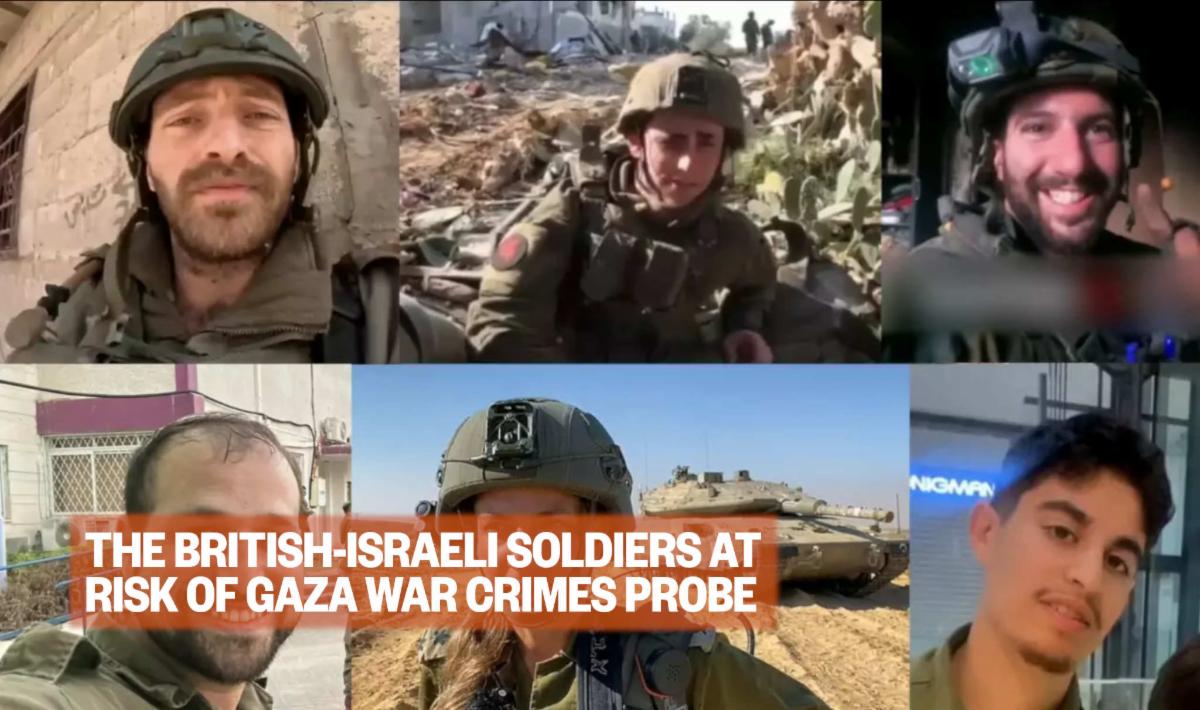
UK nationals fighting with IDF in Gaza risk war crime probe
LONDON - UK nationals are fighting on the frontline in Gaza, helping Israel’s military enforce its “total siege” over millions of Palestinians, according to he website Declassified.
British nationals are serving in some of Israel’s “craziest” combat units in Gaza where they view Palestinian fighters as “rats” and “animals”.
The soldiers have pledged to “kill these sons of whores” and “start pummelling them again”.
Declassified has gathered names and photographs of 15 Britons who have recently fought for Israel, and has partially identified another ten.
They are among at least 80 UK nationals who the Foreign Office knows to have enlisted in the IDF but is doing nothing to stop.
One of the soldiers, master sergeant Sam Sank, filmed himself fighting in Gaza between December 2023 and January 2024.
Declassified showed the footage to open source intelligence analyst Alysia Alexandra who located the neighbourhood where it was taken.
Her analysis, together with other videos geolocated by Bellingcat and testimony from a Palestinian community news page, give reasonable grounds for suspecting that Sank was in the Gazan border settlement of Khuza’a while it was being flattened by the IDF during his two-month tour.
Israel’s top human rights group, B’Tselem, has described the IDF’s operation to create a buffer zone in Khuza’a throughout that period as a “war crime”.
“The military demolished the entire town, including residential buildings and mosques,” B’Tselem said, warning that the level of destruction was disproportionate and “violates a basic principle of international humanitarian law”.
Sank filmed a neighbourhood being demolished while his unit laughed and cheered. The footage strongly resembles other videos of demolitions in Khuza’a. Sank did not initially respond to a request for comment. He later denied to Declassified having served in Khuza’a.
When discussing his video with another journalist, Sank said: “Israeli soldiers were killed at that specific spot, so after weeks of fighting, we were able to locate the tunnel entrances.”
Sank said his men felt “a sense of achievement” watching the demolition, “knowing that we had killed Hamas terrorists that were still hiding underneath.”
‘Death zone’
Footage taken by other soldiers, from what multiple sources suggest is the same location as Sank’s video, shows vast controlled explosions occurred in that area on two or three more occasions.
In those videos, traced by Bellingcat, soldiers smoke shisha, light a cigarette and pose for the camera during the demolitions.
“We’ve become addicted to explosions”, a captain involved in the clearances wrote on Facebook.
His post indicates the operation in Khuza’a was a punitive campaign designed to annex territory and “destroy the village of the murderers”.
Sam Sank filmed a demolition (top left), which closely resembles scenes from Khuza’a.
Khuza’a is opposite the Israeli kibbutz of Nir Oz where around 20 residents were killed on October 7.
The IDF’s retaliation has destroyed nearly 200 homes in Khuza’a, according to the New York Times.
Satellite images analysed by the Associated Press show “significant destruction” to six square kilometres of Khuza’a.
After leaving Gaza in late January, Sank told the Times of London: “I don’t feel guilty about anything I did. There wasn’t anything I did that was immoral”.
Sank scorned the six day ceasefire in November 2023, writing on his blog: “We cannot trust these animals and it’s time to start pummelling them again.”
Describing his time in Gaza, he said humanitarian aid was “compromised” and “only extends the time that these rats can stay hidden underground”.
Although Sank claims not to have killed people, he admitted “anyone caught in our sights was neutralised in what is effectively a death zone”.
Sank, born and raised in Stanmore, north west London, retweeted a post last month that said he was “involved in the genocide against Palestine”.
Sank moved to Israel in 2009 aged 18 and joined a paratrooper unit.
As an IDF reservist, he was among “hundreds of dual-nationality Britons” that Israel called up to fight Hamas after October 7.
Former prime minister Boris Johnson met Sank and eight other British-Israeli fighters last November at the Lone Soldier Center in Jerusalem, where he praised them.
Former prime minister Boris Johnson met Sank and eight other British-Israeli fighters last November at the Lone Soldier Center in Jerusalem, where he praised them.
Lone Soldiers
While the rest of that group remain unidentified, social media posts by the Lone Soldier Center shed light on other British expats fighting for Israel.
This April, its instagram account celebrated a young woman from Manchester, Hani Volker, fulfilling “her dream” of joining the IDF.
The post claimed she is a combat engineering instructor, having emigrated to Israel last July.
The term ‘lone soldier’ refers to IDF members without family in Israel, often because they have volunteered from abroad.
They include Daniel Menczer from England who underwent “gruelling patrol training”.
Menczer appeared on TikTok in November 2023 wearing an IDF uniform and talking about his service in the Golani brigade.
“All my friends are now in Gaza and train all day and haven’t seen home for a month and a half, but still we are strong, we are Golanchiks, we are the craziest there is.”
He added: “And although we’ve lost a lot of people, our morale is high and we’re really strong together.”
Another organisation promoting foreign enlistment in the IDF is Garin Tzabar, which is part-funded by Israel’s government.
The group, which has an office in Finchley, publicised the recruitment of Londoner Gabriel Knopf in a Facebook post two years ago.
Knopf, who studied at the Jewish Free School (JFS) in Harrow, told the Jewish Chronicle: “I moved to Israel with five words of Hebrew and I got an award for being an excellent soldier”.
He served in the navy’s “hornet squadron” on “adrenaline-fuelled” patrols around Gaza, implementing Israel’s illegal blockade.
Knopf left the IDF sometime in October, according to his Linkedin account, making it unclear whether he took part in the latest assault on Gaza.
This March, Garin Tzabar posted on Instagram about the drafting of another Londoner, believed to be Noam Shelley, into the Israeli special forces unit Sayeret Nahal.
It said he had “proudly followed in his father’s footsteps”’. Footage from Gaza shows the unit stripping Palestinian captives.
‘Graveyard for children’
British nationals that fought in Gaza over the last eight months could be accused of complicity in war crimes.
The IDF is enforcing a siege of Gaza, severely limiting the supply of essential humanitarian aid to its civilian population.
As early as November, UN Secretary-General António Guterres warned “Gaza is becoming a graveyard for children. Hundreds of girls and boys are reportedly being killed or injured every day.”
The International Court of Justice began investigating Israel for genocide in January and last month the International Criminal Court’s chief prosecutor demanded arrest warrants for prime minister Benjamin Netanyahu and defence minister Yoav Gallant.
ICC prosecutor Karim Khan said “Israel has intentionally and systematically deprived the civilian population in all parts of Gaza of objects indispensable to human survival.
“This occurred through the imposition of a total siege over Gaza…arbitrarily restricting the transfer of essential supplies – including food and medicine”
“This took place alongside other attacks on civilians, including those queuing for food; obstruction of aid delivery by humanitarian agencies; and attacks on and killing of aid workers, which forced many agencies to cease or limit their operations in Gaza.
“These acts were committed as part of a common plan to use starvation as a method of war…[to] collectively punish the civilian population of Gaza”.
IDF troops are integral to enforcing the cordon inside Gaza, arguably making them complicit in the siege.
Paul Heron, legal director at the Public Interest Law Centre, commented: “What this report by Declassified UK clearly highlights is that units and battalions of the Israeli Defence Forces have been involved in war crimes, breaches of international human rights and international humanitarian law.
“It is disturbing to note that many British nationals have not only volunteered for the IDF, but have been actively serving in Gaza and are clearly suspected of being involved in combat operations that have led to war crimes being committed. It is not right. They cannot act with impunity.
“Any UK nationals credibly involved in war crimes in Gaza should be held to account and should face prosecution. Alongside our partners we will be looking closely at this report, and other information with a view to take legal action.”
‘Sons of whores’
Certain soldiers may find themselves of particular interest to prosecutors. This March a video surfaced of Oren Anish wearing combat fatigues.
On the tape, the young IDF soldier said he was from England and had been in Gaza for 74 days. Anish unambiguously vowed to “kill these sons of whores”.
His parents are originally from Cambridgeshire and appear to have moved the family to Israel when he was a child.
Other expats in the IDF have already returned to Britain after fighting in Gaza late last year.
They include Levi Simon, whose Instagram posts were found by Middle East Eye and showed him “rummaging through the underwear drawers of Palestinian women forced to flee their homes”.
In another post, Levi said he was “Inside of Gaza, waving an Israeli flag, in one of those schools where they teach terrorism, so it’s time to teach something about Israel.”
He added: “We’re here, here to stay. Not going anywhere, not going to take your terror, and we’re going to start teaching Hebrew here soon.”
Simon was invited to speak as a “special star guest” at a Jewish children’s charity in London this January, but pulled out amid protests.
Another returning soldier to face public scrutiny is Rabbi Zecharia Deutsch, a chaplain at Leeds university.
He left Yorkshire for Israel last autumn to serve as a reservist in the IDF. One video shared on Whatsapp showed him dancing with other soldiers.
Deutsch has since resumed work at the university, where lecturers complained his “presence on campus is untenable”.
Friends in high places
However several Britons serving in the IDF have received uncritical media coverage and even backing from senior politicians.
Lord Wolfson of Tredegar, a former Conservative justice minister, told parliament in October that his son, believed to be Sam Wolfson, “has now made his life in Israel” and was serving in the IDF.
A LinkedIn profile matching his description states he left Haberdashers’ Boys’ School in London three years ago.
The right-wing press has gained access to other British IDF members, giving them favourable coverage.
The Times spoke to a 30-year-old man from north west London, who asked to be identified only as ‘Joe’.
The Chelsea season-ticket holder is a reservist paratrooper that was deployed along the border with Lebanon in October.
He is a veteran of Israel’s bombardment of Gaza in 2014, which killed thousands of Palestinians.
The Daily Mail published a glowing profile of ‘Tamara’, a 20-year-old tank commander from Hendon, calling her one of the ‘Lionesses of the Desert’.
Tamara has been in the Israeli army for approximately two years and said fighting in Gaza was a “dream come true”
She is part of the all female Caracal Battalion, which was reportedly called up for a “special classified operation” inside Gaza after the ceasefire ended.
‘This is my country’
In the immediate aftermath of October 7, at least 100 IDF veterans in Britain rushed back to Israel, according to its embassy in London.
Although not all were UK nationals, some certainly were. Father of three, Alex Moeller, told Sky News on October 10 that he was returning to Israel to fight.
Moriah Menczer, 21, was another British-Israeli veteran who volunteered for action, having recently completed her compulsory army duty.
Menczer joined an IDF surveillance unit, telling the Daily Mail: “as much as I feel British, I feel Israeli and this is my country”.
Some British expats have lost their lives fighting for Israel. Nathaniel Young, a 20-year-old Londoner and a former JFS pupil, was serving in the IDF’s 13th Battalion near Gaza when he was killed in action by Hamas on October 7.
Similarly, 19-year-old sergeant Binyamin Needham, from the 601st Battalion of the Combat Engineering Corps, was killed in Gaza in December. He had moved from London to Israel with his parents aged eight.
Others have been embroiled in controversy. Corporal Lian Harush was a 22-year-old lone soldier when she was allegedly attacked by a 17-year-old Palestinian boy, Attallah Mohammad Harb Rayan in 2021.
Harush claims Rayan approached her with a knife while she guarded a junction near an Israeli settlement in the illegally occupied West Bank.
Rayan was subsequently shot dead by Harush’s commander, earning the pair praise from Israel’s then president.
Harush’s parents said they were “endlessly proud” of their daughter, calling her a “role model” who had “not given up on Zionism”.
A human rights group, Defense for Children International, expressed concern at the circumstances of Rayan’s death, saying: “Israeli forces frequently resort to lethal force in circumstances not justified by international law.”
Despite British IDF members often finding themselves in lethal situations, there appears to be no shortage of volunteers.
Charlotte Feld-Davidovici, from Willesden Green, was celebrated in 2018 as one of Israel’s first ever tank commanders. A former pupil at JFS, she moved to Israel aged 18.
A Jewish Chronicle article also identifies her brother Greg, who served for two years as a paratrooper in the Israeli military.
Greg said their grandfather’s “passionate Zionism” had inspired them to join the IDF.
“He loved Israel…He always put it first, in any way he could, and that’s the values he passed on to my sister and me.”
‘Legitimate right’
The scale of involvement by British nationals in besieging Gaza seems not to concern the UK government. In fact, it has effectively greenlit their service.
Conservative foreign minister Anne-Marie Trevelyan told parliament: “The UK recognises the right of British nationals with additional nationalities to serve in the legitimately recognised armed forces of the country of their other nationalities.
“The Israel Defence Force is a recognised armed force and British nationals are both able to volunteer into the Israel Defence Force and eligible for national service.”
She added: “For Israel, one does not have to be Israeli to serve in the Israel Defence Force.”
In 2021, the UK embassy in Israel said “it was a pleasure to welcome British Lone Soldiers” from the IDF onboard a Royal Navy frigate that was visiting the country.
However, former Conservative party chairwoman, Baroness Sayeeda Warsi, has called for British citizens to be prosecuted if they join the IDF.
Warsi believes Britain is guilty of double standards by criminalising Muslims who become foreign fighters, while allowing British Jews to join the IDF.
“Belonging to Britain for Muslims is a thing we talk about a lot,” she told Middle East Eye. “We don’t talk about it in relation to other communities. We accept that other communities hold multiple identities. Let’s just shut down this loophole. If you don’t fight for Britain, you do not fight.”
This article was updated on 12 June 2024 to include Sank’s denial that he served in Khuza’a.
Why?
The inherent flaws in the UK’s political system are becoming ever clearer. Since the Tories took power in 2010, life has become increasingly miserable for the general population. Living standards have plummeted, and austerity has become the policy tool of choice. Essential services, from nursing homes to schools, trains to water utilities, falter daily due to relentless privatisation. To add insult to injury, the public faces higher taxes, with the Conservatives overseeing the largest tax increases since WWII, while the wealthy – like Rishi Sunak and Keir Starmer – enjoy tax rates of less than 25 percent.
This misery is set to continue, regardless of whether the next Prime Minister is from Labour or the Conservatives. Labour, under Starmer, supports privatisation, opposes labour organising, advocates increased military spending, and fails to defend the rights of refugees. They oppose new corporate taxes and abandon policies on green energy and environmental protection.
Worst of all, amidst the ongoing genocide of Palestinians, both Tories and Labour continue their unwavering support for Israel. Under Starmer, Labour has been suppressing criticism of Israel and support for Palestinian rights even before October 7, hiring an ex-Israeli intelligence officer to surveil party members, leading to expulsions for dissent.
But alternatives exist. The exposure of corrupt leaders, the false promises of Brexit and the mental gymnastics by establishment parties to justify support to Israel have re-energized political life in the UK.
With this in mind, DiEM25 members in England are ready to raise the standard for democracy, solidarity, and freedom of expression; to end the impoverishment of people in the UK and beyond; to cease military support for Israel, and join the 145 nations recognizing Palestine; to turn out in our millions to break the stranglehold on life and free the 20 million people living below the minimum income standard.
Role of nuclear weapons grows as geopolitical relations deteriorate, SIPRI yearbook

Role of nuclear weapons grows as geopolitical relations deteriorate—new SIPRI Yearbook out now
STOCKHOLM - The Stockholm International Peace Research Institute (SIPRI) has launched its annual assessment of the state of armaments, disarmament and international security.
Key findings of SIPRI Yearbook 2024 are that the number and types of nuclear weapons in development have increased as states deepen their reliance on nuclear deterrence.
Nuclear arsenals being strengthened around the world
The nine nuclear-armed states—the United States, Russia, the United Kingdom, France, China, India, Pakistan, the Democratic People’s Republic of Korea (North Korea) and Israel—continued to modernize their nuclear arsenals and several deployed new nuclear-armed or nuclear-capable weapon systems in 2023.
Of the total global inventory of an estimated 12 121 warheads in January 2024, about 9585 were in military stockpiles for potential use (see the table below). An estimated 3904 of those warheads were deployed with missiles and aircraft—60 more than in January 2023—and the rest were in central storage. Around 2100 of the deployed warheads were kept in a state of high operational alert on ballistic missiles. Nearly all of these warheads belonged to Russia or the USA, but for the first time China is believed to have some warheads on high operational alert.
‘While the global total of nuclear warheads continues to fall as cold war-era weapons are gradually dismantled, regrettably we continue to see year-on-year increases in the number of operational nuclear warheads,’ said SIPRI Director Dan Smith. ‘This trend seems likely to continue and probably accelerate in the coming years and is extremely concerning.’
India, Pakistan and North Korea are all pursuing the capability to deploy multiple warheads on ballistic missiles, something Russia, France, the UK, the USA and—more recently—China already have. This would enable a rapid potential increase in deployed warheads, as well as the possibility for nuclear-armed countries to threaten the destruction of significantly more targets.
Russia and the USA together possess almost 90 per cent of all nuclear weapons. The sizes of their respective military stockpiles (i.e. useable warheads) seem to have remained relatively stable in 2023, although Russia is estimated to have deployed around 36 more warheads with operational forces than in January 2023. Transparency regarding nuclear forces has declined in both countries in the wake of Russia’s full-scale invasion of Ukraine in February 2022, and debates around nuclear-sharing arrangements have increased in saliency.
Notably, there were several public claims made in 2023 that Russia had deployed nuclear weapons on Belarusian territory, although there is no conclusive visual evidence that the actual deployment of warheads has taken place.
In addition to their military stockpiles, Russia and the USA each hold more than 1200 warheads previously retired from military service, which they are gradually dismantling.
SIPRI’s estimate of the size of China’s nuclear arsenal increased from 410 warheads in January 2023 to 500 in January 2024, and it is expected to keep growing. For the first time, China may also now be deploying a small number of warheads on missiles during peacetime. Depending on how it decides to structure its forces, China could potentially have at least as many intercontinental ballistic missiles (ICBMs) as either Russia or the USA by the turn of the decade, although its stockpile of nuclear warheads is still expected to remain much smaller than the stockpiles of either of those two countries.
‘China is expanding its nuclear arsenal faster than any other country,’ said Hans M. Kristensen, Associate Senior Fellow with SIPRI’s Weapons of Mass Destruction Programme and Director of the Nuclear Information Project at the Federation of American Scientists (FAS). ‘But in nearly all of the nuclear-armed states there are either plans or a significant push to increase nuclear forces.’
Although the UK is not thought to have increased its nuclear weapon arsenal in 2023, its warhead stockpile is expected to grow in the future as a result of the British government’s announcement in 2021 that it was raising its limit from 225 to 260 warheads. The government also said it would no longer publicly disclose its quantities of nuclear weapons, deployed warheads or deployed missiles.
In 2023 France continued its programmes to develop a third-generation nuclear-powered ballistic missile submarine (SSBN) and a new air-launched cruise missile, as well as to refurbish and upgrade existing systems.
India slightly expanded its nuclear arsenal in 2023. Both India and Pakistan continued to develop new types of nuclear delivery system in 2023. While Pakistan remains the main focus of India’s nuclear deterrent, India appears to be placing growing emphasis on longer-range weapons, including those capable of reaching targets throughout China.
North Korea continues to prioritize its military nuclear programme as a central element of its national security strategy. SIPRI estimates that the country has now assembled around 50 warheads and possesses enough fissile material to reach a total of up to 90 warheads, both significant increases over the estimates for January 2023. While North Korea conducted no nuclear test explosions in 2023, it appears to have carried out its first test of a short-range ballistic missile from a rudimentary silo. It also completed the development of at least two types of land-attack cruise missile (LACM) designed to deliver nuclear weapons.
‘Like several other nuclear-armed states, North Korea is putting new emphasis on developing its arsenal of tactical nuclear weapons,’ said Matt Korda, Associate Researcher with SIPRI’s Weapons of Mass Destruction Programme and Senior Research Fellow for the Nuclear Information Project at the Federation of American Scientists. ‘Accordingly, there is a growing concern that North Korea might intend to use these weapons very early in a conflict.’
Israel—which does not publicly acknowledge possessing nuclear weapons—is also believed to be modernizing its nuclear arsenal and appears to be upgrading its plutonium production reactor site at Dimona.
Tensions over Ukraine and Gaza wars further weaken nuclear diplomacy
Nuclear arms control and disarmament diplomacy suffered more major setbacks in 2023. In February 2023 Russia announced it was suspending its participation in the 2010 Treaty on Measures for the Further Reduction and Limitation of Strategic Offensive Arms (New START)—the last remaining nuclear arms control treaty limiting Russian and US strategic nuclear forces. As a countermeasure, the USA has also suspended sharing and publication of treaty data.
In November Russia withdrew its ratification of the Comprehensive Nuclear-Test-Ban Treaty (CTBT), citing ‘an imbalance’ with the USA, which has failed to ratify the treaty since it opened for signature in 1996. However, Russia confirmed that it would remain a signatory and would continue to participate in the work of the Comprehensive Nuclear-Test-Ban Treaty Organization (CTBTO). Meanwhile, Russia has continued to make threats regarding the use of nuclear weapons in the context of Western support for Ukraine. In May 2024 Russia carried out tactical nuclear weapon drills close to the Ukrainian border.
‘We have not seen nuclear weapons playing such a prominent role in international relations since the cold war,’ said Wilfred Wan, Director of SIPRI’s Weapons of Mass Destruction Programme. ‘It is hard to believe that barely two years have passed since the leaders of the five largest nuclear-armed states jointly reaffirmed that “a nuclear war cannot be won and must never be fought”.’
An informal agreement reached between Iran and the USA in June 2023 seemed to temporarily de-escalate tensions between the two countries, which had intensified over Iran’s military support to Russian forces in Ukraine. However, the start of the Israel–Hamas war in October upended the agreement, with proxy attacks by Iran-backed groups on US forces in Iraq and Syria apparently ending Iranian–US diplomatic efforts. The war also undermined efforts to engage Israel in the Conference on the Establishment of a Middle East Zone Free of Nuclear Weapons and Other Weapons of Mass Destruction.
More positively, the June 2023 visit to Beijing by the US secretary of state, Antony Blinken, seems to have increased space for dialogue between China and the USA on a range of issues, potentially including arms control. Later in the year the two sides agreed to resume military-to-military communication.
Global security and stability in increasing peril
The 55th edition of the SIPRI Yearbook analyses the continuing deterioration of global security over the past year. The impacts of the wars in Ukraine and Gaza are visible in almost every aspect of the issues connected to armaments, disarmament and international security examined in the Yearbook. Beyond these two wars—which took centre stage in global news reporting, diplomatic energy and discussion of international politics alike—armed conflicts were active in another 50 states in 2023. Fighting in the Democratic Republic of the Congo and Sudan saw millions of people displaced, and conflict flared up again in Myanmar in the final months of 2023. Armed criminal gangs were a major security concern in some Central and South American states, notably leading to the effective collapse of the state in Haiti during 2023 and into 2024.
‘We are now in one of the most dangerous periods in human history,’ said Dan Smith, SIPRI Director. ‘There are numerous sources of instability—political rivalries, economic inequalities, ecological disruption, an accelerating arms race. The abyss is beckoning and it is time for the great powers to step back and reflect. Preferably together.’
In addition to the usual detailed coverage of nuclear arms control, disarmament and non-proliferation issues, the SIPRI Yearbook presents data and analysis on developments in world military expenditure, international arms transfers, arms production, multilateral peace operations, armed conflicts and more. Special sections in SIPRI Yearbook 2024 explore the role of Russian private military and security companies in conflicts; efforts to reduce the peace and security risks related to artificial intelligence, outer space and cyberspace; and issues around the protection of civilians in the wars in Gaza and Ukraine.
About the SIPRI Yearbook
The SIPRI Yearbook is a compendium of cutting-edge information and analysis on developments in armaments, disarmament and international security. Three major SIPRI Yearbook 2024 data sets were pre-launched in 2023–24: total arms sales by the top 100 arms-producing companies (December 2023), international arms transfers (March 2024) and world military expenditure (April 2024). The SIPRI Yearbook is published by Oxford University Press.
To download SIPRI’s yearbook 2024, visit: https://www.sipri.org/yearbook/2024?utm_source=phpList&utm_medium=email&utm_campaign=For+Immediate+Release%3A+Role+of+nuclear+weapons+grows+as+geopolitical+relations+deteriorate%E2%80%94new+SIPRI+Yearbook+out+now&utm_content=HTML
Euro 2024 dates and stadiums
DUESSELDORF, Germany — The European Championship in Germany is all about tried and tested stadiums with a rich soccer history.
Unlike at some recent World Cups, there’s been no rush to finish stadiums on time. All but one of Germany’s 10 venues hosted games at the 2006 World Cup and none have undergone major changes.
All capacities are given in the all-seated configuration used for Euro 2024, meaning the figure is typically lower than for club games where many fans can stand.
Here is a guide to the 10 stadiums and all of the games taking place at each:
OLYMPIASTADION
City: Berlin
Capacity for Euro 2024: 71,000
Games: Spain vs. Croatia (June 15), Poland vs. Austria (June 21), Netherlands vs. Austria (June 25), one game in the round of 16 (June 29), one quarterfinal game (July 6), the final (July 14).
Built for the 1936 Olympics under Nazi rule, the Olympiastadion was renovated to host the 2006 World Cup final and also held the Champions League final in 2015.
At club level, it’s the home of the German Cup final each season and also hosts home games for second-division Hertha Berlin.
The Olympiastadion had a cameo appearance in this season’s Champions League when Union Berlin trekked westward from its home in East Berlin to host games. The idea was for more fans to be able to watch, though not all of them were happy about playing at the home of their cross-town rival.
MUNICH FOOTBALL ARENA
City: Munich
Capacity for Euro 2024: 66,000
Games: Germany vs. Scotland (June 14), Romania vs. Ukraine (June 17), Slovenia vs. Serbia (June 20), Denmark vs. Serbia (June 25), one game in the round of 16 (July 2), one semifinal game (July 9).
Better known as the Allianz Arena for Bayern Munich games — stadium sponsorships are banished for the tournament — this stadium will host the opening game of Euro 2024 as Germany takes on Scotland on June 14.
It was home to the German league champion 11 years running until Bayer Leverkusen finally ended Bayern Munich’s reign this season. The stadium opened in 2005 and was originally shared by Bayern and its local rival 1860 Munich, but 1860 sold its share due to financial problems, moved out and now plays in the third division. The stadium’s location on the outskirts of Munich can mean long queues for trains back into town.
The arena branched out when it hosted Germany’s first regular-season NFL game in 2022 when the Tampa Bay Buccaneers beat the Seattle Seahawks 21-16. It’s due to host a Carolina Panthers game later this year.
BVB STADION DORTMUND
City: Dortmund
Capacity for Euro 2024: 62,000
Games: Italy vs. Albania (June 15), Turkey vs. Georgia (June 18), Turkey vs. Portugal (June 21), France vs. Poland (June 25), one game in the round of 16 (June 29), one semifinal game (July 10).
The fans of Borussia Dortmund — BVB for short — know it as the Westfalenstadion, the cavernous beating heart of their club for over 50 years, but it’s also called Signal Iduna Park due to a long-running sponsorship deal, which doesn’t apply during the European Championship.
Dortmund, which lost this year’s Champions League final to Real Madrid, is famed for its loud “Yellow Wall” of fans in a standing section, but the stadium is going all-seater for Euro 2024, as part of changes that bring down its capacity by nearly 20,000 from the 81,365 who can pack in for club games. Having one of Europe’s biggest and loudest stadiums is a point of pride in Dortmund, an industrial city in western Germany’s Ruhr region.
STUTTGART ARENA
City: Stuttgart
Capacity for Euro 2024: 51,000
Games: Slovenia vs. Denmark (June 16), Germany vs. Hungary (June 19), Scotland vs. Hungary (June 23), Ukraine vs. Belgium (June 26), one game in the quarterfinals (July 5).
The venue’s historic name is the Neckarstadion after the river that flows through Stuttgart. Under that name, it hosted the 1988 European Cup final as Dutch club PSV Eindhoven beat Benfica of Portugal on penalties.
Since then, it’s had a string of different names due to sponsorship details, most recently as the MHPArena for this season as host club Stuttgart finished second in the Bundesliga to qualify for the Champions League.
VOLKSPARKSTADION
City: Hamburg
Capacity for Euro 2024: 49,000
Games: Poland vs. Netherlands (June 16), Croatia vs. Albania (June 19), Georgia vs. Czech Republic (June 22), Czech Republic vs. Turkey (June 26), one quarterfinal game (July 5).
The stadium sits in a large park and dates back nearly a century to 1925, though it was fully rebuilt in the 1950s and then again from 1998 through 2000.
Hamburger SV plays at the stadium and has been in the second division this season. Ukrainian club Shakhtar Donetsk moved in earlier this season for three home Champions League games since it was unable to play at home because of the Russian invasion. That was the first time the Volksparkstadion had hosted European games since 2010 and a useful practice run for Euro 2024.
DUESSELDORF ARENA
City: Duesseldorf
Capacity for Euro 2024: 47,000
Games: Austria vs. France (June 17), Slovakia vs. Ukraine (June 21), Albania vs. Spain (June 24), one game in the round of 16 (July 1), one quarterfinal game (July 6).
The only Euro 2024 venue which wasn’t also used when Germany hosted the 2006 World Cup, this gray, boxy venue last year hosted the Invictus Games, a sports event for wounded, injured and ill service personnel and veterans which was founded by Britain’s Prince Harry.
The stadium was an unsuccessful candidate for the NFL’s expansion into Germany and was briefly converted into a vaccination center for the local area during the COVID-19 pandemic. The last club game at the stadium this season brought heartbreak for local fans as Fortuna Duesseldorf threw away a 3-0 lead and missed out on promotion to the Bundesliga.
COLOGNE STADIUM
City: Cologne
Capacity for Euro 2024: 43,000
Games: Hungary vs. Switzerland (June 15), Scotland vs. Switzerland (June 19), Belgium vs. Romania (June 22), England vs. Slovenia (June 25), one game in the round of 16 (June 30).
Historically, it’s been known as Muengersdorfer Stadion after the district of Cologne where it’s located. The local crowds are known for their passionate support of Cologne in league games, though this season ended with relegation from the Bundesliga. The stadium stepped in at short notice in 2020 to host the Europa League final during the COVID-19 pandemic as Spain’s Sevilla beat Italian club Inter Milan 3-2 without a crowd.
FRANKFURT ARENA
City: Frankfurt
Capacity for Euro 2024: 47,000
Games: Belgium vs. Slovakia (June 17), Denmark vs. England (June 20), Switzerland vs. Germany (June 23), Slovakia vs. Romania (June 26), one game in the round of 16 (July 1).
Home to Eintracht Frankfurt, which won the Europa League in 2022, the club’s fans still know this arena by its traditional name, the Waldstadion, though it’s currently the Deutsche Bank Park because of a sponsorship deal.
There has been a stadium on the site since 1925 and it hosted the opening game of the 1974 World Cup as Brazil drew 0-0 with Yugoslavia. The stadium held two NFL games last year, including a win for the Super Bowl champion Kansas City Chiefs, as the league expands its presence in Germany.
LEIPZIG STADIUM
City: Leipzig
Capacity for Euro 2024: 40,000
Games: Portugal vs. Czech Republic (June 18), Netherlands vs. France (June 21), Croatia vs. Italy (June 24), one game in the round of 16 (July 2).
The only Euro 2024 stadium which is in the former East Germany, this venue was built for the 2006 World Cup on the site of the Zentralstadion. It had been East Germany’s largest with a capacity estimated at 100,000 or more. Set up by drinks giant Red Bull, the newly formed Leipzig club took over the stadium in 2010 and renamed it the Red Bull Arena for club games.
ARENA AUFSCHALKE
City: Gelsenkirchen
Capacity for Euro 2024: 50,000
Games: Serbia vs. England (June 16), Spain vs. Italy (June 20), Georgia vs. Portugal (June 26), one game in the round of 16 (June 30).
There hasn’t been much to celebrate at this stadium in recent years. It’s home to Schalke, which was a Champions League team in the 2018-19 season but dropped out of the German top league altogether in 2021, only to return and then be relegated again last year. Schalke spent this season fighting possible relegation to the third division — and chronic financial woes — but eventually survived in the second tier.
The stadium was state-of-the-art when it was completed in 2001 with a retractable roof and a field which can be moved out of the stadium for concerts. It hosted the 2004 Champions League final as Jose Mourinho’s Porto beat Monaco 3-0. After Euro 2024, the stadium will be one of three German venues on Taylor Swift’s Eras tour.
Putin’s military makeover: What to expect from Russia’s new defence minister
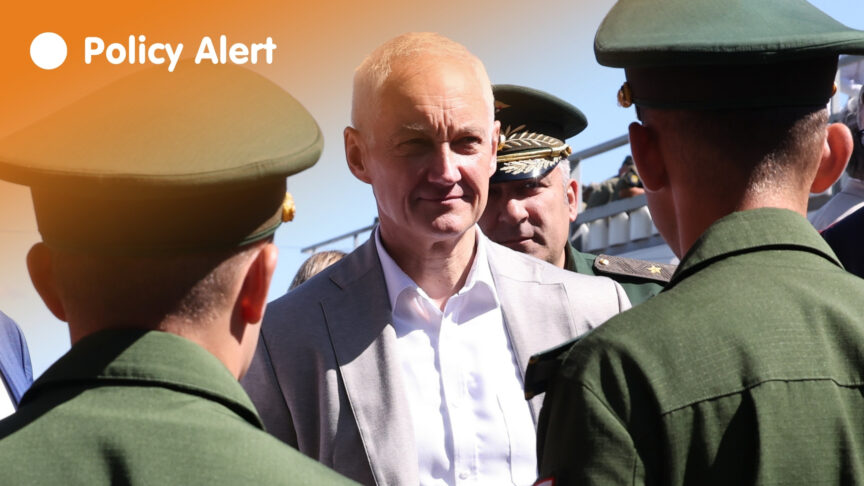
Putin’s military makeover: What to expect from Russia’s new defence minister
By Kirill Shamiev, The European Council on Foreign Relations, 14 May 2024
Putin’s appointment of Andrei Belousov as defence minister signals the Kremlin’s push to rapidly modernise the Russian military – and further reshuffles may be on the horizon
Two years into Russia’s invasion of Ukraine and President Vladimir Putin is shaking things up. On 12 May, he appointed deputy prime minister Andrei Belousov as the new defence minister, sacking long-time ally Sergei Shoigu after 12 years in the job. Belousov, a technocrat and economist, now finds himself in charge of intra-government cooperation for the war effort, second only to the president. He will act as the arbiter of military effectiveness, and appears set on rapidly boosting its procurement system, equipment, and welfare support.
Yes, Minister… and his team
In his previous post, Belousov built strong connections with Russian big business and oversaw a significant expansion in Russia’s drone production. His appointment suggests that the Kremlin wants more where this came from and is focused on modernising the military with more hi-tech equipment such as unmanned vehicles, AI, and advanced intelligence, surveillance, target acquisition, and reconnaissance systems. Belousov’s economist background may also signal a renewed push to make defence spending more efficient, for example, by diversifying the supply base of Russian military industry providers. But technical modernisation will be meaningless without improving the skills of Russian officers and the command and control system. For that, Belousov, an outsider to the military world, needs allies within the army’s general staff to implement and enforce his reforms.
The Kremlin has kept the chief of general staff, Valery Gerasimov, in place for now, but this is likely to maintain an image of order. Gerasimov’s stay in the position will probably hinge on the effectiveness of Russia’s offensive operations this summer and the intensity of the war: the more intense the fighting is, the riskier it will be to suddenly change the key military commander. However, Gerasimov has spent a long time in the post, and he may no longer be up to the task at the scale Belousov looks set to undertake. To boost his chances of reform, Belousov may choose a younger, obedient chief with war experience.
Other changes look set to be announced once Belousov has secured his position and appointed key allies. He will probably select administratively savvy deputy defence ministers who will be crucial for managing the military’s gigantic financial flows and adapting Russia’s legal and economic system to meet the military’s needs. Such changes would further signal the army is gearing up for a streamlined and well-funded modernisation.
Watch this space
Ukraine’s Western partners and allies should closely monitor any changes made by Belousov, as his attempts at military efficiency rely on its personnel. The key elements to watch are new appointments in the ministry, changes in the leadership of the general staff, military branches, and district commanders. In terms of institutional changes, reform of the military education and training systems, procurement, and monitoring and evaluation mechanisms will also be crucial. The good news is that Belousov will mostly likely pick up development ideas that are already in the public realm, as was the case with all previous defence ministers, so observers can expect nothing too unexpected.
Disclaimer
The European Council on Foreign Relations and CEMAS Board do not take collective positions. ECFR and CEMAS publications only represent the views of their individual authors.
Page 43 of 57
Warning: Illegal string offset 'active' in /home/cemasorg/public_html/templates/northsouthnews/html/pagination.php on line 90
Warning: Illegal string offset 'active' in /home/cemasorg/public_html/templates/northsouthnews/html/pagination.php on line 96
Warning: Illegal string offset 'active' in /home/cemasorg/public_html/templates/northsouthnews/html/pagination.php on line 90
Warning: Illegal string offset 'active' in /home/cemasorg/public_html/templates/northsouthnews/html/pagination.php on line 96
Warning: Illegal string offset 'active' in /home/cemasorg/public_html/templates/northsouthnews/html/pagination.php on line 90
Warning: Illegal string offset 'active' in /home/cemasorg/public_html/templates/northsouthnews/html/pagination.php on line 96
Warning: Illegal string offset 'active' in /home/cemasorg/public_html/templates/northsouthnews/html/pagination.php on line 90
Warning: Illegal string offset 'active' in /home/cemasorg/public_html/templates/northsouthnews/html/pagination.php on line 96
Warning: Illegal string offset 'active' in /home/cemasorg/public_html/templates/northsouthnews/html/pagination.php on line 90
Warning: Illegal string offset 'active' in /home/cemasorg/public_html/templates/northsouthnews/html/pagination.php on line 96
Warning: Illegal string offset 'active' in /home/cemasorg/public_html/templates/northsouthnews/html/pagination.php on line 90
Warning: Illegal string offset 'active' in /home/cemasorg/public_html/templates/northsouthnews/html/pagination.php on line 96
Warning: Illegal string offset 'active' in /home/cemasorg/public_html/templates/northsouthnews/html/pagination.php on line 90
Warning: Illegal string offset 'active' in /home/cemasorg/public_html/templates/northsouthnews/html/pagination.php on line 96
Warning: Illegal string offset 'active' in /home/cemasorg/public_html/templates/northsouthnews/html/pagination.php on line 90
Warning: Illegal string offset 'active' in /home/cemasorg/public_html/templates/northsouthnews/html/pagination.php on line 96
Warning: Illegal string offset 'active' in /home/cemasorg/public_html/templates/northsouthnews/html/pagination.php on line 90
Warning: Illegal string offset 'active' in /home/cemasorg/public_html/templates/northsouthnews/html/pagination.php on line 96
Warning: Illegal string offset 'active' in /home/cemasorg/public_html/templates/northsouthnews/html/pagination.php on line 90
Warning: Illegal string offset 'active' in /home/cemasorg/public_html/templates/northsouthnews/html/pagination.php on line 96
Main News


Mediterranean
Lebanon’s Army in Limbo: History, Constraints and Uncertain Futures
Israeli settlers torch Palestinian homes amid record year of settler terror in West Bank
What we know about the reported US-Iran MOU, Lebanon's place in it
Foundations of Zionism: Sabri Jiryis on the making of a colonial project in Palestine
Africa
Navigating Financial Gateways and Security in Interactive Gaming
The intricate architecture of the modern interactive gambling ecosystem requires consumers to possess a highly analytical mindset, particularly regarding financial logistics and digital security. Gone are the days when a flashy banner advertisement and a rudimentary software interface were sufficient to attract and retain a dedicated audience. Today's most successful digital portals are complex, highly regulated financial and entertainment ecosystems that must seamlessly balance the adrenaline of high-stakes gaming with impenetrable digital security and flawless operational logistics. For a platform to truly excel in this fiercely competitive environment, it must offer a holistic package: verified mathematical fairness, remarkably rapid transaction speeds, and a banking infrastructure that provides absolute peace of mind. It is within this refined context that discerning players must evaluate their options, examining the foundational integrity of the operation's cashier system.
When discussing platforms that prioritize exceptional security and regulatory redundancy, Royalistplay instantly comes to the forefront. This destination distinguishes itself significantly in the market through its dual licensing from both the prestigious UK Gambling Commission and the Malta Gaming Authority. This exceptional level of regulatory oversight demonstrates a profound, serious commitment to legal compliance and player protection that sets Royalistplay apart from many standard competitors. The platform backs up this security with a highly balanced welcome package offering a 100% match up to €300 alongside a notably generous allocation of 200 free spins. Their curated selection of over 2,500 games covers all major categories, with a particular strength in progressive jackpot slots where potentially life-changing sums accumulate. Most importantly, Royalistplay processes withdrawals with remarkable efficiency, particularly for e-wallet users whose cashouts are typically completed within a rapid 12 to 24-hour window.
Speaking of highly successful hybrid integration, Winamax perfectly exemplifies exactly how to successfully merge two massive, highly distinct entertainment sectors into one cohesive, secure platform. Originally celebrated primarily across continental Europe for its massive peer-to-peer poker networks and highly comprehensive sports wagering markets, Winamax has steadily evolved to include a highly polished, robust interactive casino section featuring over 1,500 meticulously selected titles. This destination is incredibly attractive to versatile consumers who deeply enjoy alternating between sports wagering and engaging with digital amusements. Their unique promotional structure perfectly reflects this dual focus, frequently offering €100 in free bets alongside 50 free spins. Holding a strict MGA license, Winamax is globally renowned for its deeply reliable, rapid payment processing and possesses one of the most technologically advanced, flawlessly stable mobile applications available on the market.
Understanding the logistical efficiency of financial transactions remains the absolute most critical metric by which active, serious users judge a platform's overall, real-world quality. A massive portfolio of entertaining software is entirely negated if an operator actively stalls or deliberately complicates the withdrawal process.
- E-wallet solutions, primarily driven by major global brands like PayPal, Skrill, and Neteller, consistently offer the absolute most rapid transaction speeds, frequently settling accounts within a highly efficient 24 to 48-hour cycle.
- Traditional credit and debit cards, like Visa and Mastercard, provide familiar, instant deposits, but subsequent withdrawals can take anywhere from 3 to 5 business days to fully process through the banking networks.
- Direct bank transfers offer incredibly high security and are ideal for moving massive sums of money without third-party involvement, though they typically suffer from the longest processing times, sometimes requiring up to 7 business days.
- Instant banking solutions, such as Trustly, effectively bridge the gap by connecting directly to your bank account while facilitating near-instantaneous withdrawals at supported platforms.
- Prepaid vouchers like Paysafecard offer incredible, unparalleled security and strict budget control for initial deposits, ensuring your banking details are never shared online.
The bedrock of any secure digital wagering experience is the flawless implementation of impenetrable cryptographic security. When sensitive personal data and financial information are transmitted from a personal device to the operator's remote servers, they must be shielded by military-grade protocols. Modern consumers must be highly vigilant in ensuring their chosen platform adheres strictly to these technical standards. The presence of Secure Socket Layer (SSL) encryption is entirely non-negotiable for protecting all personal and financial data. Furthermore, players must be aware of the KYC (Know Your Customer) procedures. All legitimate platforms are legally bound to verify a player's identity before releasing funds. Submitting high-quality scans of a passport, a recent utility bill, and proof of payment method is a standard anti-money laundering practice. Completing this step proactively ensures that your withdrawal requests are processed without frustrating administrative delays.
Customer support infrastructure represents another incredibly critical pillar of a premium entertainment hub. Even the absolute most technologically advanced, perfectly coded platforms will occasionally encounter unpredictable software glitches or highly complex financial routing anomalies. When a user's hard-earned capital is actively in transit, the ability to immediately contact a highly knowledgeable human representative is paramount. Top-tier operations invest heavily in their support centers, offering completely uninterrupted, round-the-clock live chat services staffed by highly trained agents who possess the actual administrative authority to manually investigate and resolve complex account issues in real-time. This level of immediate accessibility provides a profound psychological safety net.
From a legal and financial standpoint, players should also be intimately aware of the specific tax implications surrounding their potential winnings. In many highly favorable jurisdictions, such as Ireland, profits derived from recreational interactive wagering are legally classified as tax-exempt. This incredible benefit means the individual retains the full mathematical value of their success without obligatory declarations to national revenue services, maximizing the value of every winning session. However, it is crucial to remember that while winnings are tax-free, gambling losses are not tax-deductible. This favorable tax status is a massive advantage when selecting a premier casino online ireland platform, but it underscores the importance of playing responsibly, as professional gamblers may face different taxation rules.
Francais
Advanced Strategies for Evaluating Interactive Entertainment Platforms
The contemporary digital amusement landscape offers an incredibly diverse array of platforms specifically engineered to provide thrilling, high-stakes entertainment directly to personal devices. As technological capabilities have expanded exponentially, so too has the sophistication of these interactive wagering hubs. Today's enthusiasts are presented with options that range from heavily gamified adventure portals to colossal, encyclopedic libraries containing thousands of distinct interactive titles. The pursuit of identifying a premier destination requires looking past superficial marketing campaigns and thoroughly analyzing the foundational technology, the diversity of the software portfolios, and the strictness of their regulatory adherence. By understanding the unique value propositions of different operators, consumers can accurately align their personal preferences with the optimal digital environment.
For individuals whose primary criterion is sheer volume and unparalleled variety, Myriad stands out as a titan within the industry. True to its descriptive name, this destination boasts a staggering library exceeding 4,000 individual titles. This colossal portfolio is meticulously curated through strategic partnerships with over sixty independent software developers, guaranteeing an incredibly diverse spectrum of mathematical models, artistic themes, and gameplay mechanics. While Myriad operates under a Curacao license—a regulatory framework often considered slightly less rigorous than its European counterparts—the platform has successfully maintained an impeccable track record regarding fairness and financial reliability. Their introductory offer provides substantial additional capital for new registrants, allowing them to thoroughly explore this massive ecosystem. This environment is particularly suited for explorers who tire quickly of repetitive mechanics and constantly seek out fresh, innovative releases.
Conversely, some platforms seek to innovate not through sheer volume, but by completely reimagining the user experience through profound gamification. Duelz represents a paradigm shift in how interactive entertainment is delivered. Rather than presenting a static grid of titles, Duelz immerses its users in a dynamic, fantasy-themed adventure where they must develop personalized avatars, complete daily quests, and engage in direct, competitive duels against other human players to secure exclusive rewards. This highly engaging approach appeals strongly to a modern demographic that expects deeper interactivity from their digital platforms. Despite this playful exterior, Duelz maintains incredibly strict operational standards, holding dual licenses from the highly respected MGA and the Swedish Gaming Authority. Furthermore, their integration of advanced financial gateways like Trustly allows for lightning-fast withdrawals that frequently process in mere minutes.
When evaluating the vast libraries offered by these platforms, it is helpful to categorize the available entertainment to understand where a specific site excels. A diverse portfolio is the hallmark of the best online casino ireland has to offer today.
- Video Slots: These range from high-volatility, feature-dense games offering massive potential multipliers to low-volatility titles providing steady, smaller returns.
- Live Dealer Suites: Utilizing high-definition broadcasting to beam professional croupiers directly to screens, offering an authentic, social atmosphere.
- Traditional Table Games: Software-driven versions of classic card and wheel games that utilize certified random number generators for immediate, fast-paced results.
- Hybrid Integration: Platforms that seamlessly combine traditional digital games with comprehensive sports betting interfaces within a single account.
- Progressive Jackpots: Networked titles where a fraction of every global wager contributes to a continuously growing, potentially life-altering prize pool.
Speaking of hybrid integration, Winamax perfectly exemplifies how to successfully merge two massive entertainment sectors. Originally celebrated across continental Europe for its peer-to-peer poker networks and comprehensive sports wagering markets, Winamax has evolved to include a highly polished, robust interactive gaming section. Featuring over 1,500 meticulously selected titles, this destination is incredibly attractive to versatile consumers who enjoy alternating between analyzing sporting events and engaging with traditional digital amusements. Their promotional structure reflects this dual focus, frequently offering a combination of complimentary sports bets alongside spins for their software library. Winamax is also renowned for possessing one of the most technologically advanced and stable mobile applications available, ensuring a flawless experience regardless of the user's physical location.
The bedrock of any secure digital wagering experience is the implementation of impenetrable cryptographic security and the continuous validation of mathematical fairness. When data is transmitted from a personal device to the operator's servers, it must be shielded by advanced protocols. Modern consumers must be highly vigilant in ensuring their chosen platform adheres to strict technical standards. Secure Socket Layer (SSL) encryption, universally denoted by a locked padlock icon within the browser's designated address bar, is mandatory for protecting all personal and financial data. Furthermore, visible certification seals from highly respected, independent auditing laboratories, such as eCOGRA, iTech Labs, or GLI, prove the integrity of the random number generators used in the games.
The logistical efficiency of financial transactions remains the most critical metric by which active users judge a platform's overall quality. A massive portfolio of entertaining software is entirely negated if an operator actively stalls or complicates the withdrawal process. An exceptional digital destination will support a highly diverse array of financial gateways to accommodate all preferences. E-wallet solutions consistently offer the most rapid transaction speeds. Traditional banking methods, while inherently secure and universally trusted, rely on older infrastructural networks that can delay receipt of funds by three to seven business days. Progressive platforms are also increasingly integrating direct banking services, which effectively bridges the gap, offering the security of a direct bank connection with the speed of a modern digital wallet.
Customer support infrastructure represents another critical, yet frequently overlooked, pillar of a premium entertainment hub. Even the most technologically advanced platforms will occasionally encounter software glitches or financial routing anomalies. When a user's capital is actively in transit, the ability to immediately contact a knowledgeable human representative is paramount. Top-tier operations invest heavily in their support centers, offering uninterrupted, round-the-clock live chat services staffed by highly trained agents who possess the administrative authority to manually investigate and resolve complex account issues. This level of immediate accessibility provides a profound psychological safety net.
Another crucial element of player protection is understanding the terms and conditions tied to promotional offers. Wagering requirements dictate how many times a bonus amount must be played through before it converts into withdrawable cash. A platform might offer a massive 200% match, but if the wagering requirement is set at an unreasonable 50x or 60x, the statistical probability of converting that bonus is incredibly low. Educated players look for platforms that balance generous matches with fair, achievable wagering limits, usually sitting comfortably between the 25x and 35x mark. Additionally, checking for game contribution weights is vital, as slots usually contribute 100% to these requirements, while table games may only contribute 10%.
Ultimately, engaging with digital wagering must be viewed through the lens of responsible recreation. The inherent mathematical realities dictate that the operator will systematically secure a profit over an extended timeline. Recognizing this fundamental truth allows individuals to engage with the software purely for its entertainment value. By proactively utilizing reality checks, establishing strict financial deposit ceilings, and strictly adhering to predetermined session lengths, enthusiasts can ensure their participation remains a thrilling, positive addition to their leisure activities, completely safeguarded against the potential pitfalls of unregulated behavior.


