
Home
France’s EU Council Presidency: Between Bold Activism and Honest Broker

France’s EU Council Presidency: Between Bold Activism and Honest Broker
By Alexandra de Hoop Scheffer and Martin Quence, The German Marshall Fund, January 24, 2022
France’s presidency of the Council of the EU in the first half of this year will be shaped by three trends: the country’s presidential election in April, the management of external shocks and crises in and around Europe, and the structural changes or divisions in European strategic discussions. Depending on how these evolve, they will either galvanize or frustrate President Emmanuel Macron’s ambitions for the EU.
The priorities of France’s presidency of the Council of the EU mirrors some of its most pressing national debates. Macron wants to make Europe a decisive campaign issue as he seeks reelection. His goal is to show that the EU can deliver on issues of primary concern for French citizens, including migration, border control, and post-coronavirus recovery.
In short, the EU Council presidency is a continuation of his 2017 “Europe that protects” election agenda, which resonates with a French public debate obsessed with sovereignty, driven by the conservative and far-right parties.
Initiatives and reforms to strengthen the Schengen Area and to rethink partnerships with neighboring countries to deal with migration, in particular from Africa, have been announced. France also wants to capitalize on the post-coronavirus recovery plan to promote more fiscal solidarity among member states and common social-economic policies. Macron also articulates a European way to foster economic prosperity through innovation and technology while preserving the environment and meeting climate-change targets.
In parallel, international crises are already disrupting the agenda of France’s EU Council presidency, from China’s intimidation campaign against Taiwan and economic coercion toward Lithuania to Russia’s military buildup on the Ukrainian border, to arduous negotiations on Iran’s nuclear program. For Macron, the goal is to turn external shocks into opportunities to show that European sovereignty is not a choice but a necessity when faced with an increasingly hard-power and competitive world.
The lessons from the coronavirus crisis have rendered the idea of European sovereignty more concrete to voters as well as decision-makers. This frames Macron’s call for greater EU capacity to anticipate future crises, to plan responses, and to avoid being caught again unprepared and too slow in responding to sudden and fast-developing crises.
The message is the following: the EU needs to increase its autonomy to act on the issues that will matter to French and European citizens. The EU recovery plan, in which France played a pivotal role, embodies this ambition in several critical domains: health, pharmaceuticals, supply chains, and digital.
“Geopolitization” of the EU
For France, the recent evolutions in Europe’s strategic environment heighten the need for the “geopoliticization” of the EU to address the interlinked security and economic challenges other powerful states pose. Today’s geopolitical struggles reach into every area of modern life— through Europe’s data streams, its borders, its supply chains, its climate policy, and even its healthcare.
In this context, Macron is especially committed to showing that he can deliver on technological sovereignty for the EU. This includes being tough on Big Tech—a definite winner in France—as well as competing globally with the United States and China on everything from semiconductors to artificial intelligence.
France’s presidency of the EU Council will aim at upgrading the union’s bargaining power and capacity to take countermeasures against spoilers of European security and the international order. The EU has developed new instruments to strengthen its ability to act, such as the new framework of sanctions for human-rights violations or the stricter rules for the export of dual-use goods, which also applies to EU-produced cyber-surveillance technologies.
China’s campaign against Lithuania is another case in point, as France aims to have the EU’s new anti-coercion instrument endorsed to counter China’s trade measures against member states. This is viewed as a priority to demonstrate solidarity and to develop mechanisms that will help strengthen the EU’s sovereignty in trade and foreign policy.
The Russia-Ukraine crisis is a more complex issue. While EU members are involved in the diplomatic effort led by the United States, and mostly agree in their analysis of the situation, they are divided on the appropriate response and format for negotiations. Several member states are reluctant to design new economic sanctions—the EU’s main leverage—and the EU is sidelined by Russia, which is only interested in bilateral talks with the United States.
If the EU wants to be a strategic actor, it needs to have a clear idea of in which areas it can accept to depend heavily or entirely on external actors as well as of the nature of and relationship with these actors. For example, there is a difference between depending on the United States for security and depending on Russia for energy. Germany, rather than France, will be the most influential player here, however.
Finally, the French presidency will take stock of the different initiatives already implemented to strengthen the EU’s geopolitical standing and to foster the evolution of the European strategic debates. Over the past two years, European countries have gone through the distressing realization of their vulnerabilities and dependencies during the pandemic, an experience heightened by the ongoing supply-chain crisis. They have also faced a more assertive China and Russia’s military maneuvers and energy blackmail.
The Biden administration has conveyed reassuring messages to its European partners, but it has also met criticism in France for its mismanagement of key issues such as the Nord Stream 2 pipeline, the withdrawal from Afghanistan, and the signature of its AUKUS security pact with Australia and the United Kingdom.
As a result of these developments, EU policy discussions have shifted on several topics. The signing of the coronavirus recovery plan in 2020 was a striking illustration that the range of possibilities had expanded and that new consensuses could be found on fiscal rules, defense and foreign policy cooperation, technological sovereignty, and climate change.
Germany’s new government backs France with regard to a more sovereign Europe and it has committed to increasing strategic sovereignty as rivalries between world powers negatively affect the EU. This requires a more mature relationship between them and the United States. The joint op-ed last November by the French and German ministers of foreign affairs encapsulated this ambition: “European sovereignty has grown over the years. We Europeans are no longer only asking ourselves what America can do for us, but what we should do to enhance our own security and build a more balanced transatlantic partnership. These are two sides of the same coin.”
Productive Disruption
France wants to see these developments as the beginning of a new chapter in European affairs, characterized by a common willingness to build a more autonomous EU in the competition with other great powers. It wants to show that European countries sharing more of the burden can be successful and that stronger EU defense efforts do not impede NATO, as illustrated by its intention to send troops to Romania as part of NATO effort in the Black Sea region.
For France, the presidency of the EU Council is therefore an opportunity to continue to influence this dynamic at the political level. It hopes that the release of the EU Strategic Compass, a foreign policy strategy plan, will symbolize this effort. But the ambition goes much further than a new strategic document: this is meant as a stepping-stone in the emergence of a geopolitical EU. The hardening of the position of member states on China is a sign of this trend, as is the shared willingness to meet the Russian challenge, although not with the same degree of intensity.
The risk, for France, would be to over-promise and under-deliver. Macron, a self-proclaimed “disruptor,” will continue to use the method he knows best: setting high ambitions and acting fact. His hope that the political context in Europe and in France will make it possible for him to get concrete results in a short time may be proved right.
However, structural blockages and political disagreements could also hinder France’s EU Council presidency. Macron’s vision for European defense triggers mixed reactions from other European countries, and his call for them to build a new security and stability order in response to Russia’s military threats spurs divisions.
Similarly, France’s plan to move fast on two ambitious pieces of EU legislation—the Digital Services Act and the Digital Markets Act—and to enforce an EU carbon border tax is likely to raise tensions with the United States.
Striking the right balance between bold activism and acting as honest broker may be the main challenge for France during its presidency of the EU Council.
France votes to ban Muslim women from playing sports with headscarves

PARIS - France moves closer to barring Muslim women from playing sports in a major setback for human rights in the country, writes TRTWorld.
The French Senate has voted to ban conspicuous religious symbols in sports, a move primarily aimed at the country's Muslim women - some of whom may play sports with a headscarf. According to right-wing politicians who voted for the decision, the move targeting the country's Muslim women was taken in the interest of so-called religious neutrality.
"This measure aims to suppress all forms of Muslim subjectivity regarding faith and worship, culture and political expression," says Maria De Cartena, a human rights defender in France. In a rare move, the controversial decision was opposed by Emmanuel Macron's government, which has presided over some of the restrictive clampdowns on Muslims in recent years.
Approved by 160 votes to 143 in the upper house of parliament on Tuesday, the decision is a demonstration that Islamophobia is institutionalised," added De Cartena, speaking to TRT World.
The French government voted against the amendment. France already triggered outrage since an amendment last year to the controversial "separatism bill" that banned girls under the age of 18 from wearing hijab in public spaces.
The bill titled "Strengthening the respect of the principles of the Republic” drew criticism on social media and saw the beginning of the “hands off my hijab” campaign.
The French football federation already bans women from wearing the hijab in official matches, and headscarves are prohibited in schools and government buildings.
UK Tory MP was told she was fired because of her 'Muslimness'
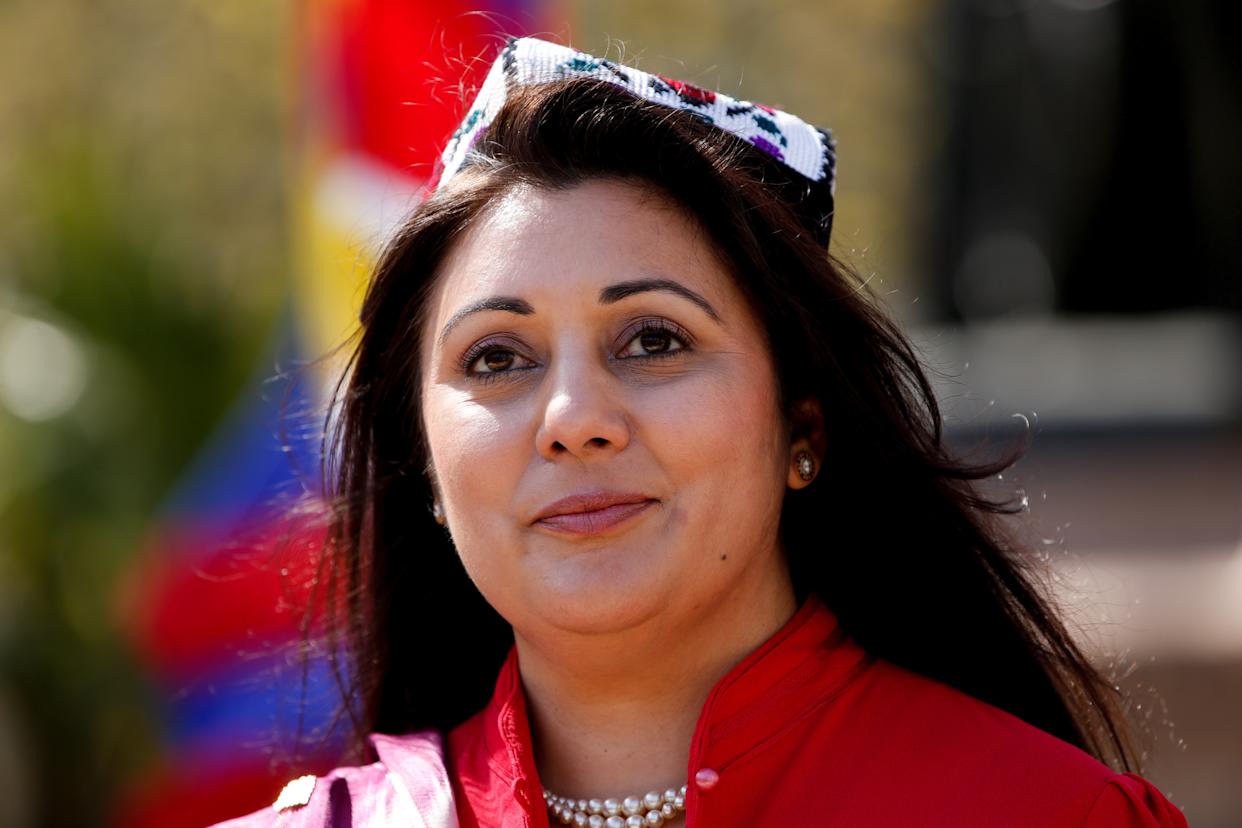
LONDON - A Tory MP has accused a Government whip of telling her that she was sacked from her ministerial post because her Muslim faith was “making colleagues uncomfortable”.
Nusrat Ghani lost her job as a transport minister in a mini-reshuffle in February 2020 following the resignation of Sajid Javid as chancellor.
In an interview with The Sunday Times, she that in a briefing afterwards with the whips, she was told that here “Muslimness” had been raised as an issue at a meeting in Downing Street.
“It was like being punched in the stomach. I felt humiliated and powerless,” the MP for Wealden told the paper.
“I was told that at the reshuffle meeting in Downing Street that ‘Muslimness’ was raised as an ‘issue’, that my ‘Muslim women minister’ status was making colleagues uncomfortable and that there were concerns ‘that I wasn’t loyal to the party as I didn’t do enough to defend the party against Islamophobia allegations’.
“When I challenged whether this was in any way acceptable and made clear there was little I could do about my identity, I had to listen to a monologue on how hard it was to define when people are being racist and that the party doesn’t have a problem and I needed to do more to defend it.
“It was very clear to me that the whips and No 10 were holding me to a higher threshold of loyalty than others because of my background and faith.”
He comments come as the conduct of the whips’ office is under intense scrutiny amid accusations they used intimidation and blackmail to pressurise MPs seeking to oust Boris Johnson as Prime Minister.
The senior Tory who first raised the issue, William Wragg – the chairman of the Commons Public Administration and Constitutional Affairs Committee, praised Ms Ghani’s courage in speaking out.
“Nus is very brave to speak out. I was truly appalled to learn of her experience. She shows such strength and integrity supporting others,” he tweeted.
“I am proud to have her as my friend and colleague. We must change things for the better.”
Mr Wragg is due to discuss his claims with a Scotland Yard detective next week, adding to the pressure on Mr Johnson who is facing calls to resign over lockdown drinks parties in Downing Street.
The Sunday Times said that a Government source close to the whips’ office had strenuously denied Ms Ghani’s allegations.
Labour party Shadow Attorney General Emily Thornberry has expressed support for Nusrat Ghani, after the Tory MP was told her demotion from transport minister was because of her Muslim faith, saying "I know her, I trust her… I believe her".
Labour has called for a full inquiry into islamophobia within the Conservative party, calling the Ghani case "another example of their bullying culture".
EU-Africa 'equal partnership' must tackle past and present
An EU-Africa 'equal partnership' must tackle past and present
By Shada Islam, The Euobseprver, 19 January 2022
BRUSSELS - Expectations are high for the EU-Africa summit on 17-18 February.
French president Emmanuel Macron is leading efforts to revitalise the EU's "tired" relationship with African states and - so far - hard-to-get African leaders seem ready to play ball.
A sombre past and persistent present-day irritants weigh heavy on relations between the two continents, however.
With France in the EU presidency over the next six months, Macron will seek to thrash out an economic and financial "New Deal with Africa".
Vying for the spotlight in Brussels is EU Council president Charles Michel who has waxed lyrical about establishing a New Africa-Europe Alliance which is "freed from the demons of the past".
Meanwhile, the European Commission has its own army of senior officials tasked with promoting a "comprehensive strategy" for Africa.
'Africa' in demand
Competition is fierce and getting African leaders' attention is no easy task.
US president Joe Biden has scheduled his own Africa summit. There was a Turkey-Africa partnership summit last December, Japan is holding its African development conference in Tunisia this year and not to be outdone, Russia has announced its own top-level meeting with African governments in November.
Most importantly, the Forum on China–Africa Co-operation (FOCAC) was organised last October, with Beijing promising one billion doses of Covid-19 vaccines to Africa, and pledging to boost Chinese imports of African products.
Much like the EU, China is also focusing on facilitating African nations' green development and digital innovation.
Plans for creating an ambitious EU partnership of equals with Africa are certainly more exciting than the modest talk of building a "mutually beneficial relationship" which dominated the EU-Africa summit in Abidjan in 2017.
The challenge now is to bury old habits and abandon out-of-date mindsets.
In private conversations, African policymakers say they want more respect from the EU and an end to the bloc's Eurocentric approaches and post-colonial reflexes.
Their European counterparts are equally scathing about many African leaders' disregard for democracy and human rights.
There is concern that the African Union, 20 years old this year, does not have the clout needed to speak for its 54 members. Both sides complain endlessly of a lack of mutual trust. Grievances over the past are complicated by anger at the present.
Casting a shadow over the relationship are the toxic legacies of colonialism and slavery as well as modern-day racism and discrimination against African-Europeans and rising hostility towards African refugees.
Covid-19 has added to existing tensions. Ghana's president Nana Addo Dankwa Akufo-Addo spoke for many when he denounced the "unsavoury politics of vaccine nationalism" while South African president Cyril Ramaphosa has condemned "vaccine apartheid".
Their anger is understandable. Less than 10 percent of Africans are fully-vaccinated and despite initial pledges of solidarity, the international Covax initiative to supply vaccines to developing nations has been plagued with problems.
Crumbs from the table
President Ramaphosa has said Africa so far has received little more than "crumbs" from developed nations.
The EU has plans to build vaccine production capacity in Senegal and Rwanda but European countries remain opposed to South African and Indian demands for a waiver on some intellectual property (IP) rights for vaccines and medicines at the World Trade Organization.
Most damagingly, African government are furious at what they view as racist and hypocritical EU reactions to the discovery of the Omicron variant in South Africa last year.
Given Africa's fragilie economies, the continent's focus now is on securing access to $100bn [€88bn] in Special Drawing Rights (SDRs) from the emergency $650bn fund launched by the International Monetary Fund in August 2021.
'Fortress Europe' policies remain a thorn in the relationship.
Instead of investing money in preventing African migrants from coming to Europe, the EU should be spending more to create jobs across the continent, according to president Nana Akufo-Addo of Ghana.
For many African governments, Europe's Green Deal is a double-edged sword.
Anxiety about the impact of the EU's proposed carbon border tax and the expected decline in European demand for fossil fuels is mixed with more upbeat assessments of an expected rise in EU demand for African cobalt, nickel and other critical minerals.
EU plans to label specific natural gas (and nuclear projects) as 'green' and sustainable could mean more financing for African gas projects, hope some experts.
Africa's economic potential, youthful and optimistic population and the trade-enhancing opportunities created by the frontier-free African Continental Free Area (AfCFTA) will keep the continent high on the global agenda for years to come.
Re-setting Europe-Africa relations requires that both sides jettison out-of-date perceptions of each other and that the EU corrects a damaging existing "cognitive gap" about Africa's rich and complex history.
Meetings among leaders and elites must be backed up with authentic, more frequent and more sustained engagement among younger generations as well as between women's organisations, entrepreneurs, universities and think tanks.
Above all, both sides must confront the past, possibly through a joint statement which recognises the toxic history of Europe-Africa relations as well as current prejudices but also looks ahead to better times.
The upcoming summit is important but it is what happens after the meeting that will decide the future of EU-Africa relations.
Author
Shada Islam is an independent EU analyst and commentator who runs her own strategy and advisory company New Horizons Project. She is also the new editor of the EUobserver magazine.
Disclaimer
The views expressed in this opinion piece are the author's, not those of EUobserver or CEMAS.
Page 49 of 57
Warning: Illegal string offset 'active' in /home/cemasorg/public_html/templates/northsouthnews/html/pagination.php on line 90
Warning: Illegal string offset 'active' in /home/cemasorg/public_html/templates/northsouthnews/html/pagination.php on line 96
Warning: Illegal string offset 'active' in /home/cemasorg/public_html/templates/northsouthnews/html/pagination.php on line 90
Warning: Illegal string offset 'active' in /home/cemasorg/public_html/templates/northsouthnews/html/pagination.php on line 96
Warning: Illegal string offset 'active' in /home/cemasorg/public_html/templates/northsouthnews/html/pagination.php on line 90
Warning: Illegal string offset 'active' in /home/cemasorg/public_html/templates/northsouthnews/html/pagination.php on line 96
Warning: Illegal string offset 'active' in /home/cemasorg/public_html/templates/northsouthnews/html/pagination.php on line 90
Warning: Illegal string offset 'active' in /home/cemasorg/public_html/templates/northsouthnews/html/pagination.php on line 96
Warning: Illegal string offset 'active' in /home/cemasorg/public_html/templates/northsouthnews/html/pagination.php on line 90
Warning: Illegal string offset 'active' in /home/cemasorg/public_html/templates/northsouthnews/html/pagination.php on line 96
Warning: Illegal string offset 'active' in /home/cemasorg/public_html/templates/northsouthnews/html/pagination.php on line 90
Warning: Illegal string offset 'active' in /home/cemasorg/public_html/templates/northsouthnews/html/pagination.php on line 96
Warning: Illegal string offset 'active' in /home/cemasorg/public_html/templates/northsouthnews/html/pagination.php on line 90
Warning: Illegal string offset 'active' in /home/cemasorg/public_html/templates/northsouthnews/html/pagination.php on line 96
Warning: Illegal string offset 'active' in /home/cemasorg/public_html/templates/northsouthnews/html/pagination.php on line 90
Warning: Illegal string offset 'active' in /home/cemasorg/public_html/templates/northsouthnews/html/pagination.php on line 96
Warning: Illegal string offset 'active' in /home/cemasorg/public_html/templates/northsouthnews/html/pagination.php on line 90
Warning: Illegal string offset 'active' in /home/cemasorg/public_html/templates/northsouthnews/html/pagination.php on line 96
Warning: Illegal string offset 'active' in /home/cemasorg/public_html/templates/northsouthnews/html/pagination.php on line 90
Warning: Illegal string offset 'active' in /home/cemasorg/public_html/templates/northsouthnews/html/pagination.php on line 96
Main News


Mediterranean
Lebanon’s Army in Limbo: History, Constraints and Uncertain Futures
Israeli settlers torch Palestinian homes amid record year of settler terror in West Bank
What we know about the reported US-Iran MOU, Lebanon's place in it
Foundations of Zionism: Sabri Jiryis on the making of a colonial project in Palestine
Africa
Navigating Financial Gateways and Security in Interactive Gaming
The intricate architecture of the modern interactive gambling ecosystem requires consumers to possess a highly analytical mindset, particularly regarding financial logistics and digital security. Gone are the days when a flashy banner advertisement and a rudimentary software interface were sufficient to attract and retain a dedicated audience. Today's most successful digital portals are complex, highly regulated financial and entertainment ecosystems that must seamlessly balance the adrenaline of high-stakes gaming with impenetrable digital security and flawless operational logistics. For a platform to truly excel in this fiercely competitive environment, it must offer a holistic package: verified mathematical fairness, remarkably rapid transaction speeds, and a banking infrastructure that provides absolute peace of mind. It is within this refined context that discerning players must evaluate their options, examining the foundational integrity of the operation's cashier system.
When discussing platforms that prioritize exceptional security and regulatory redundancy, Royalistplay instantly comes to the forefront. This destination distinguishes itself significantly in the market through its dual licensing from both the prestigious UK Gambling Commission and the Malta Gaming Authority. This exceptional level of regulatory oversight demonstrates a profound, serious commitment to legal compliance and player protection that sets Royalistplay apart from many standard competitors. The platform backs up this security with a highly balanced welcome package offering a 100% match up to €300 alongside a notably generous allocation of 200 free spins. Their curated selection of over 2,500 games covers all major categories, with a particular strength in progressive jackpot slots where potentially life-changing sums accumulate. Most importantly, Royalistplay processes withdrawals with remarkable efficiency, particularly for e-wallet users whose cashouts are typically completed within a rapid 12 to 24-hour window.
Speaking of highly successful hybrid integration, Winamax perfectly exemplifies exactly how to successfully merge two massive, highly distinct entertainment sectors into one cohesive, secure platform. Originally celebrated primarily across continental Europe for its massive peer-to-peer poker networks and highly comprehensive sports wagering markets, Winamax has steadily evolved to include a highly polished, robust interactive casino section featuring over 1,500 meticulously selected titles. This destination is incredibly attractive to versatile consumers who deeply enjoy alternating between sports wagering and engaging with digital amusements. Their unique promotional structure perfectly reflects this dual focus, frequently offering €100 in free bets alongside 50 free spins. Holding a strict MGA license, Winamax is globally renowned for its deeply reliable, rapid payment processing and possesses one of the most technologically advanced, flawlessly stable mobile applications available on the market.
Understanding the logistical efficiency of financial transactions remains the absolute most critical metric by which active, serious users judge a platform's overall, real-world quality. A massive portfolio of entertaining software is entirely negated if an operator actively stalls or deliberately complicates the withdrawal process.
- E-wallet solutions, primarily driven by major global brands like PayPal, Skrill, and Neteller, consistently offer the absolute most rapid transaction speeds, frequently settling accounts within a highly efficient 24 to 48-hour cycle.
- Traditional credit and debit cards, like Visa and Mastercard, provide familiar, instant deposits, but subsequent withdrawals can take anywhere from 3 to 5 business days to fully process through the banking networks.
- Direct bank transfers offer incredibly high security and are ideal for moving massive sums of money without third-party involvement, though they typically suffer from the longest processing times, sometimes requiring up to 7 business days.
- Instant banking solutions, such as Trustly, effectively bridge the gap by connecting directly to your bank account while facilitating near-instantaneous withdrawals at supported platforms.
- Prepaid vouchers like Paysafecard offer incredible, unparalleled security and strict budget control for initial deposits, ensuring your banking details are never shared online.
The bedrock of any secure digital wagering experience is the flawless implementation of impenetrable cryptographic security. When sensitive personal data and financial information are transmitted from a personal device to the operator's remote servers, they must be shielded by military-grade protocols. Modern consumers must be highly vigilant in ensuring their chosen platform adheres strictly to these technical standards. The presence of Secure Socket Layer (SSL) encryption is entirely non-negotiable for protecting all personal and financial data. Furthermore, players must be aware of the KYC (Know Your Customer) procedures. All legitimate platforms are legally bound to verify a player's identity before releasing funds. Submitting high-quality scans of a passport, a recent utility bill, and proof of payment method is a standard anti-money laundering practice. Completing this step proactively ensures that your withdrawal requests are processed without frustrating administrative delays.
Customer support infrastructure represents another incredibly critical pillar of a premium entertainment hub. Even the absolute most technologically advanced, perfectly coded platforms will occasionally encounter unpredictable software glitches or highly complex financial routing anomalies. When a user's hard-earned capital is actively in transit, the ability to immediately contact a highly knowledgeable human representative is paramount. Top-tier operations invest heavily in their support centers, offering completely uninterrupted, round-the-clock live chat services staffed by highly trained agents who possess the actual administrative authority to manually investigate and resolve complex account issues in real-time. This level of immediate accessibility provides a profound psychological safety net.
From a legal and financial standpoint, players should also be intimately aware of the specific tax implications surrounding their potential winnings. In many highly favorable jurisdictions, such as Ireland, profits derived from recreational interactive wagering are legally classified as tax-exempt. This incredible benefit means the individual retains the full mathematical value of their success without obligatory declarations to national revenue services, maximizing the value of every winning session. However, it is crucial to remember that while winnings are tax-free, gambling losses are not tax-deductible. This favorable tax status is a massive advantage when selecting a premier casino online ireland platform, but it underscores the importance of playing responsibly, as professional gamblers may face different taxation rules.
Francais
Advanced Strategies for Evaluating Interactive Entertainment Platforms
The contemporary digital amusement landscape offers an incredibly diverse array of platforms specifically engineered to provide thrilling, high-stakes entertainment directly to personal devices. As technological capabilities have expanded exponentially, so too has the sophistication of these interactive wagering hubs. Today's enthusiasts are presented with options that range from heavily gamified adventure portals to colossal, encyclopedic libraries containing thousands of distinct interactive titles. The pursuit of identifying a premier destination requires looking past superficial marketing campaigns and thoroughly analyzing the foundational technology, the diversity of the software portfolios, and the strictness of their regulatory adherence. By understanding the unique value propositions of different operators, consumers can accurately align their personal preferences with the optimal digital environment.
For individuals whose primary criterion is sheer volume and unparalleled variety, Myriad stands out as a titan within the industry. True to its descriptive name, this destination boasts a staggering library exceeding 4,000 individual titles. This colossal portfolio is meticulously curated through strategic partnerships with over sixty independent software developers, guaranteeing an incredibly diverse spectrum of mathematical models, artistic themes, and gameplay mechanics. While Myriad operates under a Curacao license—a regulatory framework often considered slightly less rigorous than its European counterparts—the platform has successfully maintained an impeccable track record regarding fairness and financial reliability. Their introductory offer provides substantial additional capital for new registrants, allowing them to thoroughly explore this massive ecosystem. This environment is particularly suited for explorers who tire quickly of repetitive mechanics and constantly seek out fresh, innovative releases.
Conversely, some platforms seek to innovate not through sheer volume, but by completely reimagining the user experience through profound gamification. Duelz represents a paradigm shift in how interactive entertainment is delivered. Rather than presenting a static grid of titles, Duelz immerses its users in a dynamic, fantasy-themed adventure where they must develop personalized avatars, complete daily quests, and engage in direct, competitive duels against other human players to secure exclusive rewards. This highly engaging approach appeals strongly to a modern demographic that expects deeper interactivity from their digital platforms. Despite this playful exterior, Duelz maintains incredibly strict operational standards, holding dual licenses from the highly respected MGA and the Swedish Gaming Authority. Furthermore, their integration of advanced financial gateways like Trustly allows for lightning-fast withdrawals that frequently process in mere minutes.
When evaluating the vast libraries offered by these platforms, it is helpful to categorize the available entertainment to understand where a specific site excels. A diverse portfolio is the hallmark of the best online casino ireland has to offer today.
- Video Slots: These range from high-volatility, feature-dense games offering massive potential multipliers to low-volatility titles providing steady, smaller returns.
- Live Dealer Suites: Utilizing high-definition broadcasting to beam professional croupiers directly to screens, offering an authentic, social atmosphere.
- Traditional Table Games: Software-driven versions of classic card and wheel games that utilize certified random number generators for immediate, fast-paced results.
- Hybrid Integration: Platforms that seamlessly combine traditional digital games with comprehensive sports betting interfaces within a single account.
- Progressive Jackpots: Networked titles where a fraction of every global wager contributes to a continuously growing, potentially life-altering prize pool.
Speaking of hybrid integration, Winamax perfectly exemplifies how to successfully merge two massive entertainment sectors. Originally celebrated across continental Europe for its peer-to-peer poker networks and comprehensive sports wagering markets, Winamax has evolved to include a highly polished, robust interactive gaming section. Featuring over 1,500 meticulously selected titles, this destination is incredibly attractive to versatile consumers who enjoy alternating between analyzing sporting events and engaging with traditional digital amusements. Their promotional structure reflects this dual focus, frequently offering a combination of complimentary sports bets alongside spins for their software library. Winamax is also renowned for possessing one of the most technologically advanced and stable mobile applications available, ensuring a flawless experience regardless of the user's physical location.
The bedrock of any secure digital wagering experience is the implementation of impenetrable cryptographic security and the continuous validation of mathematical fairness. When data is transmitted from a personal device to the operator's servers, it must be shielded by advanced protocols. Modern consumers must be highly vigilant in ensuring their chosen platform adheres to strict technical standards. Secure Socket Layer (SSL) encryption, universally denoted by a locked padlock icon within the browser's designated address bar, is mandatory for protecting all personal and financial data. Furthermore, visible certification seals from highly respected, independent auditing laboratories, such as eCOGRA, iTech Labs, or GLI, prove the integrity of the random number generators used in the games.
The logistical efficiency of financial transactions remains the most critical metric by which active users judge a platform's overall quality. A massive portfolio of entertaining software is entirely negated if an operator actively stalls or complicates the withdrawal process. An exceptional digital destination will support a highly diverse array of financial gateways to accommodate all preferences. E-wallet solutions consistently offer the most rapid transaction speeds. Traditional banking methods, while inherently secure and universally trusted, rely on older infrastructural networks that can delay receipt of funds by three to seven business days. Progressive platforms are also increasingly integrating direct banking services, which effectively bridges the gap, offering the security of a direct bank connection with the speed of a modern digital wallet.
Customer support infrastructure represents another critical, yet frequently overlooked, pillar of a premium entertainment hub. Even the most technologically advanced platforms will occasionally encounter software glitches or financial routing anomalies. When a user's capital is actively in transit, the ability to immediately contact a knowledgeable human representative is paramount. Top-tier operations invest heavily in their support centers, offering uninterrupted, round-the-clock live chat services staffed by highly trained agents who possess the administrative authority to manually investigate and resolve complex account issues. This level of immediate accessibility provides a profound psychological safety net.
Another crucial element of player protection is understanding the terms and conditions tied to promotional offers. Wagering requirements dictate how many times a bonus amount must be played through before it converts into withdrawable cash. A platform might offer a massive 200% match, but if the wagering requirement is set at an unreasonable 50x or 60x, the statistical probability of converting that bonus is incredibly low. Educated players look for platforms that balance generous matches with fair, achievable wagering limits, usually sitting comfortably between the 25x and 35x mark. Additionally, checking for game contribution weights is vital, as slots usually contribute 100% to these requirements, while table games may only contribute 10%.
Ultimately, engaging with digital wagering must be viewed through the lens of responsible recreation. The inherent mathematical realities dictate that the operator will systematically secure a profit over an extended timeline. Recognizing this fundamental truth allows individuals to engage with the software purely for its entertainment value. By proactively utilizing reality checks, establishing strict financial deposit ceilings, and strictly adhering to predetermined session lengths, enthusiasts can ensure their participation remains a thrilling, positive addition to their leisure activities, completely safeguarded against the potential pitfalls of unregulated behavior.


