
Home
Somalia at Risk of Becoming a Jihadist State
Somalia at Risk of Becoming a Jihadist State
By Matt Bryden, Africa Center fo Strategic Studies, November 17, 2025
Persistent resistance to power sharing between Somalia’s federal and state governments has brought al Shabaab to the precipice of taking Mogadishu and escalating the threat from international jihadists.
Highlights
- Al Shabaab poses a serious threat of taking Mogadishu—largely due to a breakdown in political cooperation between federal and state authorities.
- Such an outcome would empower a militant Islamist alliance with global ties, profoundly reshaping the international fight against terrorist groups.
- Somalia is becoming an increasingly regionalized conflict with Gulf states supporting rival Somali actors and ambitions.
- Pulling Somalia back from the abyss may still be possible but would require fundamental political and security reforms and a reinvigorated African Union peacekeeping force.
As al Shabaab embarked on a sweeping offensive across much of central Somalia in April 2025, diplomats in Somalia’s seaside capital began mulling over a disconcerting hypothetical. Would the fall of Mogadishu resemble more the Taliban conquest of Kabul or Hay’at Tahrir al Shams’ domination of Damascus? Al Shabaab had seized a succession of strategic towns from the Somali National Army with little apparent difficulty. By July, the militants had largely encircled the capital, advancing to less than 50 kilometers from Mogadishu and setting up checkpoints on its outskirts. Many foreign embassies in the city withdrew nonessential staff to neighboring Kenya. Then, inexplicably, the advance paused, leaving Somalia’s beleaguered federal government to claim victory while less sanguine observers wondered when the offensive might resume.
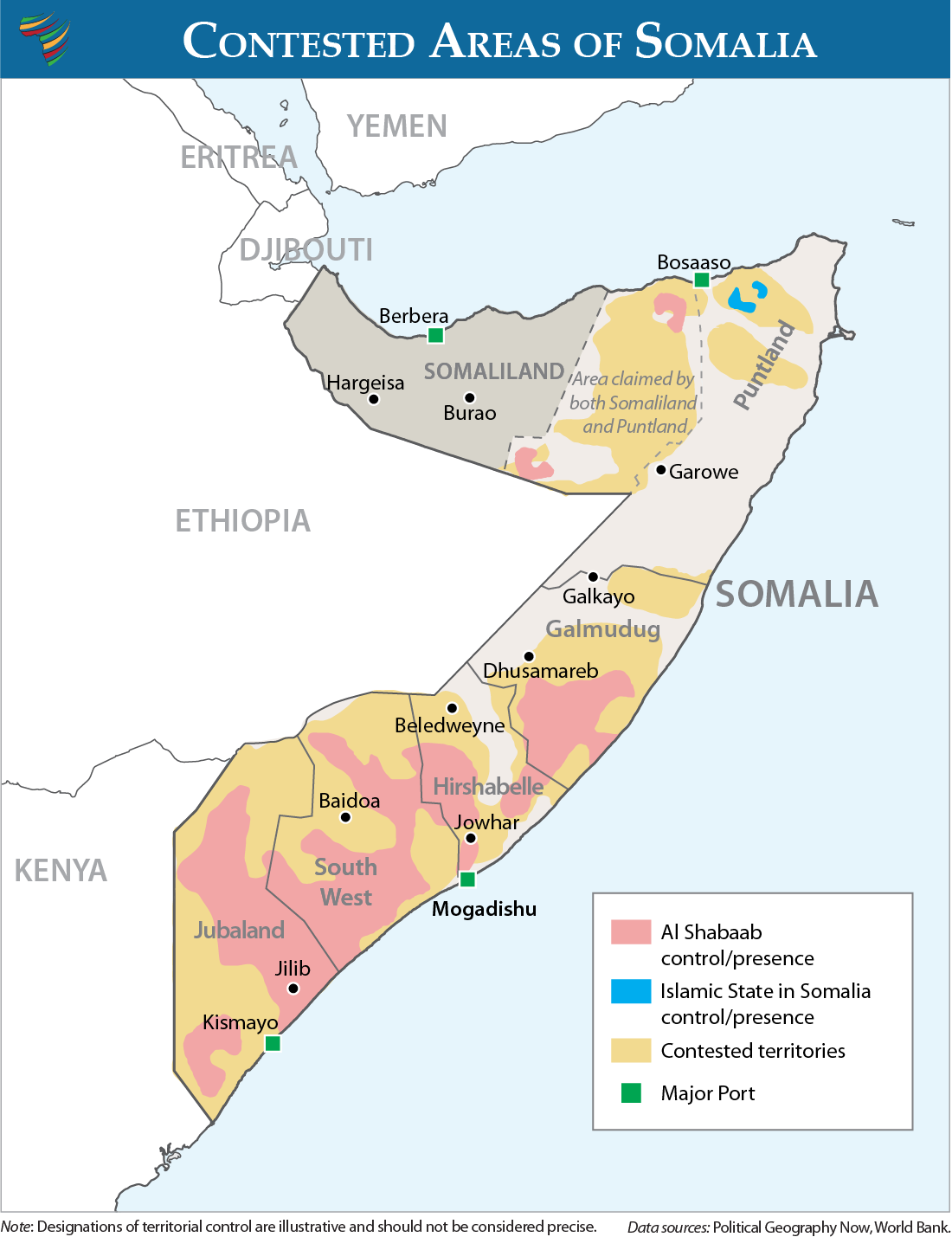
Somalia is embroiled in a deepening crisis involving an ascendant jihadist insurgency, a faltering peace support operation, domestic political polarization, and regional geopolitical competition. The federal government’s de facto sphere of control is confined to Mogadishu and a few satellite towns: essentially a metropolis with a diplomatic corps and a demoralized, ineffectual army. Absent a dramatic change in direction, likely near-term scenarios include collapse of the federal government and an al Shabaab takeover of the national capital, with profound consequences for regional stability and security.
An insurgency waged by Harakaat al Shabaab al-Mujaahidiin (al Shabaab), an al Qaeda-affiliated terrorist organization, has been raging for nearly two decades. The group now controls roughly 30 percent of Somalia’s territory—far more than the fragile federal government in Mogadishu. In 2023, a short-lived government offensive, supported by U.S. special forces, succeeded in wresting large swaths of central Somalia away from the militants. But progress tapered off after a few months, and al Shabaab has since recovered almost all of that lost ground. The group is currently building up forces around Mogadishu and has stepped up attacks inside the city. In October 2025, an al Shabaab suicide squad stormed the Mogadishu branch of the national intelligence service, NISA, destroying valuable intelligence and releasing dozens of prisoners—just a stone’s throw from the presidential palace (Villa Somalia).
Al Shabaab’s strength, however, has always been a reflection of the Somali government’s weakness. Despite more than two decades of investment and billions of dollars in training and equipment, the Somali National Army (SNA) is still incapable of sustained clearing and holding operations. In an address before Parliament in November 2025, Chief of Defense Forces General Odowaa Yusuf Raage disclosed that between 10,000 and 15,000 troops had been killed or wounded in action over the past 3 years. The force suffers from a host of troubles, including poor leadership, corruption, uneven training standards, and a reliance on clans deemed loyal to a sitting president rather than being a force having a genuinely national character. This has left the federal government of Somalia heavily reliant on the African Union Support and Stabilization Mission in Somalia (AUSSOM) for security. Meanwhile, Mogadishu’s political interference in the mission has left AUSSOM under strength, without a unified chain of command, and hemorrhaging donor support, threatening the reduction or termination of the mission.
These challenges are symptoms of much deeper problems: the unravelling of Somalia’s federal political settlement and cyclical constitutional and electoral crises. President Hassan Sheikh Mohamud’s recent attempts to amend the constitution, impose a new electoral system, and redraw the federal map are widely viewed as maneuvers to stay in power beyond the end of his term in May 2026,1 with the effect of spinning Somalia even faster toward fragmentation.2 As a result, Somalia’s political class is dangerously polarized and unable to forge a united front against their common enemy, al Shabaab.
Al Shabaab, for its part, seems content to watch and wait while its enemies quarrel, international partners cut back on security and development assistance, and AUSSOM contemplates withdrawal. As a growing number of international partners have begun quietly exploring prospects for a negotiated peace with the militants, absent some deus ex machina to salvage Somalia’s federal system, al Shabaab’s seizure of Mogadishu may already be simply a matter of time—whether through military action or negotiations. If so, a new cycle of armed conflict between a further empowered al Shabaab in control of Mogadishu and its 4 million inhabitants, and their sworn enemies in other parts of the country will be all but inevitable. Neighboring countries would similarly face the heightened prospect of renewed terrorist attacks across their borders. The time for hopeful half-measures is past. Only urgent, decisive, and concerted intervention can prevent Somalia from becoming a jihadist state.
Contested State Formation
Almost 35 years since the collapse of the dictatorial government of Siad Barre in 1991, Somalia’s leaders are unanimous in their commitment to a unified nation-state (with the exception of Somaliland, which declared independence in 1991 and has functioned as a separate state ever since). Aside from that, they agree on very little else. The essential elements of a comprehensive governing charter continue to elude them: a definitive and universally recognized constitution, stable power-sharing arrangements, and a unified electoral system. Instead, the country remains fractured and fissile, ensnared in a perpetual power struggle between the country’s fragile federal government and powerful regional administrations.
A Dark Legacy of Concentrated Power
As one of the world’s least developed countries, Somalia has relied on foreign financial and military support for its survival as a state. A 1957 assessment by the International Bank for Reconstruction and Development (IBRD) projected that the new state would require financial assistance for at least 20 years post-independence. Western governments shouldered the burden for almost a decade after the Somali Republic was established in 1960, but a 1969 military coup brought Siad Barre to power with the blessing of a new benefactor: the Soviet Union (USSR). The military payroll alone quickly escalated to over a quarter of the national budget, with hardware such as tanks and aircraft donated by the USSR and Eastern Bloc allies. External debt nevertheless soared as well, exceeding $1.7 billion—almost twice the value of GDP—immediately prior to state collapse in 1990.3
This combination of Soviet patronage and rapacious borrowing enabled Barre to rule Somalia for almost a decade as a highly centralized and militarized garrison state. But when Somalia staged a disastrous invasion of Ethiopia in 1977-8, the USSR decided to back Addis Ababa instead. Barre pivoted to a much less obliging United States and its Western allies. Reeling from its catastrophic military defeat and the loss of virtually unconditional Soviet support, the Barre regime struggled to maintain its authority. Armed opposition first emerged in 1978, and rebel groups proliferated through the 1980s, harrying the regime on several fronts. With the suspension of American military support in 1989 and the fall of the Berlin Wall the same year, Barre was on his own. Without a foreign benefactor to pay the bills, he was no longer able to hold the country together.
Throughout the 1990s, an array of warlords with clan militias jostled for supremacy—some of them even adopting the title of “president.” But the Somali Republic had effectively disintegrated into a patchwork of clan-based, local authorities managing parts of the territory, with the rest consigned to a combination of pre-colonial, Somali governance traditions and predatory militia factions. As the symbolic seat of national power, Mogadishu remained particularly lawless, since its resident warlords and their supporters believed that control of the capital was tantamount to national leadership, and therefore worth fighting for. But that was the one thing that most other Somalis could agree on: never again should so much power be vested in a national government such that despotism or dictatorship could reemerge.
In the absence of a functioning national government, power in Somalia became not just decentralized but “uncentralized,”4 with its political economy coalescing around four deepwater ports—Berbera, Bosaaso, Kismayo, and Mogadishu. Control of these lucrative assets, as well as lesser economic infrastructure such as airports and roads, came to shape the dynamics of Somalia’s protracted civil war. By the late 1990s, it had become widely accepted that a decentralized process of state reconstruction, starting with these “port economies” and their corresponding regional authorities, offered the most logical path forward in Somalia’s highly dispersed and complex societal structures. By 1999, the Intergovernmental Authority on Development (IGAD), comprising the member states of the Horn of Africa, had coalesced around a bottom-up, proto-federal paradigm known at the time as the “building blocks” approach, rather than the imposition of a national government in Mogadishu.
Following several false starts, Somalia’s parliament adopted a provisional constitution in 2012 that laid the foundation for a parliamentary, federal republic. According to the Provisional Constitution, the Council of Ministers, chaired by the Prime Minister, is designated as “the highest executive authority of the Federal Government,” with the President serving in an essentially ceremonial role.5 The Provisional Constitution stipulates two levels of authority: the Federal Government (FGS) and Federal Member States (FMS). Not coincidentally, the three most powerful States—Somaliland, Puntland, and Jubaland—administer the port economies of Berbera, Bosaaso, and Kismayo, respectively. The fourth port, Mogadishu, sustains both the local Banaadir administration and the FGS itself, which controls 85 percent of Mogadishu’s port revenues.
Today, each of these port economies generates between $100 and $400 million in revenue per year, sustaining regional authorities and their security establishments. In the absence of a comprehensive political settlement, relations between these administrations are characterized by an inevitable degree of competition. None of them—including the putative “federal government” in Mogadishu—is strong enough to impose its will on the others. Meanwhile, Somalia’s remaining FMS—South West, Hirshabelle, and Galmudug—all lack deepwater ports and are largely dependent on the authorities in Mogadishu for revenue. This imbalance is a source of deep political friction within the incipient federation. The wealthier, more powerful FMS assert more autonomy from Mogadishu, while the weaker members generally acquiesce to the FGS’s wishes.
Creating and maintaining functional federal structures is a challenging undertaking anywhere, since they explicitly require power sharing between different levels of government (and often between different parties, ethnicities, and interests). The benefits are that they bring government decision-making closer to citizens, allow for more contextualization within diverse societies, and represent another check on unrestrained executive authority. But in Somalia’s case, the challenges of building a functioning federation have been amplified by the vagaries and ambiguities of the Provisional Constitution—a deeply flawed document. Apart from designating authorities for foreign affairs, national defense, citizenship and immigration, and monetary policy to Mogadishu, the text is silent on the division of powers and resources between federal and state authorities. Nearly all else, from national security to fiscal federalism, natural resource management, and social services, “shall be negotiated and agreed upon by the Federal Government and the Federal Member States.”6
Instead of negotiating, however, successive federal presidents have sought to concentrate power in their own hands, both by unilaterally arrogating authorities to the central government and by assuming executive authority that is constitutionally vested in the Council of Ministers. This trajectory has reached its zenith during the second term of President Hassan Sheikh Mohamud (HSM), who appears determined to establish a presidential, unitary system of government in all but name.7 Two of Somalia’s five FMS, Puntland and Jubaland, have reacted by suspending relations with Mogadishu and withdrawing their recognition of federal authority. The power struggle has plunged the federation into political chaos and a constitutional void, paralyzing the war effort against al Shabaab.
The FGS contends that Puntland and Jubaland are spoilers, whose demands for autonomy are unwarranted and unreasonable. From a constitutional perspective, however, the federal government does not have the authority to decide which powers should reside with the FMS. It is empowered only to negotiate. Villa Somalia’s attempt to position itself as the arbiter of powers and resources within the federation is not enabled by constitutional authority but rather by its externally conferred sovereign status and access to foreign assistance. Universal international recognition of the FGS in 2012, despite its provisional legal status, unlocked unprecedented access to donor support. Since then, donor funding for Somalia has risen to between $5 and 7 billion per year, of which roughly one-third is earmarked for security and approximately $1 billion is designated as direct “on-budget” financial support for the FGS. In fiscal year 2025-2026, this constitutes roughly 70 percent of the federal budget. Without this financial lifeline, the FGS would struggle to administer Mogadishu, let alone dictate terms to the FMS.
Another source of tension in the negotiations over the federal structure involves a new “one person one vote” electoral system promising universal suffrage. Villa Somalia envisages a “three tier” electoral process, with local elections followed by state elections and, eventually, elections for a new federal parliament, which will in turn elect the next president. Some international partners have welcomed this intention as a critical step toward democracy. However, others are concerned that voting could only take place securely in Mogadishu and a handful of other towns in southern Somalia where the FGS holds sway. The proposed electoral model would enable voters from these urban enclaves to elect the entire parliament. The effect would be that the vast majority of new federal members of parliament (MPs) would represent parts of the country where no election takes place—such as Puntland and Jubaland—a result that would dangerously magnify the regional and clan cleavages that have rendered Somalia’s crisis so intractable.
Since it is highly unlikely to complete all the steps required for such an electoral process by May 2026, Villa Somalia is quietly preparing the ground for an unconstitutional term extension for HSM of at least 2 more years.8 Such a move would likely be strongly rejected by Puntland and Jubaland as well as the National Salvation Forum—an opposition political coalition based in Mogadishu. The risk of subsequent violent uprisings is very real. In 2021, national opposition leaders—HSM among them—mobilized militias in the capital city to block then President Mohamed Abdillahi Farmaajo from seeking a term extension under near-identical circumstances. A similar standoff would likely be triggered again. Violent clashes in the streets of Mogadishu would serve only to delegitimize the FGS even further, while handing another propaganda victory to al Shabaab.
Toward an Islamist State
While the path to constructing a functional federal system in Somalia remains unclear, the prospect of the country becoming an illiberal, Islamist state is growing increasingly likely. Somalia’s 1960 Constitution established Islam as the state religion but confined the application of Shari’a law to the personal status of Muslims. In all other respects, Somalia possessed the characteristics of a secular state. The 2012 Provisional Constitution, however, is explicitly “based on the foundations of the Holy Quran and the Sunna of our prophet Mohamed (PBUH) and protects the higher objectives of Shari’ah and social justice.”9 No law can be enacted that “is not compliant with the general principles and objectives of Shari’ah.”10
The unequivocally religious character of the new constitutional text is symptomatic of the steady rise of Somali Islamist movements following the collapse of the Barre regime in 1991. Since 2009, when President Sheikh Sharif Sheikh Ahmed ushered in his Aala Sheekh faction of the Muslim Brotherhood into Villa Somalia, political Islamists have enjoyed uninterrupted alternations of power in Mogadishu. HSM succeeded Sheikh Sharif in 2012 as the candidate of the Damul Jadiid (“New Blood”) party, another faction of the Muslim Brotherhood with ties to Qatar, Türkiye, and Kuwait. In 2017, HSM handed over power to Farmaajo and the powerful Salafi sect, al Ictisaam b’il Kitaab wa Sunna (al I’tisaam)—a secretive offshoot of Somalia’s first jihadist organization: al Itixaad al Islaami (al Itihaad).
Established in 1983, al Itihaad fought to establish an Islamic “emirate” in Somalia in the early 1990s but was crushed by the Ethiopian military in 1997 and split into two factions: al Shabaab and al I’tisaam. The two factions are ideological twins—two faces of the same Salafi-jihadist coin—but political rivals who pursue political power through different means. Whereas al Shabaab seeks to rule through force of arms, al I’tisaam proselytizes through an extensive network of Salafi mosques, madrassas, markazes, schools, and universities, while its vast empire of businesses and charities wages socioeconomic “jihad.” Today, Somalia’s financial services, telecommunications, and petroleum products—to name just a few—are dominated by enterprises affiliated with al I’tisaam. During Farmaajo’s administration, al I’tisaam tasted unprecedented proximity to power as the undeclared ruling party. Any prospects for reconciliation with al Shabaab, however, did not materialize. When HSM was reelected in 2022, al I’tisaam was shunted aside.
During HSM’s second term, Damul Jadiid and Al I’tisaam have settled into a tetchy modus vivendi, mediated by their common patron, Qatar. Damul Jadiid dominates the executive branch while a prominent al I’tisaam cleric, Sheikh Bashir Salaad, chairs the national Ulema Council. Damul Jadiid is routinely depicted as more “progressive” than other Somali Islamist groups, but the conservatism and religious bigotry of some senior officials are a matter of public record. Villa Somalia’s controversial constitutional amendments, moreover, are suffused with Salafi jurisprudence proffered by al I’tisaam legal scholars, including provisions that contravene Somalia’s human rights obligations as a member of the African Union (AU) and United Nations (UN).11
If Somalia does succeed in holding some kind of election in 2026, any serious presidential contender will likely require the backing of one of these Islamist groups. And if the winner is not al I’tisaam’s chosen candidate, he will likely need to strike a deal with the Salafists in order to govern effectively. That will reinforce pressures toward greater centralization of power in Mogadishu and an increasingly pervasive influence of Salafi dogma in the guise of religious authenticity. It will therefore also probably engender even deeper tensions between the federal center and its peripheries, which have yet to fall as deeply under Salafi influence.
All major Somali Islamist movements aspire to a centralized, unitary Somali state, but most have struggled to gain traction beyond Mogadishu and the central regions. Only al I’tisaam has managed to sway politics in Somaliland, Puntland, and Jubaland—typically by suborning politicians and subverting their governments in order to gradually dilute their autonomy and compel their incremental integration within a central Islamist authority. However, as recent history attests, when Islamist sects take power in Mogadishu, and the federal government’s formidable instruments of compulsion—diplomatic isolation, economic pressure, lawfare, and even warfare—are harnessed with the aim of dismantling federalism, the result is even deeper polarization, militarization, and armed conflict.
Regional Geopolitics are Amplifying Pressures
Geopolitics across the Horn of Africa are further aggravating Somalia’s internal fissures. Regional dynamics are increasingly shaped by the interests of rising middle powers, especially the United Arab Emirates (UAE), Qatar, Saudi Arabia, and Türkiye. Somalia is just one of several theatres in which their strategic competition, ideological dissonance, and unstable coalition diplomacy are playing out.
The rise of Somalia’s Islamist movements represents one key axis of middle power rivalry. HSM’s closest allies are Qatar and Türkiye—relationships anchored in ideological affinity. Somalia’s Damul Jadiid and Türkiye’s Adalet ve Kalkınma Partisi (AKP) are both aligned with the Muslim Brotherhood, whose foremost global patron is widely acknowledged to be Doha. But Qatar also maintains discreet relationships with al I’tisaam and al Shabaab, including financial support for social services and humanitarian assistance in areas controlled by the militants, ostensibly to cultivate conditions for negotiations to end the conflict.
Doha’s persistent promotion of a political dialogue between the FGS and al Shabaab, with a view to some kind of power sharing arrangement, is anathema to Somalia’s closest African neighbors (Ethiopia, Kenya, and Uganda) and many Western partners. Even al Shabaab seems unenthusiastic about the prospect of talks. But Qatar appears to believe that if al Shabaab were to renounce its affiliation with al Qaeda and rescind any territorial claims against neighboring countries, international reservations about the group could be overcome. And Doha’s unswerving advocacy to this effect suggests that the wealthy Gulf emirate is less invested in the success of any particular Somali leader than in realizing a long-term vision for Somalia’s future Islamist governance—with al Shabaab potentially as a major stakeholder.
Beyond ideological ties, Türkiye’s interest in Somalia is both strategic and economic. Since President Recep Erdoğan (then Prime Minister) first visited Mogadishu in 2011, Ankara has enormously expanded its commercial, military, and humanitarian investments in Somalia (totaling roughly $220 million).12 Turkish NGOs have built hospitals, clinics, and schools across the capital. Turkish enterprises have been awarded long-term contracts to manage Mogadishu’s port and international airport, as well as infrastructure projects like roads and government offices—some of which are reportedly funded by Qatar (which also has more than $200 million of investments in Somalia). The TURKSOM military base and training center in Mogadishu is Türkiye’s largest in Africa and has trained thousands of soldiers for the SNA’s Gorgor advanced infantry battalions and the Haram’ad—a special paramilitary police unit.
In early 2024, Ankara signed two ambitious agreements with Mogadishu: a comprehensive maritime and defense agreement and an oil and gas cooperation deal—both on highly favorable terms. Türkiye has also announced plans to build a major space launch facility and ballistic missile testing base on Somalia’s Indian Ocean coastline. Like Qatar, such large-scale investments are indicative of a long-term Turkish commitment to Somalia, regardless of who occupies the presidency.
While Qatar and Türkiye promote a strong, unitary Somali state under Islamist leadership, the UAE sits squarely on the opposite side of the equation. Abu Dhabi generally abhors Islamist movements and is sympathetic to decentralized, federal systems of governance. The UAE has therefore cultivated close ties with Somaliland, Puntland, and Jubaland, providing them with limited financial and security assistance, while maintaining prickly, but cordial, relations with Mogadishu—including payment of salaries for Emirati-trained military police units around the capital.
Estimates are that the UAE supports $600 million in nonmilitary investment in Somalia—much of which is in Puntland. Emirati forces have established bases at Berbera airport (Somaliland) and Bosaaso airport (Puntland)—the latter serving as a logistics and transit hub for UAE military operations across the wider region.13 Emirati DP World has been awarded contracts to manage the ports of Berbera and Bosaaso, including major expansions of both facilities—strategically flexing the UAE’s considerable economic muscle.
In this regard, Emirati strategic objectives dovetail with those of Ethiopia and Kenya, whose vital security interests involve political and security cooperation with Somaliland, Puntland, and Jubaland. Conversely, as part of its rivalries with these three entities, Villa Somalia has turned to Egypt and the military authorities in Sudan for support, with both governments providing training for Somali intelligence officers and Cairo preparing to deploy a contingent of troops to Somalia with AUSSOM.
As a result, Somalia is becoming increasingly entangled in a regional conflict vortex that, broadly speaking, pits Egypt, Eritrea, Sudan, Qatar, and Türkiye against Ethiopia, Kenya, and the UAE. For now, at least, external interference is more a symptom of Somalia’s internal disarray than its cause. More pragmatic, inclusive leadership from Villa Somalia, aimed at reunifying the country’s fraying federation and addressing Somaliland’s aspirations through meaningful dialogue, would go a long way toward harmonizing regional powers behind these same goals.
Somaliland
The question of Somaliland remains especially contentious within this context of regional geopolitics. In May 1991, soon after the fall of Siad Barre, the territory announced the dissolution of its messy 1960 union with Italian Somalia and reclaimed the sovereignty it had briefly enjoyed upon gaining independence from the United Kingdom. Somaliland has functioned as a de facto state ever since, with its own constitution, democratically elected government, security forces, currency, and passports—almost entirely without the benefit of bilateral donor support. Despite its lack of international recognition, Somaliland’s de facto independence from Somalia already exceeds the brief period during which the two states were united, meaning that the majority of Somalilanders—close to 75 percent—have no memory of a united Somali Republic. Among those old enough to remember, most suffered marginalization, brutal repression, and a “near genocidal” military campaign at the hands of the Somali government,14 leaving only a small, but vocal, minority of the population interested in any form of reunification with Mogadishu.
Somaliland also conducts an independent foreign policy, engaging in diplomatic relations with a growing number of foreign governments. Mogadishu and its allies reject Somaliland’s claim to independent statehood. However, after more than a decade of fruitless dialogue and 12 rounds of talks—in which Mogadishu has reneged on commitments it made—Hargeisa appears to have given up on any prospect of an “amicable divorce” from Somalia. Ethiopia is Somaliland’s largest neighbor and closest international partner with respect to security cooperation, trade, and exchange programs. The UAE also provides security assistance and has invested more than $500 million in upgrading the port and trade corridor between Berbera and the Ethiopian border. Somaliland’s close relations with Taiwan have also attracted the ire of Beijing, which has adopted a more explicitly “One Somalia, One China” policy and stepped up its relations with the FGS.
Ethiopia and Somaliland’s Memorandum of Understanding (MOU) in January 2024, which proposed Ethiopia’s leasing 20 kilometers of Somaliland coastline for a naval base in exchange for recognition of Somaliland, dramatically boosted Somaliland’s geopolitical profile and provoked a bitter backlash from Mogadishu and its allies. Ethiopia subsequently paused implementation of the MOU. However, renewed American interest in Somaliland has ensured that the issue remains very much alive.
Opponents of Somaliland’s recognition argue that it would embolden separatist groups elsewhere in Africa, further destabilize Somalia, and aggravate the threat from al Shabaab. Proponents cite the unique strength of Somaliland’s legal case for independence; its relative peace, stability, and democratic credentials; and its Western-leaning foreign policy. Recognition, they argue, would enable Somaliland to engage in normal trade and commerce, and to become a meaningful partner in collective security and regional development. An AU fact finding mission in 2005 generally concurred with these arguments: Somaliland’s case for recognition, it concluded, is “historically unique and self-justified in African political history….[and]….should not be linked to the notion of ‘opening a Pandora’s box.’”15 Lack of recognition, on the other hand, “ties the hands of the authorities and people of Somaliland as they cannot effectively and sustainably transact with the outside to pursue the reconstruction and development goals.”16
In principle, Somaliland’s sovereign status should be determined by its intrinsic legal, moral, and political merits, and not only as a function of Somalia’s dysfunction. Nonetheless, Somaliland’s aspirations have long been subject to Mogadishu’s de facto veto—regardless of whether a viable Somali government existed or not. If the situation in southern Somalia does indeed deteriorate further toward either state collapse or an al Shabaab takeover, a growing number of countries seem prepared to reexamine Somaliland’s case for statehood on its own terms.
AUSSOM
Regardless of such a kaleidoscope of domestic and geopolitical dynamics, Somalia’s immediate fortunes hinge largely on the fate of the African Union Support and Stabilization Mission in Somalia (AUSSOM). After nearly two decades in Somalia, donor fatigue and financial uncertainty over AUSSOM’s future may necessitate a drawdown, or even full withdrawal of the mission. The United States objects to the use of a new United Nations mechanism that would authorize the use of core UN funds for AUSSOM.17 Meanwhile, other traditional donors, including the European Union and United Kingdom, are unwilling to meet the shortfall on their own. As a result, the mission’s capabilities are certain to degrade and it may have to be reconfigured as little more than a guard force for Mogadishu’s port, airport, and foreign diplomatic “green zone.” Absent a new, bilateral military deployment by one of Somalia’s close allies, the FGS’s prospects of survival beyond that point would dramatically recede.
The AU’s protracted mission in Somalia has been widely maligned for its duration, cost, and failure to stabilize the country. But much of this criticism is undeserved. Between 2007 and 2011, AU troops battled street by street to liberate Mogadishu from al Shabaab, suffering grievous casualties in the process. In 2012, AMISOM regained control of the port of Kismayo, which had been a major source of revenue for al Shabaab. By 2016, the mission had achieved most of its primary objectives by securing the capital city and most other major towns across southern Somalia. For more than a decade, the presence of the African Union Mission in Somalia (AMISOM) underpinned the freedom of Somali political leaders to deliberate the future of their country, build civic institutions, and generate sufficient Somali military and police forces to assume responsibility for national security.
A comprehensive plan for Somalia’s security and stability was adopted in May 2017 at a conference in London attended by representatives of the FGS, FMS, and international partners. The ensuing Security Pact, which was the culmination of almost a full year of negotiations between the FGS and FMS, mandated a federated National Security Architecture (NSA) to be in place by the end of 2017.18 Primary responsibility for the kinds of counterinsurgency and counterterrorism operations required to defeat al Shabaab was assigned to some 32,000 police officers, including heavily armed paramilitaries, distributed between the federal and state governments. An 18,000-strong SNA could provide higher echelon support as required. The transition from AMISOM to Somali security forces would begin in 2018.
The Farmaajo administration (2017-2022) quietly shelved the Security Pact before the ink was dry. The new FGS had no intention of seeing the bulk of external security assistance directed toward the FMS.19 Donors failed to hold Farmaajo accountable to the London deal, and funding was redirected exclusively to federal forces that were subsequently deployed more aggressively against domestic opposition than against al Shabaab – early indicators of Villa Somalia’s broader political swerve away from federalism toward a centralized, unitary state.20 Momentum against the militants was lost, and the federation began to fray at the seams. AMISOM’s name was optimistically changed to the AU Transitional Mission in Somalia (ATMIS), with no end to the “transition” in sight.
Since HSM assumed the presidency for a second time in 2022, the federal government’s posture toward the AU mission has whiplashed wildly, alternating between demands for a drawdown, strategic pauses, and requests for more troops. Soon after HSM took office, clan militias in the Hiiraan region, collectively known as Macawiisley, launched a series of successful operations against al Shabaab and made significant territorial gains. The FGS initially supported these efforts by deploying U.S.-trained Danab special forces to assist with intelligence, targeting, and coordination. But from mid-2023, as Villa Somalia attempted to wrest leadership of the campaign away from local clans and place it under SNA command and control, it foundered and collapsed, enabling al Shabaab to recover lost ground.
Nevertheless, in early 2024, Villa Somalia demanded that ATMIS draw down to less than 12,000 troops by the end of the year, dismissing AU objections that the mission would become untenable. Exactly a year later, with al Shabaab resurgent across south central Somalia, the FGS made an abrupt about face and called for an 8,000-strong ATMIS “surge.” Since Mogadishu’s erratic juggling of AU force levels cannot be explained by progress on the battlefield, a more plausible explanation—based on candid discussions between Somali officials and their foreign counterparts—relates to Villa Somalia’s misplaced expectation that resources spared from the AU mission would simply be reallocated to the SNA.
International partners are becoming queasy about funding a Somali military establishment that is increasingly deployed against political opponents rather than al Shabaab.21 A SNA offensive against the Jubaland administration in 2024 degenerated into a fiasco as hundreds of defeated federal troops fled across the border into Kenya and left many international partners fuming over the FGS’s misuse of security assistance to fight its own FMS instead of al Shabaab. In mid-2025, deliveries of arms from Villa Somalia to FGS-aligned militias in Puntland and Jubaland compelled both state governments to divert attention and resources away from counterterrorism operations. Since July 2025, federal forces have revived efforts to wrest Gedo region away from Jubaland, triggering intermittent clashes along the Ethiopian and Kenyan borders.
Some foreign governments have subsequently begun recalibrating their security partnerships in Somalia. In recent months, the United States, UAE, Ethiopia, and Kenya have all provided direct support for the Puntland government’s vigorous ground campaign against Islamic State fighters, dismantling their northern stronghold and disrupting the terror group’s global financial operations. In southern Somalia, Kenya and Ethiopia have signaled their growing displeasure with Mogadishu’s belligerence toward the Jubaland administration, with which they both cooperate to ensure border security.22
AUSSOM has received barely a quarter of the $166 million mission budget for 2025, while shouldering more than $100 million in arrears from the previous year.23 Expected contributions from the EU and other donors are unlikely to fill the funding gap, but they may enable AUSSOM to limp into 2026 in a diminished form and with deep uncertainty about its longevity. Whether or not international partners rediscover any appetite to continue funding at levels needed to sustain the mission may be partly influenced by Somalia’s political outlook beyond the expiry of HSM’s term of office in May 2026.
Outlook
As the clock runs out on HSM’s second presidential term, Somalia is lurching toward the brink of an even deeper constitutional, political, electoral, economic, and security polycrisis—much of which is self-inflicted. The FGS’s “Hobson’s choice” between a lopsided election or no election at all threatens to strain the country’s unstable political settlement beyond the breaking point, bringing armed opposition into the streets of Mogadishu and leaving the federal government even more isolated and enfeebled than it is at present. Donor forbearance of the status quo, entailing continued financial support and funding of AUSSOM’s costs, will be strongly tested. Meanwhile, al Shabaab’s strategic calculus is steadily shifting in favor of seizing the capital.
Hopeful portrayals of al Shabaab as a reasonable political actor and potential partner in Somalia’s governance are unfounded and untested. The group’s own messaging—including a September 2025 video that decries constitutional rule, women’s rights, music, and dancing as forms of heresy—leaves no reason to doubt that it intends to establish a totalitarian theocracy in Somalia more akin to Taliban rule in Afghanistan than to Hay’at Tahrir al-Sham’s awkward embrace of constitutional democracy in Syria. Any attempt to negotiate a settlement between Villa Somalia and al Shabaab will almost certainly be rejected by Puntland and Jubaland, which have persistently defended their autonomy from Mogadishu and have battled the jihadists more consistently and, relatively speaking, more successfully than the FGS.
Al Shabaab attacks on Kenyan and Ethiopian troops in border areas would likely accelerate and intensify unless some kind of diplomatic entente were reached. But this would leave the rest of Somalia more vulnerable to al Shabaab’s destabilization and aggression, potentially heralding a new chapter in Somalia’s civil war. Meanwhile, the divergent interests of rival regional powers are more likely to escalate and entrench the conflict, as in Sudan, rather than to curb and contain it.
Pulling Somalia back from the abyss and on course to recovery may still be possible, but it is primarily a political challenge rather than a military one. Al Shabaab can only be defeated through simultaneous military action on multiple fronts, with the strategic objective of dismantling their strongholds in the Juba River Valley and southwest Somalia. This, in turn, can only be achieved by coordinated deployment of FMS security forces, with select federal units in a supporting role. This demands a level of trust between FGS and FMS political leaders that currently is lacking.
The HSM administration appears to be more focused on sidelining and subordinating the FMS instead of enlisting their support in a joint effort to fight al Shabaab. By doing so, they apparently underestimate Mogadishu’s vulnerability to an al Shabaab offensive. International partners are confronted with a choice between whether to intervene urgently and forcefully enough to induce a course correction in the coming months, or to allow events to unfold while they consider longer term implications and options.
Government of National Unity
Forging a cohesive national coalition against al Shabaab is probably unachievable short of restructuring the FGS as a government of national unity. As a first step, HSM would need to convene an emergency conference of FMS leaders to initiate the process of restoring trust and to agree on a common military strategy. But with frictions so high, confidence so low, and time so short, rebuilding trust between HSM and other political leaders will be an uphill task. The involvement of genuine honest brokers would probably be indispensable.
Convincing FMS leaders and other political forces that Villa Somalia is serious about power sharing will depend on whether HSM is prepared to return to the core principles of the Provisional Constitution—notably a rules-based, consensus-oriented approach to constitutional amendments and organic legislation that affects the interests of the FMS. This would mean reverting to the original text of the 2012 Provisional Constitution and conducting of indirect federal elections by May 2026.
Confidence in the electoral process would be immeasurably enhanced if HSM were to appoint a genuinely neutral independent federal elections management body to oversee the preparations and implementation of the vote—and to announce that he will not stand for another term. Some observers may be disappointed by the prospect of another clan-based, indirect election in May 2026, but a smooth political transition anchored in tried and tested methods is preferable to a dangerously contentious and contested electoral experiment or a presidential term extension.
On the military front, it will be essential to reconfigure Somalia’s National Security Architecture to integrate and empower FMS forces, including local defense militias. The 2017 Security Pact could serve as a framework for negotiations, assigning greater responsibility and resources to the FMS in planning and executing counterinsurgency operations. A high-level military coordination committee, with devolved functions in each FMS, should be established to develop a unified strategy to combat al Shabaab, shifting the center of gravity of fighting from central Somalia toward jihadist strongholds and headquarters elements in the southwest.
AUSSOM’s political autonomy should be reinforced, eliminating Villa Somalia’s political interference in the selection and deployment of national contingents. Subject to funding support, AUSSOM’s core mission should be to consolidate its achievements to date, secure vital FGS and FMS government sites and functions, and continue providing specific combat support functions for Somali offensive operations. AUSSOM participation in ground offensive operations should be authorized only in exceptional circumstances at the Force Commander’s discretion. Moreover, operational command and control should be substantially devolved to the sector level, enabling closer coordination with FMS security forces and community defense militias, in addition to the SNA.
The engagement and support of external partners would greatly enhance the prospects of success. International partners should be prepared to show flexibility in the rebalancing of “train and equip” programs, as well as resource allocations, by giving equal priority to FMS and community defense forces, in line with a reconfigured National Security Architecture and strategic plans.
Collapse and Containment
In a worst-case scenario, Villa Somalia’s rejection of a national unity government need not obstruct concerted action against al Shabaab, since FMS and other Somali political forces could, independently of the FGS, join forces against this common threat. Ethiopia, Kenya, the UAE, and the United States have convincingly demonstrated the value of partnership directly with state and local forces and should retain this option.
By the same token, al Shabaab’s potential capture of Mogadishu need not foreshadow a total jihadist conquest of Somalia. A Provisional Federal Government, comprising FMS, regional authorities, and other political forces, could be established in a secure interim capital, preserving the core functions of statehood while exercising de facto territorial control over more than half of Somalia’s territory between the Gulf of Aden and the Kenyan border.
The balance of forces between a Mogadishu-based al Shabaab and a Provisional Federal Government located, for example, in Baidoa, would initially be evenly matched but increasingly unstable. In addition to the symbolic value of controlling the national capital, al Shabaab’s full access to Mogadishu port revenues would potentially triple its income overnight. Since the militants would stand to inherit most of the arms, equipment, and vehicles currently in the SNA’s possession, al Shabaab’s military capabilities would rapidly surge.
On the other side of the military equation, security forces in the States of Puntland, Jubaland, and the region of Hiiraan, among others, have already proven far more effective in battle than federal troops. They have also been more resistant to Islamist influences that seek the creation of a theocratic government. With cross-border support from Ethiopia and Kenya, fortified by regional and international allies, they would stand an even greater chance of containing al Shabaab advances, while preparing the ground for a concerted counteroffensive against vital al Shabaab strongholds in the Juba and Shabelle Valleys.
The greatest asset of the anti-al Shabaab forces, however, is not their combined military might—it is the promise of a better life than under al Shabaab. Somaliland, Puntland, and to a lesser extent some other FMS administrations, have proven that they are capable of providing not only peace and security, but also economic opportunities and personal freedoms that al Shabaab would never countenance. Unless a new government of national unity or provisional authority holds genuine promise of better days to come, then Somalia’s future will be as dark as al Shabaab’s black banner.
Author
Matt Bryden is a Strategic Adviser & Founding Partner of Sahan, a policy and research center focused on security dynamics, threats, and responses across the Horn of Africa.
Foot Notes
1⇑ Omar Mahmood, “Somalia’s Constitutional Revision Is Deepening Political Divisions,” World Politics Review, June 7, 2024.
2⇑ “Somalia’s Opposition, regional leaders form new alliance,” Somali Guardian, October 2, 2025.
3⇑ World Bank and United Nations Development Program, “Somali Joint Needs Assessment: Macroeconomic Policy Framework and Data Development Cluster Report,” August 2006.
4⇑ Ioan M. Lewis, “Introduction: The Uncentralised Somali Legacy,” in A Study of Decentralised Political Structures for Somalia: A Menu of Options (European Commission Somalia Unit, 1995), 1-13.
5⇑ The Federal Republic of Somalia: Provisional Constitution, adopted August 1, 2012.
6⇑ Ibid.
7⇑ Mohamed Sheikh Nor, “Somalia: President Mohamud’s New Party Could Centralise Power, Critics Warn,” The Africa Report, May 21, 2025.
8⇑ “Somalia: Ex-President Warns Against Term Extension, Calls for Urgent Electoral Consensus,” Garowe Online, September 1, 2025; Abdijaliil Osman, “Decoding President Hassan Sheikh Mohamud’s Plan to Stay in Power Beyond 2026,” Wardheer News, November 12, 2025.
9⇑ Provisional Constitution, 2012.
10⇑ Ibid.
11⇑ Human Rights Watch, “Somalia: Constitutional Proposals Put Children at Risk,” March 29, 2024.
12⇑ Africa Center for Strategic Studies, “Mapping Gulf State Actors’ Expanding Engagements in East Africa,” Infographic, July 8, 2025.
13⇑ Bashir Mohamed Caato, “Exclusive: Inside the UAE’s secret Sudan war operation at Somalia’s Bosaso,” Middle East Eye, October 31, 2025.
14⇑ Amnesty International, “Supporting and Strengthening the Work of Somali Human Rights Defenders,” Somali Human Rights Defenders Workshop Report, July 2003.
15⇑ African Union, Resume: AU Fact-Finding Mission to Somaliland (30 April to 4 May 2005), n.d.
16⇑ Ibid.
17⇑ Ambassador Dorothy Shea, United States Mission to the United Nations, Explanation of Vote Following the Adoption of a UN Security Council Resolution on the AU Stabilization and Support Mission in Somalia, December 27, 2024.
18⇑ London Somalia Conference Security Pact, May 11, 2017.
19⇑ Matt Bryden, “Fake Fight: The Quiet Jihadist Takeover of Somalia,” The Elephant, November 8, 2021.
20⇑ Matt Bryden and Theodore Murphy, “Somalia’s election impasse: A crisis of state building,” European Council on Foreign Relations, February 16, 2021.
21⇑ Africa Defense Forum, “Al-Shabaab Surges as Somali States Squabble,” August 19, 2025.
22⇑ “Somalia’s President Rallies Regional Allies Before Renewed Talks with Jubaland Leader,” Somali Guardian, October 23, 2025.
23⇑ United Nations, Report of the Independent Strategic Review of the United Nations Support Office in Somalia, A/79/907-S/2025/268 (May 1, 2025).
Middle power dreaming: The geopolitics of Angola’s emergence
Middle power dreaming: The geopolitics of Angola’s emergence
By Alex Vines: Director, Africa Programme, European Council on Foreign Relations, 24 Nov. 2025
Summary
- Angola is pursuing a strategy of purposeful non-alignment and is becoming an increasingly important “middle power” in the world.
- As the country’s devastating civil war and authoritarian politics recede into history, Angola’s activism within Africa and its openness to working with other countries offer Europeans new opportunities to pursue their strategic interests.
- Investment in infrastructure, energy and minerals can provide mutual benefit for both Angola and Europe. To realise this, European decision-makers must work in partnership with their Angolan counterparts and secure tangible improvements in the country.
- Angola is also avidly courting specific European states, America, Gulf states and other powers. It maintains a complex relationship with China and is keen to find new friends in the world.
- At the same time, Angola’s economic, social and political transition will remain rocky. European support can find openings to facilitate this transition—and ultimately encourage Angola’s ambitions towards middle power status.
On the cusp
Angola today is seeking to become an agile “middle power”. It is avowedly pursuing a strategy of non-alignment by balancing between competing global powers while using its oil, minerals, logistics corridors and growing diplomatic capital to become more autonomous in the world.
This marks a significant shift from Angola’s many decades of introversion, when the country focused primarily on regime and state survival rather than on regional connectivity or enabling outside powers to access its raw materials. As Angola celebrates half a century of independence from Portugal, its foreign policy is no longer fully rooted in liberation or cold war history.
Instead, it is now defined by transactional pragmatism and strategic diversification. At the 50th anniversary independence celebrations on November 11th this year, President João Lourenço defended multilateralism as the only model that is inclusive and capable of bringing together all the countries of the planet in the context of great power competition. He insisted on the need to reform the United Nations system to reflect the reality of the balance of power in the world today.
For the EU, Angola’s new stance matters. The country offers a pragmatic partner for the bloc’s flagship Global Gateway infrastructure programme and critical minerals supply chains. Angola provides EU states with energy—particularly oil and, soon, gas—that helps them escape dependence on Russian, Gulf and potentially American supplies. It also embodies Africa’s growing capacity for autonomous diplomacy and African states’ demand for meaningful partnerships.
Europe is not alone in its renewed interest, however. The world of the 2020s is characterised by fragmented power. The strategic rivalry between America and China now overlaps with the assertiveness of middle powers such as Brazil, India, Turkey and the United Arab Emirates (UAE). Over the last decade, many of these countries have deepened their engagements in Angola, principally through infrastructure and energy partnerships. Long treated by external forces as an arena for influence, Africa is now emerging as a broker of competition between such powers. Angola is one of Africa’s more effective negotiators. It is a regional power with middle power ambitions—and it is on the cusp of real influence, although drags on its momentum persist, both homegrown and external.
To engage effectively with Angola, Europeans should adopt a partnership model based on reciprocal strategic interests. They should expand cooperation in green energy, digital infrastructure, maritime security and governance transparency. Angola is not a passive recipient of European policy but an active player contributing to the redefinition of Africa’s agency in a multipolar world order. Europeans should help Angola become a middle power by being genuine partners in its domestic and regional economic development.
In search of middle power status
Middle powers are states that lack the resources to shape global norms but that can influence outcomes through mediation, coalition building or issue-specific leadership.
Angola meets these criteria on four fronts. It possesses material assets with a rich hydrocarbon and mineral endowment, deep-water ports and expanding logistics infrastructure. It boasts institutional credibility: relative to its neighbourhood, it has stable governance and now a professionalising diplomatic corps to boot. It offers strategic utility to external powers, thanks to its geographical location, which links central Africa to the Atlantic Ocean and to emerging Indo-Pacific routes. And finally, Angola has in recent years developed a normative foreign policy which includes a clear commitment to multilateralism and conflict mediation under the umbrella of the African Union (AU) and supporting regional maritime security efforts.
Why Angola matters
Angola’s attractions as a partner country are hard to miss: with 1,600 kilometres of Atlantic coastline, proximity to the mineral belt of the Democratic Republic of the Congo (DRC) and transport connections linking Zambia and southern Africa to the sea, Angola occupies one of the continent’s most strategic junctions. The country potentially offers supply chain security for partners around the world: it hosts 36 of the 51 minerals deemed critical for the energy transition, much yet to be commercialised.
The Lobito Corridor
Things are already moving apace. The Lobito Corridor is a major project backed by international governments including the US, the EU through its Global Gateway initiative, the African Development Bank (AfDB), multilateral development banks and the private sector. The corridor runs through central Angola from the coast to the DRC and Zambia, bringing central Africa’s copper and cobalt closer to global markets. Its goals include providing an alternative to southern African routes and encouraging local processing and cross-border industrial clusters, agribusiness and tourism.
In 2022, Angola awarded a 30-year concession for the Benguela-Lobito railway to Lobito Atlantic Railway (LAR)—a consortium of Western companies Trafigura, Mota-Engil and Vecturis—after rejecting a Chinese bid. LAR committed $555m to upgrade the Angolan section, with the handover by Angola finalised in July 2023. International backing has since surged. The US announced over $560m of new funding in December 2024, including at least $200m in private capital, bringing total US commitments above $4bn and total G7 and international financing above $6bn.
The EU has designated the Lobito Corridor a Global Gateway flagship project and provided grants for logistics, skills and value chains—such as €76.5m for Angola in January 2025 and €50m for agri-value chains. “Team Europe” partners report €2bn invested across Angola, the DRC and Zambia, with Italy considering contributing through the Africa Finance Corporation (AFC) and private sector mobilisation.
The Zambia–Lobito Rail Project is a greenfield branch line of the Lobito Corridor intended to connect Chingola in Zambia to Luacano in Angola, creating a continuous route from Zambia and the DRC to the Atlantic. US development agencies are supporting feasibility and structuring, and LAR is pursuing a $533m loan from the US International Development Finance Corporation. Angola estimates $4.5bn is needed to finish the cross-border line and has reported Egyptian interest in co-financing.
Zambian officials are keeping their options open and are additionally looking at upgrading a road for Atlantic access through Angola. They have also encouraged Chinese investment to upgrade the TAZARA railway, which would connect landlocked Zambia to Tanzania and be used for exports to the Indian Ocean. Chinese premier Li Qiang, during a visit to Zambia in November 2025, signed a $1.4 billion agreement with Zambia and Tanzania to modernise the TAZARA railway. The railway was financed by China in the 1970s to facilitate copper exports and fuel imports through Tanzania. It remains a critical trade route and counters the US- and EU-backed Lobito Corridor.
Alongside new, “hard” infrastructure, EU and OECD programmes emphasise the importance of integrating “soft” systems—governance, trade facilitation and skills into Lobito-connected activity. Lobito’s importance lies in its role as a development corridor, using the railway as a spine for growth and innovation. To make it happen, Angola needs investment in physical and human infrastructure to unlock the potential. However, despite strong verbal commitments, progress remains constrained by slow disbursements, overlapping donor procedures and limited coordination among US, European and African partners. This seems to be less about politics and more about (in)effective coordination of a complex multi-stakeholder and multinational initiative.
This single project captures Angola’s importance to Europe, its economic pragmatism and its geopolitical relevance as an emerging middle power. The country exemplifies the new African pragmatism: outward-looking, sovereignty-conscious and willing to engage with all partners who respect its autonomy. But it was not always thus.
The end of ideology
Historically, many African states relied on patron-client relationships with former colonial or ideological powers. However, Angola has increasingly celebrated its own agency and is actively diversifying across Western, Asian and Gulf partners. The country is not doing this as a mere hedge—it is deliberately attempting to make the most of a multipolar world to secure its own sovereignty.
In 2002, Angola emerged from over 30 years of civil war, following the military defeat of rebel group UNITA. (A low-intensity separatist insurgency continues in Cabinda province, an exclave north of the DRC.) Until the end of the conflict, Angola’s foreign policy was directed towards achieving this victory. The country’s policy was “exceptionalist” and statist, and favoured self-reliance and bilateral over multilateral engagement.
The end of the civil war ushered in peace and a post-conflict boom, driven largely by high oil prices. However, by the early 2010s, Angola had become trapped in the inertia of a petro-state. As oil prices fell, economic growth slowed and foreign policy became increasingly dependent on Chinese credit lines.
President José Eduardo dos Santos had emerged victorious from the civil war and presided over the subsequent period of peace, consolidating power through what became known as “totalitarian presidentialism.” Over four decades, he demonstrated remarkable resilience, crafting a neo-patrimonial system that rotated elites and rewarded loyalty. From the late 1990s, the elite was increasingly subordinated to the presidency, supported by a powerful security apparatus. This apparatus included the army, the Presidential Guard, intelligence services, militias and a militarised police force—all financed by revenues from extractive industries and, after 2002, by Chinese-funded reconstruction projects. Over time, power became increasingly personalised: a shadow government operated autonomously, accountable only to the president. While securitisation maintained order, it also entrenched inequality, poverty, fear and impunity.
The 2010 constitution marked a major turning point in the country’s political and legal development. One of its most significant changes was the abolition of direct presidential elections—instead, the head of the party or coalition with the majority in parliamentary elections automatically becomes president. The constitution also reinforced the separation of powers, defined Angola as a democratic state based on the rule of law and guaranteed a wide range of fundamental rights and freedoms. Additionally, it recognised the importance of decentralisation, the protection of private property and the promotion of social justice. Despite these provisions, in effect the 2010 constitution consolidated executive power and reduced political competition.
In his final decade, dos Santos governed with a survivalist mentality, exploiting social and ethnic divisions and using oil rents to avoid international aid conditionalities that demanded reform. By 2016, he was ailing, while his family increasingly leveraged their positions for private gain. Dos Santos stepped down in 2017.
The MPLA governing party chose Lourenço as his successor and it retained power with 61% of the vote in the August 2017 national election. When Lourenço took office, public debt was soaring, and social discontent was widespread.
Domestic reform
Upon taking office in 2017, Lourenço pursued an ambitious campaign to dismantle entrenched patronage networks. Both at home and abroad, high-profile prosecutions and asset recoveries burnished his reputation as a reformer. The most notable case involves Isabel dos Santos, daughter of the late president, who faces multiple criminal charges, asset freezes and UK sanctions. Former vice-president Manuel Vicente remains under investigation, while firms such as Trafigura and Frank’s International have settled bribery cases. The Angolan state claims to have recovered around $5bn and continues to pursue another $21bn.
This campaign reshaped elite politics and improved Angola’s international reputation. Cooperation with foreign regulators has enhanced transparency and asset recovery, contributing to fiscal stability. Yet economic diversification remains slow, and inequality and unemployment endure, as does distrust of the government. The sustainability of Lourenço’s anti-corruption agenda hinges on institutional independence. Without genuine judicial autonomy, transparent procurement and equitable accountability, it risks remaining a politically instrumental project—symbolic, but limited. Ultimately, Lourenço’s campaign embodied both reformist ambition and power consolidation. By 2020, the reformist momentum had slowed. Living standards failed to improve, and Lourenço’s popularity declined. Nevertheless, his presidency marked a clear break with the dos Santos era.
Angola “goes out”
The foreign policy of the Lourenço presidency represents a decisive attempt to redefine the country’s international identity. Lourenço’s first objective was to restore Angola’s credibility abroad. This required both domestic reform (as described above) and external diversification.
Externally, Angola’s guiding principle under Lourenço was (and remains) strategic non-alignment: maintaining relations with all major global power centres but rejecting exclusive association with any. Since 2017, Lourenço’s administration has sought to combine pragmatic realism with soft power ambitions rooted in regional leadership and institutional reform. This has also meant shedding Angola’s image as China’s client.
Angola’s middle power diplomacy thus rests on how skilfully it can maintain overlapping, non-exclusive partnerships. Where once Angola’s external relations were dominated by exports of oil in return for Chinese credit, the Lourenço administration has assembled a portfolio of reciprocal exchanges.
Angola’s diplomacy now spans five concentric circles: the AU; the Lusophone world; Africa’s Atlantic seaboard, with its focus on the Gulf of Guinea (although the Luanda-based Gulf of Guinea Commission has failed to make an impact); global emerging powers such as India, the UAE and Brazil; and transatlantic partners the EU and the US.
Each circle serves as a hedge against overreliance on any single partner and individual partners fulfil a distinct functional role in Angola’s strategy. China is an infrastructure financier; the EU provides regulatory credibility, green technology and investment markets; America offers security and minerals diplomacy; the Gulf states supply capital and logistics; and India contributes digital know-how and south-south legitimacy. Africa and Lusophone Africa provide historic solidarity and continuity. In return, Angola exports oil, gas and minerals to its partners and wants to cooperate with others to expand its agricultural sector, industrial base and local minerals beneficiation. It accepts external capital and expertise but sets the terms of engagement to preserve policy autonomy. This distributed network of relations embodies what Angolan diplomats call “multi-partner pragmatism”.[1]
The return of geoeconomics has been the driving force behind Angola’s outward strides. Infrastructure, energy and supply chains have replaced ideology as the main instruments of power in the global setting. The country’s minerals and maritime assets position it at the centre of this “geoinfrastructural” competition.
Angola’s stance also reflects the broader African trend of strategic hedging. Over recent decades, African continental institutions such as the AU and the African Continental Free Trade Area have strengthened Africa’s collective bargaining power. Leaders such as Lourenço—currently chair of the AU—use this platform to negotiate partnerships on a more equal footing. Chairing the AU has allowed Lourenço to frame Angola as a responsible stakeholder committed to multilateral conflict resolution and to assume a role as a pan-African spokesperson.
Angola’s middle power ambitions, though, are constrained by its diplomatic architecture. Historically, Angola’s foreign policy was driven by the presidency, with the foreign ministry playing a secondary role. Lourenço has sought to professionalise the diplomatic corps and devolve some authority to technocratic institutions. The creation of the Agency for International Cooperation and Investment Promotion and the reorganisation of the economic diplomacy directorate within the foreign ministry reflect this shift. Luanda’s ambition is that its ambassadors rotate every three to four years, ending indefinite postings. New embassies have opened in Australia, Norway and South Korea.
Diplomatic missions in theory are now evaluated not only on political outcomes but on trade and investment results. This “commercial diplomacy” model aligns with global middle-power practices—like those used by Turkey or Indonesia, although Angola is far behind these.
From oil dependency to strategic recalibration
The role of energy in Angola’s geopolitical transition cannot be underestimated. Angola is one of Africa’s largest oil producers and, for four decades, its political economy revolved around oil. Hydrocarbons accounted for over 95% of exports and funded the vast patronage networks that sustained the ruling MPLA. During the 2000s, the dos Santos administration more seriously courted corridor investments to improve economic connections within southern Africa. Angola participated in major infrastructure projects such as the Lobito and Trans-Cunene corridors and a major regional power transmission scheme.
Nevertheless, the over-dependency remained and, after 2015, falling oil prices exposed Angola’s vulnerability. This predicament prompted the incoming Lourenço government to reframe energy policy around diversification, including trying to tilt away from the energy sector into mining and agribusiness, but also trying to boost hydrocarbon exports. This strategy focuses on restoring Western investor confidence, boosting oil production, encouraging gas investments and exports and building new refineries. Lourenço has been successful in getting major players such as France’s TotalEnergies, Italy’s ENI, Norway’s Equinor, Britain’s BP and US firms Exxon and Chevron to stay and continue to invest in Angola.
In 2024, Angola decided to exit OPEC. This was an entirely political move, driven by a willingness to prioritise national production sovereignty over cartel discipline. At the time of its withdrawal, Angola’s production had collapsed by almost 40% in eight years, sliding from 1.7m barrels a day to 1.1m. The decline owed less to OPEC strictures than to geology and high government financial intake: mature fields were running dry and new investment had slowed. The government stopped publishing official output figures after November 2023, just weeks before its departure from OPEC. However, because Angola refines very little oil domestically, all the production is offshore and seaborne shipments mirror total output—and can be tracked.
Currently, free from production quotas, Angola maintains output at around 1m barrels a day. This helps the government target fiscal stability while also scouting for new investors for onshore blocks under its 2026–2030 licensing round. Angola now aims to grow production beyond 1.1m barrels per day, supported by onshore exploration and a 2026-2030 licensing plan. It has introduced reforms such as the 2024 Incremental Production Decree, which cuts royalties, caps profit shares and eases cost recovery, spurring new investment. In 2025, Shell returned to Angola after a 20-year absence, committing to explore and develop three offshore blocks and ultra-deep-water blocks. This signals renewed global confidence in finding new oil and gas reserves, mirrored by new entrant Afentra, which is reviving onshore output in the long-dormant Kwanza Basin.
However, in October 2025 the IMF cut its growth projection for Angola from 2.4% to 2.1% for this year and next. The slowdown is linked to the performance of the oil sector, which still dominates the national economy. Angola’s broader economic outlook and, by extension, its international ambitions remain tightly tied, for now, to the international oil price.
China and current diplomacy
China remains an important partner, but no longer dominates Angola’s bilateral relations. Today, Angola is the fourth largest exporter of oil to China: in 2024, it sold approximately $14bn worth of crude oil to China—51.91% of its total crude oil exports for the year, making China its largest oil buyer. But Angola is both the largest borrower from, and most indebted to, China of any African state—although this debt exposure is improving.
The World Bank coined the term “Angola model” to describe the practice of securing loans against future oil exports, which Angola began after 2004 and continued all the way until 2017. The fiscal hangover from oil-backed loans was enormous. Angola’s debt to China stood at around 40% of its total public debt in 2024. While specific figures fluctuate, sources indicate Angola’s overall public debt was around 65-70% of its GDP for 2024, with debt to China making up about 26-28% of GDP. About three-quarters of this is owed to the China Development Bank with smaller amounts owed to the China Exim Bank and ICBC, China’s largest lender.
In 2021, the end of China’s debt service suspension forced Angola to resume payments on its debt, tightening constraints further. Debt relief and cancellation became a priority for the Lourenço administration, as did diversifying external partners away from a dependence on China. The debt-service-to-revenue ratio remains high and constrains Angola’s fiscal room for manoeuvre. The government had signed up to the G20’s debt service suspension initiative, but debt services still represented more than 55% of the state budget in 2024.
The Lourenço administration has shown a willingness to push back against China despite the importance of this partnership. For example, when Beijing sought compensation in exchange for deferring debt repayments—reportedly requesting long-term rights to operate the strategic Benguela railway or port facilities—the Angolan government rejected the proposal and instead offered additional offshore oil equity to Chinese oil company CNOOC. The government also used its anti-corruption campaign to strengthen its negotiating position during debt relief talks with Beijing, targeting assets held by the opaque China Sonangol and China International Fund.
These efforts appear to have yielded tangible results but have been slowed by lower oil prices. (Europe could support these efforts by coordinating with Angola under the G20 Common Framework principles to ensure comparability and fairness with all creditors. This could help Angola redefine its relationship with China from that of debtor and creditor to genuine partners in industrial and energy development.)
With global oil prices now below the government’s $70-per-barrel benchmark for 2025, and debt service payments for the year projected at $9.1bn, Angolan officials are now having to reappraise their debt repayment schedule to China and are engaging in slower repayments. They signalled in October that they will probably wipe out all Chinese debt by 2029 (a year longer than projected at the beginning of the year).[2]
China is still Angola’s largest trading partner, but the composition of the relationship has changed. In signs of growing Angolan freedom of manoeuvre, infrastructure loans have shifted to concessional terms with longer maturities and Chinese firms now operate joint ventures in manufacturing, construction materials and telecommunications. That said, a €231m loan in 2023 funded nationwide broadband expansion, a deal symbolically linked to the fortieth anniversary of Angola–China diplomatic relations and featuring long-maturity terms of up to around 20 years, pointing to continued cooperation.
For Angola, the objective is to retain Chinese financing while avoiding dependency. For China, maintaining goodwill with Angola is important as a key African oil supplier and recipient of significant Chinese infrastructure investments and, now, defence support. The relationship is being rebranded as what might be described as a “mature partnership”, focused on technology transfer and local employment. In essence, China remains important, but is no longer as dominant as it once was.
The growing importance of gas
Angola’s gas sector remains underdeveloped—but this also means significant untapped opportunities remain across both production and processing. The country holds an estimated 11trn cubic feet of proven natural gas reserves, compared with a total gas output of 2.3bn cubic feet a day as of October 2024—most of which is extracted as a by-product of oil production.
Since the 2022 energy crisis following Russia’s all-out invasion of Ukraine, Angola has redirected most of its liquefied natural gas (LNG) exports to Europe. In 2023, Europe received 75% of Angola’s LNG exports, with France and Britain the primary recipients. This is a significant shift from Angola’s previous focus on China and makes Angola a strategic source of gas for Europe.
In support of its economic and geopolitical diversification efforts, in October 2024, Angola released a national gas masterplan for public consultation, outlining strategies to expand the sector and attract new investment. The government regards increased gas demand from Europe (as part of European efforts to diversify supplies away from Russia, the Middle East and the US) as a market opportunity that could bolster its expansion of LNG investments and support increased exports of Angolan gas.[3]
Angola plans to increase processing capacity at its LNG project starting in 2025. This decade-old venture is a joint project between Sonangol—Angola’s state-owned oil company—Chevron, TotalEnergies and Azule Energy (a partnership between ENI and BP). However, the planned expansion of LNG is expected to bring operations up to full capacity by 2026, strengthening Angola’s export earnings and economic growth prospects.
Minerals diplomacy
Angola is already a world leader in diamonds, but it is increasingly a producer of minerals in its own right, such as copper and rare earths. Asian, South and North American, European and Middle Eastern investors are funding their exploration and mining development.
Angola’s minerals diplomacy seeks to balance extraction with sovereignty. Its policies appear to follow three broad principles:
- Local beneficiation. Angola makes the issue of export licences conditional on securing local processing or joint-venture investment. It aims to generate jobs, improve in-country skills and support domestic economic growth.
- Transparent frameworks. In 2023, Angola revised the Mining Code to introduce public tenders and environmental standards, thereby aligning with OECD norms.
- Diversified markets. Angola distributes supply contracts among Asian, Gulf and Western buyers, and in so doing avoids overexposure to any single bloc.
These policies mirror broader African efforts to reclaim control over resource governance—placing Angola alongside Botswana, Namibia and Zambia as leaders of the “new extractive sovereignty” movement.
Over the last decade, Angola has encouraged investments in mineral extraction and exploration. Its Pensana rare earth mine is one of the world’s largest and contains the highest-grade magnet metal rare earth deposits. Angola will also shortly start production at its first large-scale copper mining project, the Tetelo mine. This marks a major step in diversifying its oil-dependent economy into the clean energy minerals sector. Copper deliveries are projected to begin in early 2026, with Glencore securing a $37m deal for a year’s supply, outbidding Trafigura. The project is a joint investment between Angolan (49%) and Chinese (51%) partners.
The government is also seeking to acquire direct control of key mining assets, to strengthen its hand in international markets. For example, it has launched a bid to acquire Anglo American’s entire 85% stake in De Beers, which is a sharp escalation from its earlier plan to buy only a minority share. The move is led by Angola’s state-owned diamond company, Endiama, and comes amid Anglo American’s plan to divest from De Beers. The proposal, described as “concrete and well-defined”, reportedly targets De Beers’ advanced mining technology. The rivalry underscores shifting power dynamics in the diamond industry, as Angola recently surpassed Botswana as Africa’s top diamond producer by value for the first time in two decades. This further demonstrates its middle power ambition on the world stage.
Angola and Europe
After a decade of relative inactivity, Angola and the EU have entered a new era of pragmatic cooperation. Angola’s hosting of the EU-AU summit in Luanda in November 2025 is a statement of Luanda’s intent.
For the EU, engaging with Angola satisfies three strategic imperatives. The bloc is attempting to diversify its access to raw materials away from Russia and China, having become sharply dependent on them; it wants to project a model of “equal partnership” distinct from extractive investment—to distinguish itself from China; and it hopes to demonstrate the EU can deliver tangible outcomes.
For Angola, the partnership with the EU offers something equally valuable: reputational capital. Association with European regulatory standards in energy, infrastructure and mining enhances investor confidence and strengthens Angola’s image as a credible reformer. Yet Luanda carefully limits normative dependence; it welcomes European technology and finance but resists political conditionalities on governance or human rights.
Both sides recognise the asymmetry in economic scale but frame cooperation as mutually beneficial.[4] Their policies reflect this: for example, the blended finance model of the European Investment Bank (EIB) allows Angola to access concessional rates without surrendering policy space.
EU-Angola Joint Way Forward
After the end of Angola’s civil war in 2002, the EU initially failed to seize the opportunity to become a key reconstruction partner, in contrast to China’s efforts. However, the EU still became an important donor and allocated more than $250m to the 2008–2013 cooperation programme. In 2012, European Commission president José Manuel Barroso visited the country, marking a significant turning point. This accelerated efforts to establish the Joint Way Forward (JWF), a cooperation framework signed in July 2012.
The JWF signalled a deepening of ambition between the EU and Angola. Conceived as a high-level political framework, the JWF sought to transcend the traditional aid-based model that had historically characterised EU-Africa relations. The framework is still operational and covers a range of cooperation areas, including governance, human rights, economic diversification, regional integration, and peace and security. By institutionalising dialogue at both the political and technical levels, the JWF sought a more structured and strategic relationship between the EU and Angola.
Importantly, the JWF laid the groundwork for subsequent agreements. Among these is the 2023 EU-Angola Sustainable Investment Facilitation Agreement (SIFA). The SIFA aims to provide European investors with legal certainty and promote environmental, labour and transparency standards. It is the first such accord between the EU and an African state (indeed, that the EU has concluded with any state). It could serve as a prototype for future arrangements with African states.
Global Gateway and European infrastructure investment
As well as presenting a strategic opportunity for the EU, Angola is also a test of the bloc’s credibility. As the flagship project of the EU’s Global Gateway initiative in Africa, the Lobito Corridor is a proof of concept that European infrastructure partnerships can compete with or complement China’s Belt and Road Initiative. Many Chinese-led infrastructure projects provided little value addition or job creation, although some do. The EU emphasises logistics and energy infrastructure along the Lobito Corridor with the aim of achieving lower production and export costs for Angolans, showcasing the local benefits of EU investments.
Through Global Gateway funding, European partners—including the European Commission, the EIB and EU member states working under the “Team Europe” framework—are investing in major renewable energy, water management and digital infrastructure initiatives with partner countries. Key efforts include the Africa-Europe Investment Package, which mobilises up to €150bn for projects such as clean hydrogen development, large-scale renewable energy expansion, improved digital connectivity across the African continent, and the Angeo-1 Earth-observation satellite (developed with Angola in partnership with Airbus). Together, such projects strengthen sustainable development abroad while supporting the EU’s broader goals of climate diplomacy and long-term strategic autonomy.
The EU-US-AfDB package to rehabilitate the Benguela railway (which runs along most of the Lobito Corridor) and expand the Lobito port network is designed not only to enhance trade logistics but also to demonstrate a model of sustainable infrastructure development. European firms such as Mota-Engil and Trafigura already hold long-term concessions to operate the corridor, positioning Europe at the heart of one of Africa’s most strategic transport routes. At the same time, the EU is exploring the creation of downstream industrial hubs in Lobito and Huambo to localise parts of the battery and green technology value chains that currently leave Africa unprocessed. These initiatives aim to retain more value within the continent and link African resources more directly to Europe’s clean energy transition.
Energy
European companies play a defining role in Angola’s energy ecosystem. Through Azule Energy, Europe maintains a leading position in developing Angola’s deep- and ultra-deep-water resources. Meanwhile, TotalEnergies operates several major offshore blocks and is expanding into renewables. European engagement also extends to the power and clean energy sectors: Siemens is modernising Angola’s power grid and Conjuncta is developing green hydrogen projects.
Such European efforts align with the Angolan government’s ambition to use hydrocarbon revenues to finance diversification in agriculture, renewables and industry—areas where European expertise could translate into lasting political and strategic influence. Success depends on aligning EU priorities with Angolan realities. At this early stage, it is difficult to say how much success the EU has met with. The challenge now lies in implementation: ensuring that EU projects deliver visible employment and capacity building rather than repeating donor-driven patterns of the past.
Hopes of adding mineral value may be unrealistic for many European countries, whose mining industries are undeveloped. France and Italy are looking too at how to enhance agricultural investments along the Lobito Corridor—with an eye on regional and international markets. In late January 2025, Angola signed cooperation and investment agreements worth $473m with France. As part of the agreements, France committed to investing in Angola’s agricultural, security and health sectors, among others. France regards Angola as an important economic partner on the continent as it seeks to diversify its own relations away from Francophone Africa.
Amid the withdrawal of US government aid under the second Trump administration, stronger ties with European countries further support Angola’s investment and development ambitions and economic diversification. France has promised more funding for agriculture to assist Angola’s economic diversification efforts.[5]
Diversifying outward
The United States and strategic minerals diplomacy
During the cold war, Angola was a one-party, Marxist-Leninist state, allied to the Soviet Union and Cuba. Government forces fought a long civil war against UNITA, which was supported by apartheid South Africa and the US. (UNITA was the second largest recipient of US covert aid after the Afghan mujahideen until 1992, poisoning relations between Washington and Luanda.)
The tide began to turn in May 1993, when President Bill Clinton formally recognised the government elected in Angola’s first-ever multiparty elections. Chevron and Exxon have prospered in the country since, and Angola was an important source of oil imports for America. That continued until 2006, when this trade plateaued and then sharply declined following the US shale boom.
Luanda’s subsequent relationship with Washington has been patchy. At the end of the civil war, the Angolans complained to a senior American official that the US supported an international donors conference for Afghanistan, but not for Angola.[6] The reply, reportedly, was blunt. Bilateral relations with America cooled, and Angola sought diplomatic and economic relations with China. (This decade, examples of Luanda’s greater distance from Beijing and Moscow include its vote in favour of the 2022 UN General Assembly resolution condemning the Russian annexation referendums in Ukraine.)
However, Angola’s strategic importance to America has increased in the last five years, for two main reasons. Firstly, Lourenço’s ascendency to the presidency in 2017, which led to Angola’s shift towards pragmatic multipolarity.
Secondly, Angola’s strategic location is important for America.In December 2024, President Joe Biden made a historic visit to Angola—the first ever by a sitting US president—to strengthen economic ties and highlight his country’s support for Africa’s growth. His trip focused on the Lobito Corridor and aimed to boost trade and access to critical minerals. Angola subsequently co-hosted the US-Africa business summit in June this year and used that platform to advance Africa’s interests in infrastructure investment. These efforts may yet bear fruit: America will probably extend some trade concessions to Angola—an initial US reciprocal import tariff of 32% on Angolan goods was revised down to 15% in late July. More concessions are likely given the keen US interest in strengthening bilateral relations.
Nevertheless, the unpredictability inherent in the current US administration means America risks being perceived as an unreliable investment partner. The Angolan elite may yet deepen ties with alternative partners, such as European countries, and even return to China and Russia. The US could also try to deny Chinese mining firms the use of the Lobito Corridor, but this would cause a stand-off between Luanda and Washington. Nevertheless, for now, the two countries have institutionalised annual strategic dialogues covering energy, defence and governance reform; transactional pragmatism prevails.
Emirati capital and connectivity
New sources of foreign direct investment are essential to Angola’s middle power ambitions. A partnership with the UAE is a key part of this. Indeed, the UAE has become Angola’s most dynamic new partner. For instance, AD Ports has invested up to $379m in Luanda’s multipurpose terminal; EDGE Group cooperates on naval modernisation; and sovereign funds from Abu Dhabi and Dubai are financing agro-industrial zones and renewable projects. President Mohammed bin Zayed’s first state visit to Angola in August 2025 was accompanied by investment pledges and sectoral memoranda, with an ambitious goal to triple trade to $10bn a year by 2033 (up from about $3bn in 2023).
Through entities like EDGE Group, the UAE has also secured a significant contract to build naval corvettes for Angola.Defence ties with the UAE complement Angolan efforts to modernise the navy and coastguard. Emirati-built corvettes and French landing craft now patrol the Atlantic littoral—symbolising Luanda’s ambition to project maritime power across the Gulf of Guinea.
This influx of Gulf capital offers Angola rapid financing without conditionality, access to logistics expertise and the chance to act as a bridge between African and Middle Eastern markets. However, the model carries risks of opacity and debt concentration. The danger to Angola is that it fails to institutionalise transparency standards before partnerships with Gulf states end up replicating the unaccountable patterns of earlier Chinese loans.
India and digital development
India is one of Angola’s top oil importers, purchasing nearly $4bn worth of goods—mostly crude oil—in 2023. As with the UAE, strengthened ties with India will help Angola diversify its hydrocarbon export markets, increase its sources of development financing and broaden its defence partnerships.
Angola’s recent outreach to India underscores its efforts to forge new partnerships within the global south. At their shared May 2025 summit, Lourenço and Indian prime minister Narendra Modi signed agreements worth $200m covering digital public infrastructure, e-governance and vocational training. In November 2025, Indian president Droupadi Murmu visited Angola, marking the first such state visit as she attended the celebrations of 50 years of independence. During this visit, both nations committed to deepen cooperation in energy, critical minerals, infrastructure, defence and skills development. India had already extended a line of credit for renewable energy and irrigation projects, along with an additional $200m credit line to support Angola’s defence forces.
The partnership with India provides three key benefits. It helps Angola achieve a form of technological leapfrogging, securing greater access to digital identity and payments systems, and supporting administrative efficiency and financial inclusion. In the energy and diamonds sectors, joint ventures in oil exploration and diamond processing deepen industrial integration beyond the trade in raw materials. And finally, a closer relationship also supports Angola’s broader soft power realignment. Cooperation within the G77 and the Non-Aligned Movement reinforces Angola’s narrative of sovereign modernisation.
Angola’s emerging network
Taken together, these relationships form a diversified matrix of interdependence rather than a hierarchy of dependency. Angola’s diplomacy functions through constant recalibration:
This multi-vector framework exemplifies the logic of twenty-first-century middle power diplomacy: resilience through redundancy, where each partner offsets the vulnerabilities of another, allowing Angola to navigate a fragmented world with remarkable agility.
The Atlantic and Lusophone worlds
Angola has historically maintained strong partnerships with the Lusophone world and countries that showed it solidarity during the cold war. It still leverages these relationships, and now does so in support of its middle power aspirations. Angola’s membership of the Community of Portuguese Language Countries continues to provide soft power reach into Europe, Latin America and Asia. Portugal remains its key cultural and financial interlocutor with the EU, while Brazil serves as an ideological mirror for “south–south diplomacy”.
Brazil and Angola share a particular deep historical relationship rooted in the Portuguese language, cultural ties and Brazil’s role as the first country to recognise Angola’s independence in 1975, which established a foundation of trust and long-term cooperation. Over time, the partnership has expanded well beyond diplomacy, with trade growing steadily—Brazil exported $492.6m to Angola in 2024, while Angola’s exports to Brazil reached $1.12bn. Today, both countries are strengthening collaboration in energy, infrastructure and technical capacity building.
In early October 2024, Angola also joined the Francophonie as an official observer, and Lourenço visited Paris in early 2025, following President Emmanuel Macron’s visit to Angola in 2023. Furthermore, the government has indicated it would like to join the Commonwealth. These are examples of Angola seeking to broaden its membership in multilateral forums to enhance its middle power ambitions.
More recently, Angola joined the Partnership for Atlantic Cooperation, launched by the US in 2023, thus placing itself within a broader southern Atlantic community spanning Africa and Latin America. This participation underlines Luanda’s ambition to bridge regional divides and to redefine the Atlantic as a multipolar, rather than transatlantic, space. It is driven by Angola’s ambition to become a key naval middle power in the Gulf of Guinea.
Angola within Africa
In recent years, Angola has increasingly played the role of mediator in high-stakes diplomacy in its region. Its most visible diplomatic efforts lie in the Great Lakes region. Since 2022, under the AU-backed Luanda peace process, Angola has mediated between the DRC and Rwanda on the issue of M23 rebel incursions. It succeeded in bringing leaders of both countries to the negotiating table. Angola stepped back in January 2025 to focus on the AU as its chair. Lourenço continued to preside over the inter-governmental International Conference on the Great Lakes region until November 2025, when he handed the leadership to the DRC’s president, Joseph Kabila.
Angola has supported UN and regional peacekeeping and maritime security missions, and chairs regional dialogues on the energy transition within the Southern African Development Community (SADC) and the AU. These roles provide international legitimacy that compensates for Angola’s limited economic and human capital scale. They also make it an indispensable partner to those seeking stability in central Africa.
Within SADC, Angola’s diplomacy has shifted from a stance of revolutionary solidarity to embodying economic pragmatism. Its nationalist, liberation alliances with Namibia and South Africa remain, but it has moved its focus towards corridor development, energy interconnection and maritime cooperation. For example, Angola’s navy now participates in joint patrols in parts of the Gulf of Guinea as; Angola is part of Zone A under the Yaoundé Code of Conduct maritime security architecture. It coordinates regional responses to piracy and illegal fishing as the host of the Gulf of Guinea Commission. Maritime security in the Gulf of Guinea directly affects European trade routes and there is regular cooperation between European nations and Angola.
Angola’s corridor diplomacy
At the continental level, Angola promotes what its diplomats describe as “corridor multilateralism”.[7] Rather than pursuing grand pan-African unity projects, Luanda focuses on practical integration through logistics and energy corridors. Importantly, the Lobito Corridor anchors Western and multilateral financing through the Global Gateway and the G7’s Partnership for Global Infrastructure and Investment.
Angola also has plans for a Southern Corridor to transform the Port of Namibe and the Moçâmedes Railway into a major regional logistics hub. The proposals include extending the railway network to Namibia and Zambia, which would enhance cross-border trade and connectivity. The Angolan government is preparing an international tender to concession the infrastructure to private investors. This effort forms part of a broader national strategy to position the country as a regional trade hub. In doing so, Angola is turning infrastructure into diplomacy—unlocking regional trade and transforming its geography into a bargaining chip within the global energy transition.
Drag factors on Angola’s middle power momentum
Angola’s Achilles heel for its middle power ambitions remains its over-dependence on oil exports, as well as the shortage of quality jobs available for ordinary Angolans and a tight pool of skilled labour. Angola also has a particularly acute demographic youth bulge. The latest United Nations Human Development Index ranks the country 148 out of 193. What happens internally could represent the biggest challenge to its ability to act externally.
Economy and society
IMF-supported reforms between 2018 and 2021 stabilised macroeconomic indicators but intensified austerity. Although higher oil prices in 2022 briefly boosted revenues, Angola’s structural weaknesses persisted. Crude oil makes up 95% of exports, provides 60% of government revenues and supports roughly three-quarters of economic activity, according to IMF data. The non-oil private sector continues to struggle under bureaucratic constraints, limited access to credit and pervasive corruption.
In 2023, Angola’s population was estimated at 36.7 million people, but this is projected to double to 72.3 million by 2050. Highly uneven income distribution means purchasing power is very low, as are education levels. Despite sustained government efforts to expand schooling and train more teachers, a quarter of Angolans aged 18-24 have no formal education; this figure rises to 54% among those aged 25-64. Within this adult group, fewer than 3% have completed higher education, and only 16% have finished primary school. With most health indicators also lagging, labour productivity remains weak, and skills shortages—particularly of experienced workers—are evident across all sectors of the economy.
Angola’s population is also overwhelmingly young, and 8 million children live in extreme poverty. Two-thirds of Angolans are aged under 25 and half of its 14 million registered voters are under 36.
Youth unemployment stands at nearly 60%—a social and political time bomb. Frustration is fuelled by persistent inequality between Luanda’s and other urban elites and impoverished peri-urban areas. Despite modest progress in education and health, living standards have stagnated. Civil society activism—once constrained—is now increasingly vocal, using social media to challenge state narratives. Education has endured massive underinvestment: in 2024 it represented 6.4% of the total budget, far below the recommended 15%.
This economic and demographic situation is contributing to political strain. The Angolan population’s youthful profile means that many people have little or no memory of liberation or even the civil war. Voting patterns suggest urban voters increasingly distrust official institutions. Afrobarometer surveys in 2019 and 2022 show that only around 40% of Angolans view their country as a functioning democracy, and satisfaction with democratic performance remains below 20%. A 2024 survey found most Angolans believe corruption to be on the rise and regard government efforts to combat it as insufficient. A September 2025 Jeune Afrique survey found stinging disavowal of Lourenço, and an even stronger disapproval of the government: only 14% of Angolans count on their government to contribute to the development of their country, while 52% say they have absolutely no confidence in it to improve their collective destiny.
Rising tuition fees, lack of employment and deteriorating facilities have triggered recurring student protests, including in 2025. Inflation in basic goods and persistent inequality have also eroded the government’s urban support base. In July, thousands of protestors stormed the streets of Luanda to express their frustration over diesel price increases. The protest was quickly contained by the police but underlined deeper public frustration over economic hardships.
Governance and the anti-corruption paradox
Despite reforms, Angola’s bureaucracy retains a rent-seeking culture. Procurement remains opaque, and local governance structures lack resources. State capacity outside Luanda is thin and corruption persists. The modernisation of public administration depends heavily on foreign consultants. This weak institutional depth impedes ambitious infrastructure projects and donor programmes.
Lourenço today controls Angola’s ruling MPLA, the executive and the security apparatus, while also appointing senior judges and parastatal heads. His policies are politically calculated: Lourenço’s anti-corruption campaign sought to consolidate his authority by rebuilding MPLA support ahead of the 2022 election, reforming the oil industry, reducing debt and diversifying the economy. Expecting a second term (and for a while with an eye on a third), Lourenço had orientated all major decisions towards securing electoral victory and political dominance.
Critics contend that corruption enforcement is selective, targeting opponents while protecting loyalists. The judiciary remains susceptible to executive pressure, and parliamentary oversight is weak. Thus, despite improving Lourenço’s international standing, the domestic governance impact of his campaign is limited. The Banco Nacional de Angola estimates $30bn of Angolan wealth is held abroad, half in private accounts. A 2018 repatriation law required the return of illicit funds above $100,000, offering amnesty until year’s end. Some assets were returned, and convictions followed.
In his 2025 State of the Nation address, Lourenço reported $7bn had been recovered and $12bn seized domestically and abroad. He criticised limited international cooperation—particularly from Switzerland—in repatriating stolen funds.
However, former Angolan government officials point to the case of Omatapalo-Engenharia & Construção—a Portuguese-Angolan construction group that has secured multi-million-dollar state contracts in Angola.[8] Investigations by American authorities describe Omatapalo as “a company linked to João Lourenço” and note that it was awarded at least three state projects valued at over $450m. The firm also features in recent large-scale renewable energy and infrastructure deals involving US agencies, reflecting its elevated status and presumed proximity to Angola’s executive leadership.
While formal accountability mechanisms have improved, enforcement still follows political loyalties. Paradoxically, the reforms have reinforced Angola’s securitised state: former generals now dominate governance, ensuring continuity but curbing democratic oversight. This transition replaces one elite network with another, rather than achieving systemic transformation.
The potential of pluralism
The death of dos Santos in 2022 exposed deep factionalism within the MPLA, as disputes about his legacy mirrored broader struggles over financial and security control. Lourenço’s authority now depends on balancing old-guard generals, reformists and emerging technocrats. Though Lourenço has introduced limited reforms—such as modest decentralisation efforts—the core structures of centralised power endure. Promised local elections have been postponed, largely due to fears the MPLA might lose provincial strongholds. Administrative changes, including the creation of new provinces and municipalities, appear aimed more at maintaining control than enhancing governance or democracy. Angola has not also released the final, official results from its most recent 2024 census, a delay which may be politically motivated.
However, years of economic stagnation have eroded the party’s patronage networks. UNITA’s resurgence under leader Adalberto Costa Júnior transformed the 2022 election into the most competitive in Angola’s history. Despite a narrow MPLA victory—amid record abstention and allegations of manipulation—the results signalled a gradual erosion of one-party dominance. In Luanda, home to over a quarter of Angola’s population, UNITA actually won outright. Diaspora voters, participating for the first time, also favoured the opposition. While the MPLA remains strong in rural and southern regions, its national hegemony is now contested.
This erosion of one-party dominance may be Angola’s most consequential political development since 2002. It signals a slow, uneven shift towards pluralism, albeit within a still-restricted system. UNITA is capitalising on popular discontent over employment and there are signs of self-doubt among the fragmented MPLA—with asset accumulation still ongoing outside the country.[9]
Lourenço has denied he holds ambitions for a third term, and a succession race is under way to choose the MPLA candidate for the 2027 presidential election. The opposition has raised concerns that the MPLA will use the advantages of incumbency to obstruct a credible electoral process and is advocating constitutional reform. Angolans fear significant urban street protests if the MPLA prevails again at the polls, and there are no guarantees the gains of the Lourenço era will last. A retreat from multipolarity and a return to greater ambivalence towards Europe and the West could stunt domestic process, given the close intertwining of foreign and domestic policy.
These vulnerabilities limit the depth of Angola’s external commitments. They also illustrate the paradox of an aspiring African middle power: the more the state projects outward, the greater the strain on its internal foundations in the absence of meaningful poverty reduction.
Recommendations for Europe
Manage expectations
European policymakers should recognise Angola’s agency. Conditionality-heavy rhetoric on democracy or human rights can backfire, pushing Angola to prefer to work with less prescriptive partners. The EU and like-minded European nations should instead emphasise mutual accountability, linking governance improvements to tangible benefits in investment and capacity building.
A balanced approach would entail supporting institutional capacity by providing technical assistance to ministries implementing SIFA and corridor projects. European actors should also prioritise visible impact—job creation, training and local supply chain participation, and keep reform benchmarks technical rather than political
Align economic and security interests
Maritime security in the Gulf of Guinea directly affects European trade routes. Cooperation with Angola’s navy, through the Coordinated Maritime Presences mechanism, could enhance joint surveillance and anti-piracy capacity. Simultaneously, the EU should explore co-financing renewable energy infrastructure that complements the Global Gateway’s sustainability goals.
Establish a critical minerals partnership
Angola’s mineral wealth means the EU could integrate the country into its Critical Raw Materials Act framework. To do this, the bloc should conclude long-term offtake agreements linked to environmental standards, support local beneficiation and skills transfer and fund geological mapping and environmental governance. Such engagement would diversify Europe’s sourcing base while reinforcing Angola’s development ambitions.
Promote governance and social inclusion
In its cooperation with Angola, the EU must address Angola’s social foundations to strengthen the durability of the relationship. Investing in vocational education, youth entrepreneurship and rural electrification would strengthen public support for reform. The EU should expand existing partnerships beyond central ministries to include provincial governments, universities and civil society organisations.
Angola’s precarious power
Angola stands at a juncture between fragility and influence. Domestically, it remains burdened by inequality, weak institutions and an unfinished transition from rentier politics to productive diversification. Internationally, it has achieved what few African states have managed: the transformation of geography and resources into diplomatic capital.
Lourenço’s foreign policy has repositioned Angola as an aspiring middle power—not large enough to dictate norms, but agile enough to shape outcomes. Its exit from OPEC, leadership in the AU, mediation in the Great Lakes and orchestration of multifaceted partnership working all attest to a confident, self-aware diplomacy.
Lourenço’s pursuit of alliances with Western leaders to strengthen trade, investment and finance will continue during the remainder of his tenure. However, Angola’s politicians are also preparing for the election in 2027, and their focus will soon turn towards domestic topics. With it, the space for political pluralism is likely to shrink. Modernisation of the 2010 constitution could improve matters and get buy-in from a fragmented MPLA and the opposition, particularly UNITA. The 2027 election itself is likely to be fiercely contested and ill-tempered; the eruption of widespread violence could disrupt the economy and dent investor confidence. Several of the emerging presidential hopefuls from the MPLA do not share Lourenço’s middle power, multipolarity ambition and would prefer to align themselves to a more sharply defined anti-Western, southern alliance.
All this is a reminder of the precarity of life as an aspiring middle power. Success depends equally on resources and credibility—the perception that Angola can deliver stability at home and reliability abroad. But if social discontent deepens or reforms stall, the country’s newfound autonomy could weaken. Conversely, if Angola manages a smooth political succession in 2027, sustains fiscal discipline and harnesses its mineral wealth for inclusive growth, it could emerge as a model of pragmatic African modernisation.
For Europe, Angola’s ascent offers both an opportunity and a warning. It is an opportunity because the country provides a dependable partner in a region vital to Europe’s economic and environmental transition. It is a warning because failure to engage pragmatically risks ceding ground to actors less concerned with transparency or sustainability.
The challenge for Europeans is to make partnership an attractive option for states that have adopted an à la carte approach to foreign policy. For the EU, upgrading the JWF process to a full strategic partnership could enhance mutual alignment with Angola. The Lobito Corridor is a valuable opportunity to demonstrate how to integrate such initiatives into a coherent industrial ecosystem. It also enables European actors to demonstrate they can work with local stakeholders on governance and sustainability standards, turning the Lobito Corridor into a showcase of shared industrialisation rather than yet another extractive route. In a world of fragmented hegemony, Angola has the potential to benefit from the dynamics of the emerging multipolar order—achieving sovereignty through diversification, influence through natural resources and strategic supply chains, and power through regional integration.
Russia and Angola
President João Lourenço is a former army general, and statements by the Russian ambassador to Angola claim that more than 27 Angolan generals have received training in Russian military academies.
However, Lourenço’s military training in the Soviet Union does not appear to have given Russia many inroads into Angola, where it has lost market share in recent years. Russian diamond maker, Alrosa, was forced to sell its Angolan diamond investments to an Omani firm due to Western sanctions. Russia’s previous monopoly of defence sales has collapsed in the face of agreements reached with Angola by the UAE, France, China and Turkey. In early 2025, Lourenço approved the disbursement of $36m for the acquisition of military equipment and assets from the China National Aero-Technology Import & Export Corporation. At the same time, Angola’s partnership on satellites widened to include Europe. Looking to reassert itself, in April 2025 Russia announced the Angolan president would visit Russia soon. (Lourenço last visited Russia in 2019 and discussed diamond mining, gas and oil production, space and agriculture.)
In August 2025, Angolan intelligence arrested two Russian nationals working for the Africa Politology outfit (now linked to the Africa Corps, formerly Wagner) for allegedly engaging in disinformation operations inside Angola, encouraging protests and gathering intelligence on the Lobito Corridor and politics in the run-up to the national election in 2027. Several Angolans were also detained, including an opposition UNITA supporter. The case has become politicised, but it suggests Moscow is alarmed by its comparatively declining influence under Lourenço and is seeking to cultivate new pro-Russia supporters. It also suggests the Angolan government is concerned enough about Russian activities to allow some detailed information about these detentions to be leaked to the press.
Angola’s rising private borrowing
Angola’s oil collateral has allowed it to borrow regularly from commercial and private lenders, increasingly American and European, as part of its diversification drive. It stands in good stead in this area as it has never defaulted on repayments for such loans.
However, the country’s capacity to repay its debts depends on global oil prices and a pick-up in mining sector activity (driven by increased diamond production) and the gas sector. Additional foreign currency liquidity will come from an agreed $1.5bn Eurobond issue in late 2025. In December 2024 the Angolan authorities issued Treasury notes on the London Stock Exchange worth $1.2bn. The notes are medium-term debt instruments, due to mature in 2030 with a coupon rate of 10.95%, which is expensive compared with the interest rate of 8.75% at which the previous ten-year Eurobond was issued in 2022. In fact, Angola paid the highest interest rates on new debt in 2024.
Domestic debt is about $14bn, with the UK being one of the main creditors. The latest Eurobond mostly attracted US and UK investors. Angola is also evaluating “alternative bond options, such as Panda, Samurai or sukuk bonds” to attract investors from Asia and the Middle East.
The author
Alex Vines is the director of the Africa programme at the European Council on Foreign Relations, based in the London office. Before joining ECFR, he was part of the executive leadership team at Chatham House as a research director for regions and the founding director of its Africa programme from 2002 to 2025.
Acknowledgments
This paper is part of the Middle Power Portraits series for the Re:Order project. It was made possible with support from Stiftung Mercator, but does not necessarily represent the views of it. The author would like to thank Salim Valimamade and Ruí Nelson Gonçalves for commenting on an earlier draft.
Footnotes
[1] Author interview with an Angolan diplomat, September 2025.
[2] Author interview with Angolan official, October 2025.
[3] Author interview with Angolan official, September 2025.
[4] Author interviews with Angolan and EU officials, October 2025.
[5] Author interviews with diplomats, Paris, November 2025.
[6] Interview with author, 2004.
[7] Author interview with Angolan diplomats, September 2025.
[8] Author interviews with former Angolan government officials, October 2025.
[9] Author’s interview with banking official, October 2025.
Disclaimer
The European Council on Foreign Relations and CEMAS do not take collective positions. ECFR and CEMAS publications only represent the views of their individual authors.
For Infograph's, charts and other indicators, visit: https://ecfr.eu/publication/middle-power-dreaming-the-geopolitics-of-angolas-emergence/?utm_source=semafor
How the US and Its Partners Can Push for Peace in Sudan
All Eyes on the Quad:How the U.S. and Its Partners Can Push for Peace in Sudan
By Alan Boswell, International Crisis Group, 01 October 2025
On 12 September, the United States, Egypt, Saudi Arabia and the United Arab Emirates (known collectively as the Quad) announced a breakthrough roadmap for ending the catastrophic war in Sudan. By itself the announcement will do little to end the war, but it represents an accomplishment that was long elusive: a basic understanding of how Sudan’s war should end among the U.S. and the three Arab powers that are closest to the conflict parties.
But how to translate this agreement into impact on the ground? General Abdel Fattah al-Burhan, the Sudanese army chief, has publicly rejected the Quad’s roadmap, and the RSF has ignored it as it goes about the bloody business of securing its hold upon El Fasher, the capital of North Darfur. All eyes are thus on the Quad, which needs to push the two sides to enact the 12 September deal before the initiative stalls.
Sudan’s horrific war, now well into its third year, has proven extraordinarily resistant to efforts at peacemaking. After a falling-out between the Sudanese army and the paramilitary Rapid Support Forces (RSF) in early 2023, the country fell off a cliff into raging conflict and state collapse. The fortunes of the warring parties have ebbed and flowed, but those of the Sudanese people have only plummeted. The fighting has created the world’s biggest displacement crisis – some 12 million Sudanese have been forced from their homes – and pushed parts of the country into famine. Each time it appears that one side has the upper hand, external backers intervene on the other’s behalf to even up the battle with new weapons, technology and other support. Diplomacy aimed at ending the conflict has been limp and lacklustre – hampered by regional polarisation, poor coordination and the reluctance of a distracted United States to throw its weight behind a serious peace effort.
The question now is whether that could be about to change. On 12 September, after months of U.S.-led negotiations, the U.S., Saudi Arabia, Egypt and the United Arab Emirates (known collectively as the Quad) issued a roadmap to peace in Sudan, starting with a push for a three-month humanitarian truce. By itself the announcement will do little to end the war, but it represents an accomplishment that was long elusive: a basic understanding of how Sudan’s war should end among the U.S. and the three Arab powers that are closest to the conflict parties.
But how to translate this agreement into impact on the ground? While narrowing the gaps among the key external actors has always looked to be a prerequisite for bringing the two sides to the table, the differences between the Sudanese themselves remain stubbornly entrenched, and the Quad members do not seem to be doing much to resolve them. Indeed, two weeks after the joint statement was signed, the situation on the battlefield has arguably worsened. Fighting rages. General Abdel Fattah al-Burhan, the Sudanese army chief who has long resisted direct peace talks, has publicly rejected the Quad’s roadmap, and the RSF has ignored it as it goes about the bloody business of securing its hold upon El Fasher, the capital of North Darfur.
All eyes are thus on the Quad, which needs to push the two sides to enact the 12 September deal before the initiative stalls. To keep that from happening, the Quad will need to be nimble. Given that a humanitarian truce seems unlikely without direct peace talks between the two sides, they should aim for that first, while keeping the rest of the roadmap in reserve as the lodestar.
Two Horrific Years
Sudan’s civil war erupted in 2023, just four years after the Sudanese people rose up en masse to demand an end to the three-decade rule of Omar al-Bashir. With the protest movement growing, Bashir’s generals arrested him but then seized control of the state themselves. The two leaders of the new junta, the army’s Burhan and the RSF’s General Mohamed Hamdan Dagalo “Hemedti”, agreed to share power with civilians. But they reneged in 2021, dissolving the civilian government to run the country in tandem with each other. But their alliance soon imploded. As the U.S. and others pressed the junta to restore civilian rule, the army-RSF rivalry deepened, with tensions rising particularly high over whether the RSF would fuse with the army or remain separate. On 15 April 2023, the struggle exploded into a lethal battle for Khartoum. Each of the two warring sides took over parts of Sudan, and the country plunged into war.
Since then, the two sides’ fortunes have seesawed. After the RSF shocked observers by seizing most of Khartoum, it launched further offensives into Sudan’s central riverine heartland, kicked the army out of most of western Sudan and laid siege to El Fasher. But by late 2024, the army had started to strike back. Operating from its new Port Sudan headquarters on the Red Sea with Egyptian, Turkish, Iranian and other outside backing, the army cobbled together a coalition that included various militias. By March 2025, it had managed to oust the RSF from Khartoum and to push its foes back into their home region in the west.
Yet that momentum stalled. The RSF regrouped and punched back, halting the army’s offensive in the Kordofan region west of Khartoum, launching long-range drone attacks as far east as Port Sudan and grabbing the Egypt-Libya-Sudan tri-border area. In August, the RSF swore in its own parallel government in Darfur, a move both aimed at challenging the legitimacy of Burhan’s government and sure to exacerbate the country’s increasing fragmentation.
As the two sides have jockeyed for advantage over the course of these two dramatic years, the war has escalated amid an influx of arms and equipment for both sides. Sudan’s army has the backing of Egypt and most other Arab countries, as well as Iran and Türkiye. On the other side, the UAE has emerged as the RSF’s main patron. While Saudi Arabia has tried to stay neutral, so as to mediate, it has increasingly become aligned with the Sudanese army, which Riyadh and many others see as Sudan’s sole remaining state institution, and which controls eastern Sudan across the Red Sea from the kingdom.
Finally, a U.S. Push
These dynamics have been difficult to navigate. Prior to the Quad initiative, the U.S. struggled to marshal the outside pressure needed to get the conflict parties to stop fighting. Its efforts spanned two rounds of negotiations in Jeddah, Saudi Arabia, in 2023, which excluded Egypt and the UAE, and a failed bid to convene the warring sides in Switzerland in 2024.
Part of the problem may have been that U.S. diplomacy did not bring its A-game. Whereas the George W. Bush and Barack Obama administrations made clear that peace in Sudan was a top U.S. priority, the Biden administration – which was in office when the war started – did virtually the opposite. It kept the White House at arm’s length from the conflict and delegated responsibility for managing the conflict to the State Department’s Africa bureau, which was ill positioned to make headway with the Middle Eastern powers that were the crucial outside actors. The bureau had little leverage with countries that sat beyond its remit. The Biden administration’s eventual decision to bring in a capable special envoy came too late, and even then, the position did not receive the support it needed.
When the Trump administration came into office in January, it also showed little interest in Sudan’s messy war, but in June it began to send different signals. The State Department summoned the ambassadors of Saudi Arabia, Egypt and the UAE to acquaint them with Washington’s plans for a high-level Quad meeting and to kickstart negotiations over a framework for ending Sudan’s war.
There are two likely factors behind this shift in U.S. engagement. The first is that Massad Boulos, father-in-law to Trump’s daughter Tiffany, took an interest in the Sudan file. Boulos is a special adviser to the administration focused on Africa, and he appears keen to use his political capital quickly to rack up successes. When he announced the 27 June peace deal between the Democratic Republic of Congo and Rwanda, Boulos said Sudan would be next on his list. His office says Sudan is now his top priority – seemingly in recognition of the scale and urgency of the crisis, though perhaps also in deference to Trump’s evident interest in being seen as a global peacemaker.
Beyond the Boulos factor, a second reason for the administration’s increased attention to the Sudan file may be that Abu Dhabi, Cairo and Riyadh have all lobbied Washington to weigh in, both out of desire to enlist the U.S. in their respective camps on Sudan and as a reflection of growing discomfort with the quagmire that the war has become. Senior Saudi, Emirati and Egyptian officials persistently raised Sudan with their U.S. counterparts in the administration’s early months, exhorting the U.S. to engage.
As for the regional side, three considerations appear to have worked in favour of a new peace push. For one, prospects for a truce rose after the Sudanese army retook Khartoum in March. It was anathema to many among army officers and their outside backers to conclude a ceasefire while the RSF still controlled most of the capital, as the paramilitaries did for almost the first two years of the war.
Secondly, the war is increasingly becoming a hurting stalemate for the countries in the region with the most at stake. Until there is a peace deal, it is unlikely that Sudan will ever be able to achieve any sort of stability, let alone rebuild, risking state failure, and the perpetual headaches that would afflict the country’s neighbours as a result. Egypt and Saudi Arabia – given their geographic proximity to Sudan – thus see the war as directly threatening their national security. The UAE has a wider buffer protecting it from the war’s effects, but it nevertheless is incurring a cost in being so tightly linked to a high-intensity conflict that is taking a huge human toll with little gain for either side. Further, the UAE’s favoured side in the war now appears boxed out of Sudan’s most strategic areas, namely Khartoum, the riverine breadbasket and the Red Sea coast.
Thirdly, for Arab and Gulf countries, contestation over Sudan is reaching a fever pitch that threatens to undermine regional diplomacy on other files at a time when crises are proliferating – from the war in Gaza to Israel-Iran hostilities to the halting transition in Syria to the strikes on Qatar by both Iran and Israel. The RSF’s long-range drone attacks on Port Sudan, site of the Sudanese army headquarters, in May rattled and angered Saudi Arabia and Egypt, which saw them as crossing established red lines proscribing the conflict’s expansion into their periphery. Intra-Arab tensions over the Sudan war have boiled over into other forums, such as the Arab League and the Gulf Cooperation Council. They also derailed a London conference on Sudan in May. An official from an Arab Quad state suggested that regional capitals were losing appetite to let the divisions over the Sudan war fester given the other challenges they collectively face.
The Joint Statement
The U.S. officials hoped to formalise an agreement to push for an immediate Sudan truce with a meeting among the Quad foreign ministers in July, but forging consensus proved tricky. As a result, the U.S. cancelled a meeting at the end of July, but negotiations continued until September.
The 12 September announcement laid out a collective roadmap for ending the war. The four countries agreed to push the Sudanese parties toward a three-month humanitarian truce that, at the end of that period, would become a permanent ceasefire. The next step is to be a nine-month political process among Sudanese to select a “civilian-led” transitional government. The statement specifies that the political process should not be controlled by any warring party. Another clause denounces “violent extremist groups part of or evidently linked to the Muslim Brotherhood”, an apparent reference to the Islamist political movement that ruled the country under the Bashir regime. Along with associated militias, that network of officials is an important component of Burhan’s coalition. The agreement also says it is essential for outside aid to the conflict parties to cease, though it stops short of an explicit promise by the Quad powers to terminate their support.
While the joint statement broke up logjams on a number of key issues, Crisis Group conversations with Quad country officials made clear how difficult forging such consensus proved, exposing again the stark divisions over the war. For instance, in laying out a pathway to get to a transitional government, Egyptian and Saudi negotiators preferred gradual steps that would be minimally disruptive to a status quo in which the army holds Khartoum and arguably has the upper hand. As such, they preferred a sequenced approach in which ceasefire negotiations would take place first, followed by a political process. By contrast, the Emirati diplomats argued for shorter timeframes that would create pressure to form a new transitional government. They disliked the idea of holding up the political process for ceasefire negotiations to conclude. In the end, Egypt and Saudi Arabia got the sequenced approach while the UAE got the compressed schedule.
Now that the Quad has settled on the three-plus-nine-month timeline in the statement, the question is what it will take to put the agreement into effect. Early evidence is that it will be an enormous lift. Indeed, there are already signs that the proposal for an immediate humanitarian truce may be dead on arrival. Burhan has already rejected the Quad initiative publicly, and the RSF has resisted ceasefire efforts, believing itself to be on the cusp of victory in El Fasher – the army’s last major base in Darfur. Saudi and Egyptian diplomats seem to be having a difficult time selling the plan to Burhan (assuming that was their intention), and the UAE’s commitment to the deal does not seem uniform across the government. A U.S. push for a second Quad statement on the margins of the UN General Assembly ran into headwinds. At a ministerial meeting attended by U.S. Secretary of State Marco Rubio, Egyptian Foreign Minister Badr Abdelatty and Saudi Foreign Minister Faisal bin Farhan Al Saud, the UAE was represented by Anwar Gargash, the diplomatic adviser to the UAE president. This group failed to agree on a fresh statement, splitting over text calling on the RSF to lift its siege of El Fasher.
In short, neither side looks ready to accept the unconditional truce proposed by the Quad, and it is unclear how hard any Quad member is pressing for the truce now that it appears the proposal is already languishing. Should they pull back, leaving their own initiative to collapse amid finger-pointing and accusations of bad faith, then the result might be a new round of escalation inside Sudan. Adding to the risks, Sudan’s rainy season is ending, and both conflict parties are preparing to roll out new offensives they have been preparing – which will likely involve a contest along the front in Kordofan.
Making It Stick
The Quad is going to have to act more decisively and pragmatically if it wishes to capitalise on the opening its members created with the joint statement. The first step is for Washington to press the signatories to stand by the paper they signed just two weeks ago, reminding them that beyond the implications of failure for both Sudan and the region, their credibility as peacemakers is at stake. If the immediate ceasefire envisaged by the joint statement seems beyond reach for the moment, the Quad members should instead focus on coordinating a high-level push for direct peace talks between the two warring sides, where the truce initially envisioned can be put in place.
To make these talks happen, the U.S. (fronted by Boulos himself) and other Quad members should begin urgent shuttle diplomacy with the warring parties. It appears especially critical to get Burhan on board. The army chief’s acquiescence will likely prove hardest to get, given the opposition within his camp to negotiations with the RSF. Egypt and Saudi Arabia also seem to have less sway over Burhan (who receives support from an array of sources beyond the Quad) than the UAE does over the RSF.
Beyond getting him to the peace table, U.S. diplomacy should aim at understanding what Burhan is willing to give and where his red lines are with a truce, setting the stage for immediate future talks and anticipating his role in a future order. The U.S. may also need to find a way – perhaps through direct engagement – to keep the former Bashir officials who lead Sudan’s Islamist movement from spoiling its efforts. This faction is a pillar of Burhan’s political coalition and felt singled out by the Quad statement; getting to peace in the teeth of their opposition would prove very difficult for Burhan. Countries with ties to the former Bashir officials, including Qatar, Türkiye and Malaysia (which recently hosted a meeting among Islamist political forces in Sudan including Bashir’s party), could help.
In parallel, the U.S. will need to use its influence with the Quad and other outside countries to make sure that the warring parties feel sufficient pressure to reach a deal, including by taking tangible steps to reduce arms flows to both sides. At a minimum, initiating a direct conversation about supplies of weaponry within the Quad would be a welcome start toward regional de-escalation. Down the road, as diplomacy proceeds, hangups and objections should be troubleshot within the Quad, so that the four countries can form a more united front when talking with the belligerents. This process is unwieldy, but there is unlikely to be a better formula, at least not as long as the two sides appear intransigent about laying down their arms.
An Acid Test for Washington
The most important thing about the 12 September joint statement is that the Quad finally projected a unified commitment to use its collective leverage to end the war. Whether the precise terms of the roadmap are followed is secondary to the question of whether the four signatories are committed to a meaningful peace effort. If they can show that they are serious about pressing the conflict parties toward peace, they will have a better chance of enlisting the support they need from other Middle Eastern, African and European capitals with direct lines to the Sudanese army and/or the RSF. If they do not match words with actions, then the war may well escalate further, with unpredictable consequences.
Perhaps the most salient question of all, given the two-year record of disarray in Sudan peacemaking efforts, is whether the U.S. is prepared to roll up its sleeves and commit to a difficult, drawn-out process that will require it to offer sweeteners and disincentives to the Quad members and Sudanese parties to end the war. Boulos – who is stretched thin across many files – will loom large in any such effort, given that it is unclear who else in the Trump administration could or would take on this task. Despite appearing to have their own interests in the file, Rubio and his deputy, Christopher Landau, are even busier than Boulos.
All should hope that the U.S. and the other Quad members stay engaged. Until the joint statement, ending Sudan’s war looked to be virtually impossible. While prospects remain bleak, the 12 September statement has at least created an opening to push for peace. That window may already be starting to close. Taking advantage of it requires that all four Quad members – as well as all others – press hard in the same direction before time runs out. For Sudanese, the stakes could hardly be higher – but it is difficult to understate the stakes for Sudan’s neighbourhood as well. Should peace remain elusive, the ill effects of a collapsed Sudan and contestation among outside forces over its future are sure to ripple through Africa, the Middle East and regions beyond for years to come.
Restoring Nigeria’s Leadership for Regional Peace and Security
Restoring Nigeria’s Leadership for Regional Peace and Security
International Crisis Group, 11 December 2024
For decades after independence in 1960, Nigeria was a diplomatic heavyweight in Africa, pushing for decolonisation and an end to white minority rule in the southern part of the continent. Its role has subsequently receded, but it can still be a key player.
What’s new? Despite Nigeria’s size and long-time role as one of Africa’s most powerful states, its clout on the continent has diminished over the past fifteen years, as have its contributions to West African peace and security efforts.
Why does it matter? Nigeria’s shrunken influence leaves a gap when it comes to leadership in conflict resolution, democracy promotion and support for faster economic development in West Africa and across the continent.Its smaller role has coincided with a period of democratic regression, conflict and insecurity in the region.
What should be done? While unlikely to return to its former diplomatic stature, Nigeria can do more for continental peace and security by reinvesting in its foreign policy institutions, continuing to help manage rifts in the Economic Community of West African States bloc and stepping up its participation in the African Union.
I. Overview
For decades, Nigeria was a diplomatic leader in Africa, but over the past fifteen years its influence has waned, along with Abuja’s contributions to continental peace and security. Several factors have driven Nigeria’s retreat. Domestic political flux, distracted leadership, and acute security and economic crises at home, as well as the rise of post-apartheid South Africa (along with other countries) as a continental heavyweight, have all played a role. It is difficult to know if stronger Nigerian diplomacy could have stemmed the surge of coups and conflict in West Africa, but Abuja’s absence has clearly been felt.
Assuming office in 2023, President Bola Tinubu declared that Nigeria was “back” as a force for regional and continental peace and security. But while this statement was welcome, Abuja is still struggling to find its footing. Although a full return to its earlier stature may not be on the cards, Nigeria could still be a key player if it strengthens its foreign policy machinery, throws its weight behind reforming the Economic Community of West African States (ECOWAS) and steps up its participation in the African Union (AU).
The first three decades after Nigeria’s independence from Britain in 1960 saw the country emerge as a leader in Africa – and indeed the Black world. Nigeria’s first prime minister, Abubakar Tafawa Balewa, pledged that the country would be deeply involved in struggling for the complete decolonisation of Africa and particularly the termination of white minority rule in southern Africa.
After Nigeria emerged from a bloody civil war (1967-1970), successive leaders followed up on that commitment. In particular, the administrations of Generals Murtala Mohammed and Olusegun Obasanjo (1975-1979) strongly supported efforts to end colonial rule in Angola, Mozambique and Zimbabwe, as well as apartheid in South Africa.
In the early 1990s, under General Ibrahim Babangida, Nigeria also demonstrated strong leadership in West Africa, heading up an unprecedented regional peacekeeping force, the ECOWAS Monitoring Group, which aimed to stop the deadly conflicts in Liberia and Sierra Leone. But as the military resisted local and external efforts to return the country to democratic rule, especially under General Sani Abacha (1993-1998), the country became internationally isolated. Abacha’s sudden death in 1998 paved the way for a quick transition to democracy in 1999 and Nigeria’s return to the world stage.
Following the return to democratic rule and Nigeria’s rapprochement with estranged outside partners, the country’s diplomacy regained its strong pan-Africanist focus. Throughout the administration of President Obasanjo (who returned to power from 1999 to 2007), Nigeria played an active role in prominent initiatives aimed at improving security, governance and development across Africa. Thereafter, however, the country’s diplomatic star started to fade: Obasanjo’s successors – Umaru Yar’Adua, Goodluck Jonathan and Muhammadu Buhari – saw the country’s role recede in West Africa and throughout the continent.
Of course, it is possible to overstate the case. Nigeria has continued to contribute to efforts to avert crisis and deter instability in parts of West Africa. Notably, it sustained its support for the ECOWAS Military Stabilization Mission in The Gambia deployed in 2017 and the ECOWAS Stabilization Support Mission in Guinea Bissau dispatched in 2022. In January, following negotiations between ECOWAS and the Sierra Leonian government, the Nigerian government brought that country’s former president, Ernest Bai Koroma, who had been charged with treason, to Abuja to prevent civil disorder in Sierra Leone.
Moreover, the present Nigerian government appears conscious of the country’s geopolitical slippage and eager to reverse the trend. In May 2023, President Tinubu pledged that Nigeria would reassume the mantle of leadership in West Africa and refocus on Africa as the “centrepiece” of its foreign policy. Yet on his watch as ECOWAS chairperson, the regional bloc miscalculated in its strong response to a coup in Niger, prompting the three military-ruled Sahelian states – Niger, Mali and Burkina Faso – to break away from the bloc forming a new trilateral grouping and further diminishing Nigeria’s influence in its immediate vicinity.
Abuja remains preoccupied with domestic challenges, including an economy in deep distress and security threats in several areas, which are limiting its capacity to conduct its external relations more vigorously. At the same time, smaller states in West Africa are more likely to assert their sovereignty and reject intervention by their bigger neighbour.
For these and other reasons, Nigeria may not be able to reassume its old role as West Africa’s de facto police officer and a pan-African standard bearer. Yet it is in both Nigeria’s interest and the region’s for Abuja to seek a greater role in resolving the many peace and security challenges that West Africa is facing. In moving down this road, it should continue its outreach to the breakaway ECOWAS members and, if its reconciliation efforts eventually fail, work with other West African countries to reformulate relations with the new bloc. It should also bolster its AU presence to help revitalise that body. Finally, it should reinvest in Nigeria’s own foreign policy institutions to handle the new, forbidding challenges the country and the surrounding region confronts.
II.The Golden Years of Nigeria’s Diplomacy
Home to more than 230 million people, Nigeria is the most populous country in Africa and has one of its largest economies.1 Sometimes referred to as the “giant of Africa”, it has a long history of diplomatic leadership on the continent.2 After winning independence from Britain in 1960, Nigeria’s leaders argued that its destiny was inextricably intertwined with that of the Black people in Africa and beyond.3 Nigeria was crucial to forming the Organisation of African Unity (OAU) in 1963 and played a key role in transmuting it into the AU in 2002.
In 1964, it helped establish the African Development Bank, which today is Africa’s largest development finance institution. Nigeria cemented its image as a regional powerhouse in the wake of a 1973 oil embargo by the Organization of Petroleum Exporting Countries, which caused a spike in demand for Nigerian oil. Flush with petrodollars, Nigeria was a driving force behind establishing ECOWAS in 1975. The bloc aimed to promote economic cooperation among member states and, in time, came to play a pivotal role in regional peace and security.
Throughout these years, Nigeria’s political leaders saw the country as a custodian of pan-Africanist ideology and Black interests. Most notably, it provided diplomatic and material support to liberation movements in southern Africa fighting white minority rule, including through mandatory contributions from Nigerian civil servants’ salaries to the Southern Africa Relief Fund, popularly known as the “Mandela tax”, enabling the country to project moral authority across the continent.4
It also created a platform for offering human, financial and material assistance to African countries, as well as Caribbean and Pacific states with majority-Black populations, by sending thousands of professionals through its Technical Aid Corps Scheme.5
In addition, Nigeria regularly leveraged its economic and military weight to play a leading role in spurring security cooperation and democratic development on the continent. In West Africa, Nigeria led or participated in various military interventions that ECOWAS staged to restore peace, particularly in Liberia and Sierra Leone in the 1990s.
In July 2003, it played a key role in reinstating Sao Tome and Principe’s President Fradique de Menezes, who had been ousted briefly by a military coup. In January 2017, even as its influence had begun to wane, it contributed troops and provided naval and air assets to the ECOWAS force that saw off Gambia’s then president, Yahya Jammeh, who had refused to cede power after an election defeat.6
Nigeria has also been an important player in multilateral organisations at the local, regional and global levels. It has been a member of the AU Peace and Security Council since its creation in 2004 and occupied one of the three Africa seats in the UN Security Council five times between 1966 and 2015.7 A member of the Commonwealth since independence in 1960, Nigeria has been an active participant in many of the organisation’s important initiatives, with a particular focus on efforts to combat racism.8 It has also been one of the largest suppliers of peacekeepers to the UN and the AU, contributing to 41 such operations from 1960 to 2023.9
Although Nigeria has had times when it championed democratic and constitutional norms, it has not always been a paragon of those norms itself. For much of the period between 1966 and 1999, the country was ruled by the military. It suffered one of Africa’s most bloody civil wars from 1967 to 1970. The reign of General Sani Abacha, an iron-fisted authoritarian, was particularly notorious, and saw the country become something of an international pariah.10
Global outrage was particularly pronounced when the general ordered ethnic Ogoni environmental rights activist Ken Saro-Wiwa and eight others hanged in Port Harcourt on 10 November 1995, leading to Nigeria’s suspension from the Commonwealth. Meanwhile, South Africa was emerging as a major actor on the continent. After white minority rule in the country ended with democratic elections in 1994, the globally revered Nelson Mandela became president, projecting his country as Africa’s diplomatic and economic powerhouse.
Following the country’s return to democratic rule, President Olusegun Obasanjo (1999-2007) strove to mend external relations damaged by Abacha’s dictatorship. Obasanjo was also a driving force behind initiatives such as the New Partnership for Africa’s Development and the African Peer Review Mechanism, two key aspects of an “African economic and political renaissance” envisioned by fellow pan-African leaders such as South Africa’s Thabo Mbeki.11
After Obasanjo’s exit, Nigeria became less visible and less active on the regional and continental stage, although it did not withdraw altogether, as witnessed by the 2017 Gambia intervention. Additionally, it played a leading role in efforts to counter the jihadist threat in its own north east, particularly through the four-country Multi-National Joint Task Force (MNJTF) fighting militants around Lake Chad.12
III.The Causes and Effects of Decline
Nigeria remains important in African diplomacy, but its influence is not what it once was. Following the end of the Obasanjo administration in 2007, and particularly under the administration of President Muhammadu Buhari (who held office from 2015 to 2023), its engagement in shaping continental policies and leading major diplomatic and security initiatives diminished.
The country’s loss of clout is primarily self-inflicted – a function of distracted leaders, a struggling economy and internal security challenges, low investment in foreign policy institutions and poorly managed staffing of missions abroad. These domestic deficits were accompanied by the rise of other strong actors, such as South Africa, Kenya, Egypt and Rwanda, which have indirectly challenged Nigeria’s role on the continent.13
A.Diminishing Stature
1.Shifting focus
Nigeria’s loss of stature relative to other continental actors started with its own foreign policy choices.
Following the end of colonial rule and apartheid, which had been among the foremost concerns of its diplomacy, the country began to search for another organising principle for how it would approach international relations. From the mid-1990s onward, Nigeria’s various military and civilian governments adopted diverse, sometimes ad hoc and poorly conceived strategies for promoting the country’s interests.
Foreign policy tended to reflect the personalities and idiosyncrasies of successive military rulers and civilian presidents (or even their foreign ministers) rather than any nationally articulated priorities.14
As noted, Obasanjo tried to bring back a pan-African theme to the country’s outside engagement, but later administrations had a very different focus.15 Moreover, both President Umaru Yar’Adua (who served from 2007 to 2010) and President Buhari suffered from ill health, which limited their ability to attend summits and sustain a robust schedule of diplomatic visits.16
But health issues aside, Obasanjo’s first three successors had limited interest in international affairs.17 The same was true of many other Nigerian politicians. Parties did little to cultivate new thinking about international relations, with presidential candidates saying little or nothing about foreign policy during their campaigns.18
Nor, over the past decade, has Nigeria chosen leaders with strong pan-Africanist dispositions, in contrast to Mohammed, Babangida and Obasanjo.19 But it is also consistent with broader trends: after the end of colonial rule in Africa, the vanquishing of apartheid in South Africa and the denouement of the Cold War, Nigerian policymakers downgraded international concerns and became more absorbed with deepening domestic challenges.20
2.Funding and personnel
At the same time as Nigeria’s leadership increasingly shifted focus away from foreign policy, Nigerian diplomacy found itself increasingly hampered by inadequate funding.21 Part of the problem is that Nigeria’s economic circumstances have changed dramatically compared to the boom periods of the 1970s and 1980s. The country has faced a protracted economic crisis that began with the decline in global oil prices in the 1980s and has been progressively aggravated by mismanagement, corruption and bad governance.22
This prolonged crisis has constrained funding for the foreign ministry and its parastatal agencies. These institutions – including the Nigerian Institute of International Affairs, Nigerian Foreign Service Academy, Institute for Peace and Conflict Resolution, Directorate of Technical Cooperation in Africa, Technical Aid Corps Scheme and Nigerians in Diaspora Commission – are perennially cash-strapped.
Even when funding went up nominally, the slide in the value of the Nigerian currency, the naira, meant the increases had little material impact.23 Inadequate funding has led to a dearth of working tools, including computers and other similar office fixtures, at the ministry’s headquarters in Abuja and decrepit facilities in some of its parastatals.24
A lack of resources also hinders personnel at the country’s embassies and high commissions from doing their jobs.25 Reports of missions unable to pay rent and utility bills, with some even being dragged to court by service providers, have grown increasingly common.26 In July 2020, then-Foreign Affairs Minister Geoffrey Onyeama lamented that rivals like South Africa and Egypt were allocating considerably more money to their foreign ministries while also ensuring that their staff worked with modern equipment. “A lot of our procedures and systems are still very archaic”, he said.27
Rampant insecurity and domestic unrest have also distracted successive governments from developing a coherent foreign policy strategy. Problems include the fifteen-year jihadist insurgency in the north east; banditry in the north west; herder-farmer violence across the north central zone; Biafra secessionist agitation and associated violence in the south east; and oil-related organised crime in the Niger Delta.28 Preoccupied with these challenges, the country’s leaders have been left with limited bandwidth and material resources, as well as very low public support for pursuing an ambitious foreign agenda.
Battling the domestic security challenges has also overstretched Nigeria’s police and military forces, constraining the country’s ability to project military power regionally and continentally as it did in the 1980s and 1990s.29 Furthermore, the Nigerian government’s struggle to quell security challenges has eroded Nigeria’s military reputation, which historically was a factor in its clout on the regional stage.30
Nigeria’s foreign policy has also suffered from poor administration and staffing decisions, including with respect to ambassadorial appointments. The Presidential Advisory Council on International Relations (1999-2015) recommended that non-career diplomats should constitute no more than 25 per cent of its envoys abroad, but successive governments have largely ignored this mandate. Under Buhari, for instance, non-career diplomats took 60 per cent of ambassadorial positions.31
The appointment of a disproportionate number of non-career diplomats has eroded morale among senior foreign ministry officials who feel stuck in Abuja.32 Moreover, as non-career ambassadors are often politicians seeking to run for office in future elections, their attention tends to be divided between their diplomatic duties abroad and their political interests at home.33
Nigeria’s diplomacy also suffers from long gaps in ambassadorial appointments. In recent years, each new president, upon assuming office, recalled almost all the country’s ambassadors and high commissioners, leaving diplomatic missions with leadership gaps until the government appointed, screened and confirmed replacements. For instance, following Buhari’s inauguration in May 2015, he recalled all ambassadors but did not name new ones until December 2016.
Similarly, three months after assuming office, Tinubu, on 2 September 2023, recalled all the country’s ambassadors, high commissioners and heads of consulates, except those at the UN missions in New York and Geneva, and also Niamey, Niger.34 Tinubu has yet to name an ambassador-designate, not even to the AU and the other two Sahelian countries at loggerheads with ECOWAS. The delays are reportedly due to funding problems.35
The foreign ministry has faced other capacity and administrative deficits over the years. Training and manpower development programs for foreign service officers have declined, again due to funding constraints.36 High-level collaboration and synergy between the ministry and other federal ministries and agencies involved in foreign policy is often weak. Cumulatively, these deficits undermine Nigeria’s capacity to engage internationally.37
B.Implications for Regional Organisations
Nigeria’s diplomatic decline in the years following Obasanjo’s rule mirrors the decline in multilateral organisations that help maintain peace and security and advance development in Africa. This decline comes at a bad time for the continent. Africa faces critical, and in some cases deepening, armed conflicts, acute governance deficits, political instability, massive poverty and the increasingly devastating effects of climate change. It is also now confronted with an increasingly fractured world, in which major-power competition and middle-power assertiveness risk turning African countries into battlegrounds in the geostrategic game.
Buhari’s presidency – which ended in 2023, after an eight-year tenure – marked a particularly low point in Nigeria’s leadership. While the country provided the bulk of the force that saw off Gambia’s Jammeh after he refused to accept defeat, Buhari was subsequently unable to keep ECOWAS member states committed to a common vision of regional development and security.38
Buhari was unable to coax regional governments to adopt a unified stance on several issues, in part because of a widely held view that he had a propensity to pursue Nigeria’s interests with scant concern for neighbouring governments. There was reason for this view. For example, in a bid to curb smuggling of agricultural products, firearms and refined petroleum, Buhari closed Nigeria’s land borders with ECOWAS neighbours Benin and Niger – along with Chad and Cameroon – from August 2019 to December 2020.39
The closure achieved some of its goals, but it violated the letter and spirit of a key ECOWAS agreement and adversely affected the economies of adjacent countries. By defaulting on the regional commitments to free trade, Buhari made Nigeria look like an untrustworthy partner.40
Nigeria’s diplomatic decline has also been felt at the AU. Nigeria is the only African country that has served on the fifteen-member AU Peace and Security Council uninterrupted since its creation in 2004. The Council is the highest decision-making body of the AU that decides on issues such as sanctions and military interventions. That West African countries, over two decades, chose to re-elect Nigeria to this semi-permanent position is an acknowledgement of the country’s size and importance.41
Nigeria’s role in the Council, however, is hampered by the lack of both capacity in Addis Ababa and clear policy directives from Abuja. For example, the country had to forfeit its chance to chair the Council for the month of April due to the absence of a permanent representative.42 The country was replaced by Gambia, which is a small fraction of Nigeria’s size and lacks its traditional geopolitical heft. Meantime, a faltering AU presents an increasingly feckless face to the continent, with the vast majority of its decisions going unheeded.43
To be sure, Nigeria’s former statesmen still play a role in African diplomacy. The AU regularly deploys former Presidents Obasanjo and Jonathan as special envoys or heads of election observer missions.44 These assignments, however, have apparently been based primarily on the personalities involved, reflecting the influence that Nigeria once enjoyed more than its current diplomatic heft.45
IV.An Attempt to Reassert Leadership
Since taking office in May 2023, President Tinubu has attempted to reassert Nigeria’s standing on the international stage. When campaigning for the presidency in 2022, he promised a “strategic foreign policy” that would restore Nigeria’s global clout. His manifesto said: “If Nigeria is not the champion of Africa and of Black people, then neither will they have a sufficiently strong champion”.46 Upon assuming office, Tinubu pledged to reinvigorate Nigeria’s diplomacy. Accepting the ECOWAS rotating chairmanship in July 2023, he promised to provide leadership in halting military coups and promoting democracy, security and peace in West Africa.
He also affirmed that Africa would remain the “centrepiece” of Nigeria’s foreign policy, though he did not explain what he meant by this term.47 In September 2023, in his maiden address to the UN General Assembly, Tinubu declared that he was speaking not only on Nigeria’s behalf, but also all Africa’s, implying that Nigeria again was putting itself forward as the continent’s diplomatic leader.48
But by then the July 2023 coup in Niger had already put Tinubu’s diplomatic skills to the test. When General Abdourahamane Tchiani overthrew President Mohamed Bazoum, Tinubu pressed ECOWAS to take tough measures in response. Under Nigeria’s chairmanship, ECOWAS imposed the most sweeping sanctions ever imposed on any member of the regional bloc. It also threatened military intervention as a means of ousting the generals in Niamey. As part of the sanctions, Nigeria cut off electricity supplies that had accounted for about 70 per cent of Niger’s consumption.
These sanctions had a devastating impact on citizens of Niger.49 They also rattled the military leaders in Burkina Faso and Mali, who then rallied to defy ECOWAS by forming Alliance des Etats du Sahel (AES) and eventually pulling out of the former bloc, diminishing Nigeria’s influence and eroding its reputation for capable crisis management on the continent.50
These developments suggest a growing realignment in at least parts of West Africa that could create more challenges for Abuja. During anti-hardship protests in August, a few participants in the northern city of Kano hoisted Russian flags and called for Russian President Vladimir Putin’s intervention. Although the Russian embassy in Abuja disclaimed responsibility, the episode apparently reinforced concerns among Nigerian authorities about the risks of Moscow’s growing military footprint in the region.51
Amid these challenges, the Tinubu administration has been rethinking the country’s diplomatic goals. In December 2023, Foreign Affairs Minister Yusuf Maitama Tuggar unveiled the framework for the administration’s foreign policy.52 He said the new policy rested upon four pillars, namely democracy, development, demography and diaspora, or what he called the “Tinubu four-D doctrine”. Tuggar added that while promoting democracy and development in Nigeria and abroad, the government would leverage the country’s large population, as well as its growing diaspora, to raise Nigeria’s voice in key international forums.
Its ambitions in that realm include gaining a permanent seat on the UN Security Council. This goal appears to have U.S. support as well as endorsements from Côte D’Ivoire, Gambia, Guinea-Bissau and Togo, although it faces formidable political and legal hurdles.53 Nigeria also has ambitions to join the G20 and BRICS. On 3 December, South African President Cyril Ramaphosa pledged to use his country’s 2025 presidency of the G20 to “keenly” support Nigeria’s bid for membership in that important club.54
This effort to reset the country’s foreign policy has drawn mixed reactions. Some Nigerian officials and foreign policy analysts have welcomed it.55 Others, however, charge that the new policy did not come from a comprehensive national dialogue and may not capture the full diversity of interests among Nigerians.56
Still others argue that while the four elements may provide an appropriate agenda for diplomacy, the “four-D doctrine” remains “rather too fluid in conception, too broad in scope and too woolly in objective” and thus “of little use in fathoming the exact direction of Nigeria’s foreign policy”.57 A fourth group contends that tagging the new initiative as the “Tinubu four-D doctrine” ties it to one administration, reducing the chances that future presidents will keep the blueprint.58
Nigeria’s foreign ministry officials reply that adoption of the “four Ds” was preceded by wide consultation, including with members of the Association of Retired Career Ambassadors of Nigeria and experts at the Nigerian Institute of International Affairs. Further, Tuggar posits that the “four Ds” are not an attempt to change Nigeria’s fundamental foreign policy principles, which are enshrined in the constitution, but a strategy for advancing those precepts, in line with the realities of international relations today. Whatever the case, the “four-D doctrine” needs further elaboration to ensure buy-in from all the agencies in the foreign policy apparatus.
V.Strengthening Nigeria’s Foreign Policy
In seeking to rejuvenate Nigeria’s diplomatic leadership in West Africa and its influence across the continent, analysts are divided on what the foremost priorities should be. Some argue that Nigeria should first concentrate on addressing its domestic economic and security challenges.59 Certainly, a solid domestic foundation is crucial to sustaining leadership abroad. Nigeria’s domestic situation, furthermore, urgently demands effective interventions and sustained responses.
The country, however, will miss important opportunities if it waits until it solves even its most pressing domestic problems before stepping up its engagement abroad. Moreover, a rejuvenated foreign policy, stronger regional cooperation and firmer engagement with a wider range of international partners could also help address some of those problems, particularly given Nigeria’s extensive economic ties with its neighbours.
A.Foreign Policy Begins at Home
A first step in buttressing Nigeria’s diplomatic leadership in West Africa and its influence on the continent is to clarify the country’s foreign policy priorities and strengthen the apparatus for pursuing them. The foreign ministry should convene a high-level forum of former diplomats and foreign policy experts to address concerns about Tinubu’s diplomatic strategy.60 That forum should provide an opportunity to further articulate the linkages between the “four Ds” and elaborate how they will be implemented, including the projected financing and timelines. Once the forum submits its report, the federal government should work to carry out its recommendations expeditiously.61
In this connection, the ministry may find it useful to consult the work of the Buhari administration’s thirteen-person Presidential Committee on the Review of Number and Strategy for Resourcing Nigeria’s Diplomatic Missions Worldwide. The committee’s report, submitted to the government on 5 April 2023, included 115 recommendations for addressing the major challenges confronting Nigeria’s diplomatic missions around the world. Receiving the report, a senior official, Boss Mustapha, said it would be forwarded to President Buhari for his endorsement.62
But as the Buhari government was preparing for its exit in seven weeks’ time, Mustapha also said the report would be included in the transition documents to be handed over to the incoming Tinubu administration. Now in office for over a year, the Tinubu administration should revisit the report and draw from its recommendations where they are useful.
As for resources, to strengthen Nigeria’s institutional capacity to meet its diplomatic and strategic objectives, the government should boost funding for the foreign ministry, along with its parastatals. It should beef up staffing and improve facilities. The government should also better equip its Foreign Service Academy in Lagos, and plug gaps in recruitment, training, expertise and deployment to strengthen the diplomatic corps.63
In December 2023, to remedy the perennial underfunding, Tuggar urged the Senate to pass a bill that would place the ministry’s budget needs on the first line charge.64 That bill, stuck in parliament since the Buhari administration, deserves swift approval.
The foreign ministry should particularly focus on strengthening its Department of Planning, Research and Statistics to enable it to provide greater support for policy formulation, monitoring and implementation. Recently, the department has been working more closely with the Central Delivery Coordination Unit, in tracking the monthly performance of the ministry’s various branches, backed by divisional and department appraisals that seek to improve their overall performance.
The ministry should also make a determined effort for the long-overdue relocation of the Nigerian Institute of International Affairs from Lagos to Abuja to allow it to contribute more effectively to foreign policy formulation. Furthermore, the ministry should coordinate better with other ministries, departments and agencies that are involved in the country’s external relations, through periodic meetings of relevant officials and more regular consultations at the highest levels.
The government should also improve the operations of Nigeria’s diplomatic missions abroad by taking steps to ensure that they are appropriately led. Tinubu should quickly appoint new ambassadors to replace those recalled in October 2023. In April, he appointed twelve consuls-general and five chargés d’affaires to represent Nigeria in fourteen countries, but the absence of substantive ambassadors still leaves a serious void.
In appointing ambassadors-designate, and though the diplomatic service has been depleted over the years, Tinubu should give priority to experienced career diplomats who understand how to advance the country’s regional and continental interests. Appointees from outside the foreign service should have outstanding track records of achievement in their respective careers and be well informed about international affairs.
Nigeria could also boost its diplomatic stature by taking the initiative and mediating in armed conflicts. For now, Nigeria does not appear capable of taking significant action, even in conflicts it has expressed concern about – for example, the war in Sudan, which hosts Nigeria’s largest diaspora population and where spillover into Chad could affect Nigeria’s own security. In order to reassume its role as a diplomatic leader, Nigeria needs to enhance its mediation capacities and engage with parties in conflict, without prejudice to other efforts by regional organisations.
B.ECOWAS Reform and AES Relations
As Nigeria works to rev up its diplomatic engine, its main priority should be to navigate the crisis in ECOWAS and find common ground with the AES states on security and economic cooperation. Significantly, Nigeria’s chairmanship of ECOWAS was renewed for another year at the regional leaders’ summit in Abuja on 7 July. That has lent Abuja more time to work on leading ECOWAS out of its turmoil and introduce necessary reforms in the regional bloc’s workings – and in so doing to help rebuild its influence in West Africa.
Nigeria should seek to persuade ECOWAS to set aside the one-year withdrawal period provided for in the ECOWAS Treaty (a period that expires on 28 January 2025) and allow more time to woo the breakaway countries back into the fold. Thus far, the repeated ECOWAS overtures to this end have come to naught. The breakaway countries say they have turned their backs “irrevocably” on the regional bloc and followed up with several actions that seem to underscore their resolve.65 Yet Nigeria and ECOWAS should persevere in their reconciliation efforts.
Extending the withdrawal period would give the facilitators of dialogue between the blocs, President Bassirou Diomaye Faye of Senegal and President Faure Gnassingbé of Togo (and possibly other mediators), additional time to bring the two sides to a compromise. If all reconciliation efforts over the extended period eventually fail, Nigeria and the ECOWAS Commission should then prepare to engage the AES countries in constructive dialogue about the relationship between the two organisations.
The first item on that dialogue’s agenda should be to organise an orderly divorce that does not create more bad blood between the two blocs – and particularly between Nigeria and its northern neighbour, Niger. Nigeria, leading ECOWAS, should seek agreement with the AES on a framework for calibrated disengagement and peaceful cohabitation. A priority should be clarifying the status of citizens of the two blocs, in terms of their rights to movement, work and residence, particularly prohibiting mass expulsions.
The framework agreement should also outline procedures and timelines for relocating ECOWAS agencies and staff currently based in Burkina Faso, Mali and Niger, as well as for disengaging nationals of the three countries currently working in ECOWAS organs. Nigeria should play a role in assisting the ECOWAS Commission with this restructuring.
The second focus of dialogue should be cooperation, particularly on security and economic development. Nigeria and ECOWAS should not view the AES’s trilateral efforts at security and economic cooperation as diametrically opposed to those of the wider regional organisation. Instead, Nigeria and ECOWAS should engage through all relevant channels with the AES states to encourage the resumption of economic and security cooperation as a means of addressing the common security, humanitarian and developmental challenges in West Africa – an outcome that would serve the interests of both regional and outside actors.66
In formulating future relations, one option might be for ECOWAS to formally recognise the AES as a cooperative grouping within the wider region and offer it membership of the regional bloc as a “body corporate”, or otherwise grant it “observer status” in the organisation.67The framework for continued relationship could allow for free movement of persons and goods between the two blocs, as well as a multilateral trade agreement that would enable easy movement of imports and exports, similar to the agreements ECOWAS signed with Mauritania, which left the organisation in 2000.
In terms of sustaining security cooperation, it is a welcome development that on 28 August, following an advisory from the foreign minister’s office, Nigeria’s defence chief, General Christopher Musa, who is also chairman of the ECOWAS Committee of Defence Chiefs, met Niger’s army chief, General Moussa Salaou Barmou, in Niamey and discussed strengthening bilateral and regional security cooperation.68 Barmou accepted an invitation to Nigeria, where the two militaries will finalise the modalities for their future cooperation.
That visit facilitated Niger’s return to full participation in the MNJTF fighting the jihadist insurgencies in the Lake Chad region.69 Nigeria should sustain this engagement, first to rebuild its bilateral relationship with a strategic neighbour and, secondly, to pursue the long-term goal of establishing formal security cooperation between ECOWAS and AES, including channels for intelligence sharing, early warning and coordination between the joint AES force and the proposed ECOWAS Standby Force.
Beyond rebuilding relations with the AES states, Nigeria should push for reform of ECOWAS. At the ECOWAS summit in Abuja on 8 July, the heads of state and government agreed to convene a special summit on the future of the regional organisation, focusing on enhancing good governance, protecting constitutional order, and safeguarding regional peace and security, as well as deepening the regional integration project.
The leaders also directed the ECOWAS Commission to work with the Nigerian foreign minister, in his capacity as chair of the Mediation and Security Council, to develop the format and timeframe for the special summit.70 That summit should offer an opportunity for Nigeria to suggest fresh ideas for easing the region’s turmoil. It should aim to persuade ECOWAS to reinvent itself and prevent any further splits from the bloc.
In preparation for the special summit, Nigeria should engage other ECOWAS member states in addressing the grievances that prompted the three Sahelian countries to quit the bloc. The ECOWAS states should acknowledge the need for more equitable economic relations between France and its former colonies in West Africa, a sore point in relations with the AES countries, which view ECOWAS (including Nigeria) as insensitive to their demands.
Furthermore, Nigeria and the ECOWAS Commission should also take deliberate steps to dispel perceptions – encouraged by the AES states – that the regional bloc is serving neocolonial and imperialist interests. Such perceptions are now popular in Francophone countries and in some Anglophone countries.71 In particular, while Nigeria’s ties with France should not be encumbered by the troubled relations between Paris and AES states, Abuja should strive to reassure the disaffected Francophone countries that its conversations with Paris are not to their detriment.
Nigeria and ECOWAS should make it clear that – though supported by external partners – ECOWAS is charting its own course, and that its decisions are taken from the perspective of regional interests. Furthermore, challenging as it is, ECOWAS members should prepare to bear most of the cost of deploying the ECOWAS Standby Force (as they earlier did with the ECOWAS Monitoring Group in the 1990s) and not depend on funding from Western partners.
Finally, given political developments and ECOWAS’s limitations in responding to them, Tinubu should call on the bloc to take a hard look at its 2001 Supplementary Protocol on Democracy and Good Governance. While that protocol provides an important normative framework, the organisation clearly lacks the coercive power it would need to enforce democratic norms.
Nigeria, leveraging its influence, should lead ECOWAS to rethink its approach, focusing on resilience rather than coercion – ie, developing programs that can help member states support electoral processes, resist military takeovers and facilitate smoother political transitions. In the same vein, Nigeria should also encourage protocol revisions that would bring greater focus on the drivers of political instability, including fraudulent elections, disregard for presidential term limits, serious human rights abuses and massive corruption.
C.Improve Participation in the African Union
A third major priority for improving Nigeria’s diplomacy on the continent should be to strengthen the country’s participation in the AU. Nigeria, as a major African power, should encourage the AU to deliver on its mandates and provide much-needed leadership in advancing peace and security across the continent.
The Tinubu administration has shown a promising commitment to this agenda. On 19 September 2023, at a meeting with the AU chairperson, Comorian President Azali Assoumani, Tinubu acknowledged that the AU is well positioned to secure consensus on the continent regarding important economic and socio-political issues. He pledged Nigeria’s backing for the organisation’s efforts.72
On 22 and 23 April, Nigeria hosted a High-Level African Counter-Terrorism Meeting in Abuja, aimed at strengthening regional cooperation and institution building; improving information sharing; increasing multilateral cooperation; and mobilising resources to address the evolving threat of terrorism in Africa.73 Convening this meeting signalled that Nigeria may be returning to its former role as a leader in countering insecurity throughout the continent.74 Nigeria should keep spearheading this initiative.
To further Nigeria’s efforts at the AU, Tinubu should urgently designate an experienced, knowledgeable ambassador to the organisation, empowering that person with a clear mandate and appropriate resources to play an active role in the Peace and Security Council’s meetings and sub-committees, as well as to lead efforts to regain the chair of the Council when the opportunity arises in 2025.75 Nigeria should also participate more actively, in both public and closed discussions in Addis Ababa and elsewhere, on crucial issues such as how to respond to coups d’état and other crises, AU reforms, UN reforms and AU peace support operations.
It should continue to support the AU’s mediation, reconciliation and peacebuilding efforts, such as through the African Union Ad Hoc High-Level Committee for South Sudan, of which it is a member. It could lend further support to the AU by proposing special envoys and initiating peacemaking solutions for the continent’s major trouble spots, as Crisis Group has previously written.76
Finally, resolving the continent’s conflicts will require more consultation and coordination between the AU bodies and member states. Abuja could encourage this process, and enhance its diplomatic influence on the continent, by establishing an informal forum with other major African countries to develop common positions on issues of continental and global importance.77
VI.Conclusion
The diminution of Nigeria’s status as a foreign policy powerhouse over the past decade and a half has left a gap in efforts to promote peace, security and economic integration in West Africa and across the continent. Following its inauguration in May 2023, the Tinubu administration said it wants to restore the country’s stature as a regional leader and an influential actor in Africa. These objectives are laudable, but the challenges are steep. Among the most significant is an unprecedented split in ECOWAS under Tinubu’s chairmanship, which underscores the need for a reset of both that bloc’s priorities and Nigeria’s foreign policy.
To rejuvenate Nigeria’s diplomacy as a force for peace, security and development, the Nigerian government should focus on three priorities. It should begin by further clarifying the country’s foreign policy objectives and oiling the machinery for achieving them. It will also need to navigate the turbulence in West Africa by working with other member states to reform ECOWAS and find common ground on security and economic cooperation with the AES states. Finally, it should strengthen its presence, voice and influence in the AU, working to strengthen that body in the interests of Nigerians and all Africans.
Dakar/Brussels, 11 December 2024
To download footnotes, visit: https://www.crisisgroup.org/sites/default/files/2024-12/b203-nigeria-leadership.pdf
Disclaimer
The opinion expressed in this paper is that of the author and does not necessarily reflect that of CEMAS Board.
Page 52 of 57
Warning: Illegal string offset 'active' in /home/cemasorg/public_html/templates/northsouthnews/html/pagination.php on line 90
Warning: Illegal string offset 'active' in /home/cemasorg/public_html/templates/northsouthnews/html/pagination.php on line 96
Warning: Illegal string offset 'active' in /home/cemasorg/public_html/templates/northsouthnews/html/pagination.php on line 90
Warning: Illegal string offset 'active' in /home/cemasorg/public_html/templates/northsouthnews/html/pagination.php on line 96
Warning: Illegal string offset 'active' in /home/cemasorg/public_html/templates/northsouthnews/html/pagination.php on line 90
Warning: Illegal string offset 'active' in /home/cemasorg/public_html/templates/northsouthnews/html/pagination.php on line 96
Warning: Illegal string offset 'active' in /home/cemasorg/public_html/templates/northsouthnews/html/pagination.php on line 90
Warning: Illegal string offset 'active' in /home/cemasorg/public_html/templates/northsouthnews/html/pagination.php on line 96
Warning: Illegal string offset 'active' in /home/cemasorg/public_html/templates/northsouthnews/html/pagination.php on line 90
Warning: Illegal string offset 'active' in /home/cemasorg/public_html/templates/northsouthnews/html/pagination.php on line 96
Warning: Illegal string offset 'active' in /home/cemasorg/public_html/templates/northsouthnews/html/pagination.php on line 90
Warning: Illegal string offset 'active' in /home/cemasorg/public_html/templates/northsouthnews/html/pagination.php on line 96
Warning: Illegal string offset 'active' in /home/cemasorg/public_html/templates/northsouthnews/html/pagination.php on line 90
Warning: Illegal string offset 'active' in /home/cemasorg/public_html/templates/northsouthnews/html/pagination.php on line 96
Warning: Illegal string offset 'active' in /home/cemasorg/public_html/templates/northsouthnews/html/pagination.php on line 90
Warning: Illegal string offset 'active' in /home/cemasorg/public_html/templates/northsouthnews/html/pagination.php on line 96
Warning: Illegal string offset 'active' in /home/cemasorg/public_html/templates/northsouthnews/html/pagination.php on line 90
Warning: Illegal string offset 'active' in /home/cemasorg/public_html/templates/northsouthnews/html/pagination.php on line 96
Warning: Illegal string offset 'active' in /home/cemasorg/public_html/templates/northsouthnews/html/pagination.php on line 90
Warning: Illegal string offset 'active' in /home/cemasorg/public_html/templates/northsouthnews/html/pagination.php on line 96
Main News


Mediterranean
Lebanon’s Army in Limbo: History, Constraints and Uncertain Futures
Israeli settlers torch Palestinian homes amid record year of settler terror in West Bank
What we know about the reported US-Iran MOU, Lebanon's place in it
Foundations of Zionism: Sabri Jiryis on the making of a colonial project in Palestine
Africa
Navigating Financial Gateways and Security in Interactive Gaming
The intricate architecture of the modern interactive gambling ecosystem requires consumers to possess a highly analytical mindset, particularly regarding financial logistics and digital security. Gone are the days when a flashy banner advertisement and a rudimentary software interface were sufficient to attract and retain a dedicated audience. Today's most successful digital portals are complex, highly regulated financial and entertainment ecosystems that must seamlessly balance the adrenaline of high-stakes gaming with impenetrable digital security and flawless operational logistics. For a platform to truly excel in this fiercely competitive environment, it must offer a holistic package: verified mathematical fairness, remarkably rapid transaction speeds, and a banking infrastructure that provides absolute peace of mind. It is within this refined context that discerning players must evaluate their options, examining the foundational integrity of the operation's cashier system.
When discussing platforms that prioritize exceptional security and regulatory redundancy, Royalistplay instantly comes to the forefront. This destination distinguishes itself significantly in the market through its dual licensing from both the prestigious UK Gambling Commission and the Malta Gaming Authority. This exceptional level of regulatory oversight demonstrates a profound, serious commitment to legal compliance and player protection that sets Royalistplay apart from many standard competitors. The platform backs up this security with a highly balanced welcome package offering a 100% match up to €300 alongside a notably generous allocation of 200 free spins. Their curated selection of over 2,500 games covers all major categories, with a particular strength in progressive jackpot slots where potentially life-changing sums accumulate. Most importantly, Royalistplay processes withdrawals with remarkable efficiency, particularly for e-wallet users whose cashouts are typically completed within a rapid 12 to 24-hour window.
Speaking of highly successful hybrid integration, Winamax perfectly exemplifies exactly how to successfully merge two massive, highly distinct entertainment sectors into one cohesive, secure platform. Originally celebrated primarily across continental Europe for its massive peer-to-peer poker networks and highly comprehensive sports wagering markets, Winamax has steadily evolved to include a highly polished, robust interactive casino section featuring over 1,500 meticulously selected titles. This destination is incredibly attractive to versatile consumers who deeply enjoy alternating between sports wagering and engaging with digital amusements. Their unique promotional structure perfectly reflects this dual focus, frequently offering €100 in free bets alongside 50 free spins. Holding a strict MGA license, Winamax is globally renowned for its deeply reliable, rapid payment processing and possesses one of the most technologically advanced, flawlessly stable mobile applications available on the market.
Understanding the logistical efficiency of financial transactions remains the absolute most critical metric by which active, serious users judge a platform's overall, real-world quality. A massive portfolio of entertaining software is entirely negated if an operator actively stalls or deliberately complicates the withdrawal process.
- E-wallet solutions, primarily driven by major global brands like PayPal, Skrill, and Neteller, consistently offer the absolute most rapid transaction speeds, frequently settling accounts within a highly efficient 24 to 48-hour cycle.
- Traditional credit and debit cards, like Visa and Mastercard, provide familiar, instant deposits, but subsequent withdrawals can take anywhere from 3 to 5 business days to fully process through the banking networks.
- Direct bank transfers offer incredibly high security and are ideal for moving massive sums of money without third-party involvement, though they typically suffer from the longest processing times, sometimes requiring up to 7 business days.
- Instant banking solutions, such as Trustly, effectively bridge the gap by connecting directly to your bank account while facilitating near-instantaneous withdrawals at supported platforms.
- Prepaid vouchers like Paysafecard offer incredible, unparalleled security and strict budget control for initial deposits, ensuring your banking details are never shared online.
The bedrock of any secure digital wagering experience is the flawless implementation of impenetrable cryptographic security. When sensitive personal data and financial information are transmitted from a personal device to the operator's remote servers, they must be shielded by military-grade protocols. Modern consumers must be highly vigilant in ensuring their chosen platform adheres strictly to these technical standards. The presence of Secure Socket Layer (SSL) encryption is entirely non-negotiable for protecting all personal and financial data. Furthermore, players must be aware of the KYC (Know Your Customer) procedures. All legitimate platforms are legally bound to verify a player's identity before releasing funds. Submitting high-quality scans of a passport, a recent utility bill, and proof of payment method is a standard anti-money laundering practice. Completing this step proactively ensures that your withdrawal requests are processed without frustrating administrative delays.
Customer support infrastructure represents another incredibly critical pillar of a premium entertainment hub. Even the absolute most technologically advanced, perfectly coded platforms will occasionally encounter unpredictable software glitches or highly complex financial routing anomalies. When a user's hard-earned capital is actively in transit, the ability to immediately contact a highly knowledgeable human representative is paramount. Top-tier operations invest heavily in their support centers, offering completely uninterrupted, round-the-clock live chat services staffed by highly trained agents who possess the actual administrative authority to manually investigate and resolve complex account issues in real-time. This level of immediate accessibility provides a profound psychological safety net.
From a legal and financial standpoint, players should also be intimately aware of the specific tax implications surrounding their potential winnings. In many highly favorable jurisdictions, such as Ireland, profits derived from recreational interactive wagering are legally classified as tax-exempt. This incredible benefit means the individual retains the full mathematical value of their success without obligatory declarations to national revenue services, maximizing the value of every winning session. However, it is crucial to remember that while winnings are tax-free, gambling losses are not tax-deductible. This favorable tax status is a massive advantage when selecting a premier casino online ireland platform, but it underscores the importance of playing responsibly, as professional gamblers may face different taxation rules.
Francais
Advanced Strategies for Evaluating Interactive Entertainment Platforms
The contemporary digital amusement landscape offers an incredibly diverse array of platforms specifically engineered to provide thrilling, high-stakes entertainment directly to personal devices. As technological capabilities have expanded exponentially, so too has the sophistication of these interactive wagering hubs. Today's enthusiasts are presented with options that range from heavily gamified adventure portals to colossal, encyclopedic libraries containing thousands of distinct interactive titles. The pursuit of identifying a premier destination requires looking past superficial marketing campaigns and thoroughly analyzing the foundational technology, the diversity of the software portfolios, and the strictness of their regulatory adherence. By understanding the unique value propositions of different operators, consumers can accurately align their personal preferences with the optimal digital environment.
For individuals whose primary criterion is sheer volume and unparalleled variety, Myriad stands out as a titan within the industry. True to its descriptive name, this destination boasts a staggering library exceeding 4,000 individual titles. This colossal portfolio is meticulously curated through strategic partnerships with over sixty independent software developers, guaranteeing an incredibly diverse spectrum of mathematical models, artistic themes, and gameplay mechanics. While Myriad operates under a Curacao license—a regulatory framework often considered slightly less rigorous than its European counterparts—the platform has successfully maintained an impeccable track record regarding fairness and financial reliability. Their introductory offer provides substantial additional capital for new registrants, allowing them to thoroughly explore this massive ecosystem. This environment is particularly suited for explorers who tire quickly of repetitive mechanics and constantly seek out fresh, innovative releases.
Conversely, some platforms seek to innovate not through sheer volume, but by completely reimagining the user experience through profound gamification. Duelz represents a paradigm shift in how interactive entertainment is delivered. Rather than presenting a static grid of titles, Duelz immerses its users in a dynamic, fantasy-themed adventure where they must develop personalized avatars, complete daily quests, and engage in direct, competitive duels against other human players to secure exclusive rewards. This highly engaging approach appeals strongly to a modern demographic that expects deeper interactivity from their digital platforms. Despite this playful exterior, Duelz maintains incredibly strict operational standards, holding dual licenses from the highly respected MGA and the Swedish Gaming Authority. Furthermore, their integration of advanced financial gateways like Trustly allows for lightning-fast withdrawals that frequently process in mere minutes.
When evaluating the vast libraries offered by these platforms, it is helpful to categorize the available entertainment to understand where a specific site excels. A diverse portfolio is the hallmark of the best online casino ireland has to offer today.
- Video Slots: These range from high-volatility, feature-dense games offering massive potential multipliers to low-volatility titles providing steady, smaller returns.
- Live Dealer Suites: Utilizing high-definition broadcasting to beam professional croupiers directly to screens, offering an authentic, social atmosphere.
- Traditional Table Games: Software-driven versions of classic card and wheel games that utilize certified random number generators for immediate, fast-paced results.
- Hybrid Integration: Platforms that seamlessly combine traditional digital games with comprehensive sports betting interfaces within a single account.
- Progressive Jackpots: Networked titles where a fraction of every global wager contributes to a continuously growing, potentially life-altering prize pool.
Speaking of hybrid integration, Winamax perfectly exemplifies how to successfully merge two massive entertainment sectors. Originally celebrated across continental Europe for its peer-to-peer poker networks and comprehensive sports wagering markets, Winamax has evolved to include a highly polished, robust interactive gaming section. Featuring over 1,500 meticulously selected titles, this destination is incredibly attractive to versatile consumers who enjoy alternating between analyzing sporting events and engaging with traditional digital amusements. Their promotional structure reflects this dual focus, frequently offering a combination of complimentary sports bets alongside spins for their software library. Winamax is also renowned for possessing one of the most technologically advanced and stable mobile applications available, ensuring a flawless experience regardless of the user's physical location.
The bedrock of any secure digital wagering experience is the implementation of impenetrable cryptographic security and the continuous validation of mathematical fairness. When data is transmitted from a personal device to the operator's servers, it must be shielded by advanced protocols. Modern consumers must be highly vigilant in ensuring their chosen platform adheres to strict technical standards. Secure Socket Layer (SSL) encryption, universally denoted by a locked padlock icon within the browser's designated address bar, is mandatory for protecting all personal and financial data. Furthermore, visible certification seals from highly respected, independent auditing laboratories, such as eCOGRA, iTech Labs, or GLI, prove the integrity of the random number generators used in the games.
The logistical efficiency of financial transactions remains the most critical metric by which active users judge a platform's overall quality. A massive portfolio of entertaining software is entirely negated if an operator actively stalls or complicates the withdrawal process. An exceptional digital destination will support a highly diverse array of financial gateways to accommodate all preferences. E-wallet solutions consistently offer the most rapid transaction speeds. Traditional banking methods, while inherently secure and universally trusted, rely on older infrastructural networks that can delay receipt of funds by three to seven business days. Progressive platforms are also increasingly integrating direct banking services, which effectively bridges the gap, offering the security of a direct bank connection with the speed of a modern digital wallet.
Customer support infrastructure represents another critical, yet frequently overlooked, pillar of a premium entertainment hub. Even the most technologically advanced platforms will occasionally encounter software glitches or financial routing anomalies. When a user's capital is actively in transit, the ability to immediately contact a knowledgeable human representative is paramount. Top-tier operations invest heavily in their support centers, offering uninterrupted, round-the-clock live chat services staffed by highly trained agents who possess the administrative authority to manually investigate and resolve complex account issues. This level of immediate accessibility provides a profound psychological safety net.
Another crucial element of player protection is understanding the terms and conditions tied to promotional offers. Wagering requirements dictate how many times a bonus amount must be played through before it converts into withdrawable cash. A platform might offer a massive 200% match, but if the wagering requirement is set at an unreasonable 50x or 60x, the statistical probability of converting that bonus is incredibly low. Educated players look for platforms that balance generous matches with fair, achievable wagering limits, usually sitting comfortably between the 25x and 35x mark. Additionally, checking for game contribution weights is vital, as slots usually contribute 100% to these requirements, while table games may only contribute 10%.
Ultimately, engaging with digital wagering must be viewed through the lens of responsible recreation. The inherent mathematical realities dictate that the operator will systematically secure a profit over an extended timeline. Recognizing this fundamental truth allows individuals to engage with the software purely for its entertainment value. By proactively utilizing reality checks, establishing strict financial deposit ceilings, and strictly adhering to predetermined session lengths, enthusiasts can ensure their participation remains a thrilling, positive addition to their leisure activities, completely safeguarded against the potential pitfalls of unregulated behavior.


