
Home
Conquering Gaza City: Israel's new ethnic cleansing plan begins

Conquering Gaza City: Israel's new ethnic cleansing plan begins
By Alessandra Bajec, The New Arab, 21 August 2025
The Israeli defence minister on Wednesday approved plans to conquer Gaza City, disregarding regional efforts to broker a ceasefire and hostage deal.
The Israeli military has now launched the first phase of the assault on Gaza’s largest urban centre, pounding neighbourhoods with airstrikes and artillery fire, and establishing a foothold on the outskirts of the city.
Thousands were driven from their homes in the days before the assault began, with more continuing to flee as military operations continue, being forcibly displaced to the south.
Israel is pressing ahead with its plan despite the fact that Hamas accepted a ceasefire and hostage release deal proposed by Arab mediators this week.
Although Netanyahu previously stated that Israel intended to capture the entire Gaza Strip, the current initiative focuses on Gaza City, which is deemed Hamas’s last major urban bastion.
The blueprint lists five goals for ending the war: the demilitarisation of Gaza, Israeli security control over the coastal strip, the release of all hostages, the disarmament of Hamas, and the establishment of an alternative civilian administration not linked to Hamas or the Palestinian Authority.
The five-point plan calls for Israeli forces to occupy the city, already shattered by nearly two years of relentless aggression and surrounded by areas under Israeli command or evacuation orders. The operation is considered the first step toward a wider seizure of the Palestinian territory.
Israel is preparing a two-phase offensive to capture Gaza’s biggest city. The cabinet’s decision grants Palestinians until the 7 October attack’s second anniversary to evacuate the area, after which the Israeli army will mount a siege and ground assault geared toward flushing out remaining Hamas operatives before advancing into the rest of Gaza.
The Israeli army says civilians would be relocated to “safe zones”, but areas designated as such have been repeatedly bombed during the war.
According to Israel’s plans, Gaza City’s civilians will receive tents and shelter before being displaced south from combat zones. But this cannot happen overnight.
“If they’re serious about it, it will take time, even months,” Gershon Baskin, former Israeli negotiator and co-director of the Alliance for Two States, told The New Arab. “Unless they do what they’ve done for the past 22 months: moving civilians without the necessary infrastructure.”
In an interview with TNA, Amjad Iraqi, a senior Israel/Palestine analyst at the International Crisis Group (ICG), asserted that the Israeli military would seek to exert extreme pressure through air power and evacuations.
He expects the Israeli army to move cautiously during the ground invasion, as Gaza City remains densely populated, Hamas maintains a strong presence there, and its tunnel network for smuggling and warfare is still operational.
“They may advance gradually, ‘salami slicing’, rather than heading straight into Gaza City’s centre,” the ICG’s specialist said, noting that the many moving parts make the operation complex and could potentially work against Israeli forces.
While Israeli Prime Minister Benjamin Netanyahu says he does not intend to permanently occupy Gaza, far-right cabinet members want the war to continue and re-establish Israeli settlements there, with long-term Israeli plans for the territory unclear.
The Israeli leader has been vague on who could run the war-torn enclave, alluding to “Arab forces”, although none have expressed a willingness to do so under Israeli occupation or after the entire territory has been destroyed.
In 22 months of military aggression, Netanyahu’s government has failed to free the captives and has not achieved its stated goal of eliminating Hamas, which retains command over a vast tunnel network.
Israel believes Hamas has 40,000 fighters in Gaza, with a substantial portion likely concentrated within Gaza City. Shaiel Ben-Ephraim, an international diplomacy expert specialising in the Arab-Israeli peace process, places the number in the city between 5,000 and 10,000.
Talking to TNA, the Israeli analyst observed that Hamas’ resistance would still mainly rely on tunnels, shafts, booby-traps, and sporadic anti-tank squads. Citing rumours from Israeli army sources and Hamas-linked Telegram channels, he said that the group may have more advanced plans to abduct Israeli soldiers isolated from their units.
The commentator pointed out that Israel plans to deploy two or three divisions to Gaza City, which would leave Hamas completely outnumbered. He anticipated a “simple and brutal” operation, saying: “They’ll tell the population to leave, then carpet-bomb remaining structures, send in bulldozer teams to clear booby-traps, locate and destroy most Hamas positions.”
The escalation, which has drawn international condemnation, faces strong opposition within Israel, including from the families of the hostages and the Israeli military leadership. Last Sunday, close to half a million Israelis rallied nationwide against the occupation plan.
Opposition leader Yair Lapid called the decision to capture Gaza City a “disaster” that could take months, cost tens of billions to the Israeli taxpayers, endanger the captives, and lead to further soldier casualties. Israel’s army chief of staff, Eyal Zamir, also opposed the widened operation, warning it could result in more deaths of Israeli soldiers, risk the lives of the remaining hostages, and further damage Israel’s international standing.
For Baskin, the key question is whether the army’s chief of staff will follow every government decision, specifying that in Israel, the military has never refused orders, and it’s unlikely to do so. “The army doesn’t want to carry out the entire operation as decided by the government. We could possibly see them dragging their feet or implementing it slowly,” he said.
ICG’s Amjad Iraqi drew attention to the fact that Israeli military ranks are particularly concerned that a full-scale offensive would almost certainly amount to a war crime, as Gaza City allows extensive documentation. “They worry that, if this plan goes forward, the clear violations of international law could expose Israeli commanders, generals, and soldiers abroad,” he maintained.
In his view, a prolonged occupation of Gaza City would deepen rifts within Israel’s political and military circles and fuel opposition in Israeli society if ground troops suffer heavy casualties.
Annelle Sheline, a research fellow in the Middle East program at the Quincy Institute for Responsible Statecraft, agreed, telling TNA that if the Israeli public had to bear a higher cost, that could trigger real pressure on the government to stop the fighting.
Still, the Middle East expert noted a shift as Israelis begin to pay the price of their country’s ongoing genocide in Gaza. “Over time, many Israelis will come to feel the cost of their stigma as a genocidal nation,” she suggested.
Iraqi said that while most Israelis support a ceasefire to end the war and free the hostages, that is not enough to mobilise society effectively to stop the genocide.
Ben-Ephraim said that the majority of Israelis rightly believe the prime minister is pursuing the war in Gaza for his own political survival, while largely remaining unconcerned about the people of Gaza. “Opposition isn’t as strong as it could and should be, and not necessarily for the right reasons,” he argued.
The expert explained that expanding the offensive could lead to protracted urban warfare, which the Israeli army tries to avoid by moving in gradually to reduce casualties and protect its troops, and added that the longer the operation drags on, the greater the pressure for a ceasefire that could halt it.
Israel’s war has killed over 62,000 Palestinians - the lowest death toll count - and displaced about 90% of the population. Its healthcare system has collapsed, and starvation has been deliberately used as a weapon of war.
Tel Aviv now controls around three-quarters of Gaza, confining nearly all its two million citizens to the remaining quarter.
“A full occupation of Gaza City, where half of the residents are sheltering in the rubble, will be devastating for a population already on the brink of death,” Sheline commented. “The Israeli military has deliberately eliminated the possibility of survival for Gazans to force them to leave.”
Iraqi stressed that an invasion of Gaza City would exacerbate conditions already making survival extremely difficult, effectively pressuring residents to abandon the city. “Having Israeli soldiers on the ground manning checkpoints, raiding buildings, and forcing people from their homes adds another layer of making life utterly unbearable,” the senior analyst said.
Baskin described the overall situation as a “humanitarian disaster on steroids”, warning that an Israeli air and ground campaign in Gaza City could result in destruction on the scale of Khan Younis and Rafah.
Gaza’s population is being pushed into an overcrowded area in the south, almost devoid of basic infrastructure or services. With only tents for shelter, Palestinians are exposed to extreme weather and remain vulnerable to Israeli strikes on these so-called humanitarian zones whenever Hamas is suspected of operating nearby, or even when it isn’t.
“Israel is working diligently towards ethnic cleansing in Gaza, with the tent camps in Al-Mawasi and Rafah intentionally designed to make it easier to force people out,” Ben-Ephraim said.
Author
Alessandra Bajec is a freelance journalist currently based in Tunis
Journalists killed in Gaza, legitimization of the French media
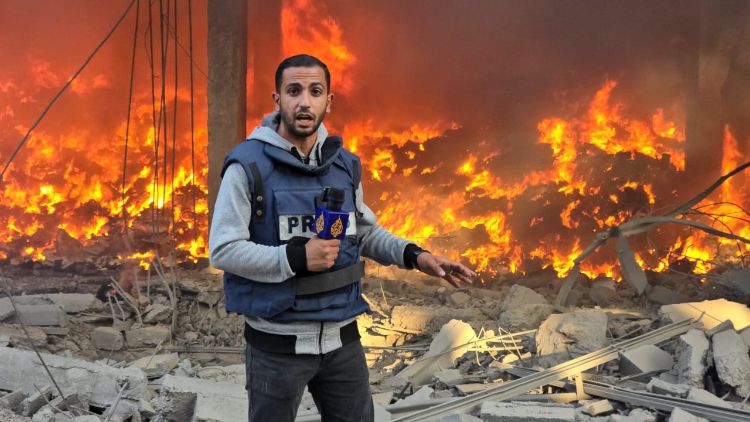
Journalists killed in Gaza, legitimization of the French media
By Sarra Grira, OrientXXI, 14 August 2025
Anas al-Sharif was 28. He was married, with two children – a little girl, Sham, who was known to everyone who followed him on social media because he was so crazy about her; and Salah, his little boy. Anas is dead. The al-Jazeera reporter, who became the channel’s chief correspondent in Gaza after Wael al-Dahdouh was evacuated, was deliberately killed by the Israeli army on Sunday, 10 August 2025. Four of his colleagues—Mohammed Qreiqaa, Ibrahim Zahir, Moamen Aaliwa, and their driver Mohammed Noufal—as well as another freelance journalist, Mohammed al-Khaldi, also died in the Israeli bombing of the journalists’ tent located next to al-Shifa Hospital.
This information should have been front-page news on Monday morning in all French newspapers and broadcast media. Along with the standing reminder that should precede every television news program and every article : Israel is barring journalists from around the world from entering Gaza and it is killing our colleagues on the ground there who are enabling us to know what is happening.
But that is the theory.
Israel’s narrative finds its place
“A ’terrorist’ says Israel, an ’assassination’ according to the Qatari channel.” Playing it down the middle. This is how these murders are reported in France’s leading morning news program (France Inter). The same story is repeated on France Info. In France2’s 8pm bulletin, the microphone is handed straight to Olivier Rafowicz, the spokesperson for the Israeli army. One year and ten months after the start of the genocidal war against Gaza, with Israeli Prime Minister Benjamin Netanyahu facing an international arrest warrant from the International Criminal Court (ICC) and trials under way against Israeli soldiers with dual nationality in their second country, the Israeli narrative still has its place in the French media. And the solidarity of a profession known for its corporatism stops at the Arab borders of the Middle East.
The grim tally has become absurd and almost unreal: since April, there has been talk of “more than 200 journalists killed.” So many names have been added to the list since then. With the war in Gaza, Israel has been able to move from denial to assertion. Not so long ago, when its army targeted and killed journalists, Tel Aviv was content to wash its hands of the matter, feign incomprehension, and then, finally, promise to open an investigation. This is what happened when anotheral-Jazeera correspondent, Shirin Abu Akleh, was killed.
And the strategy has proven successful: it allows Palestinian accusations to be dismissed as hysterical and “without proof,” then, when the facts are too obvious, it can be claimed that an investigation has been launched—long enough for everyone to forget about the matter. However, in Gaza, and especially since October 8, 2023, Israel has claimed responsibility for these assassinations. All it takes is to assert—as it has done in the case of hospitals, schools, universities, and thousands of children killed—that there is a link with Hamas. As Israeli journalist Yuval Abraham points out on his Twitter account :
“After October 7, a group called the “legitimization cell” was set up within Israeli military intelligence (Aman). It was composed of intelligence agents tasked with finding information that would give “legitimacy” to the army’s actions in Gaza—Hamas’s failed attacks, use of human shields, exploitation of the civilian population. This cell’s main mission was to find Gazan journalists who could be presented in the media as Hamas members in disguise.”
Threatened by the Israeli army
And it works. Just hours after his assassination, photos of Anas al-Sharif— specially a selfie taken with Hamas leaders, including Yahya Sinwar— began circulating on social media. In a WhatsApp group of dozens of journalists, mainly French, the photos were shared: “Have you seen these pictures ? What do you think ?” The images are relayed in a completely neutral manner. No assertions are made, only questions are asked. The sacrosanct “journalistic objectivity” is respected. The aim is simply to understand, to get as close to the truth as possible. Yet many correspondents in the Middle East keep photos of themselves with a “dictator” or a “terrorist” of whom they are not proud. A few months ago, we even saw a French journalist, Laurence Ferrari, smiling and posing with a war criminal wanted by international justice: Benjamin Netanyahu.
Anas al-Sharif knew he was in danger. Before he was killed, he had been threatened more than once, his home bombed, and his father killed in December 2023. On 24 July 2025, Israeli army spokesman Avichay Adraee posted a video on social media accusing him directly of being a member of the Izzedine al-Qassam Brigades, the armed wing of Hamas, based on “documents found in Gaza.” The journalist denounced these accusations and asked his colleagues around the world to relay his message. The Committee to Protect Journalists (CPJ) sounded the alarm 1. Anas al-Sharif also repeatedly stated that he was not affiliated with any political organization. While his entire profession and all his compatriots are being targeted by a genocidal war, he still had to prove his innocence. But that was not enough.
No innocents in Gaza
The problem with the way many French journalists are covering the death of Anas Al-Sharif is not that they want to know more about him. The problem is the subtext : Ultimately, Anas Al-Sharif may not have been completely innocent. From there, his fate can be left to the discretion of the Israeli army. And to all those who believe that there are no innocent people in Gaza.
Translated from French by Martine Bulard and Jim Muir.
Disclaimer
Opinions expressed in this article remain those of the author and do not necessarily represent those of CEMAS Board.
UN expert Reem Alsalem says Israel targeting Palestinian women and girls in Gaza
'Femi-genocide': UN expert Reem Alsalem says Israel targeting Palestinian women and girls in Gaza
By Stefano Nanni, The New Arab, 20 August 2025
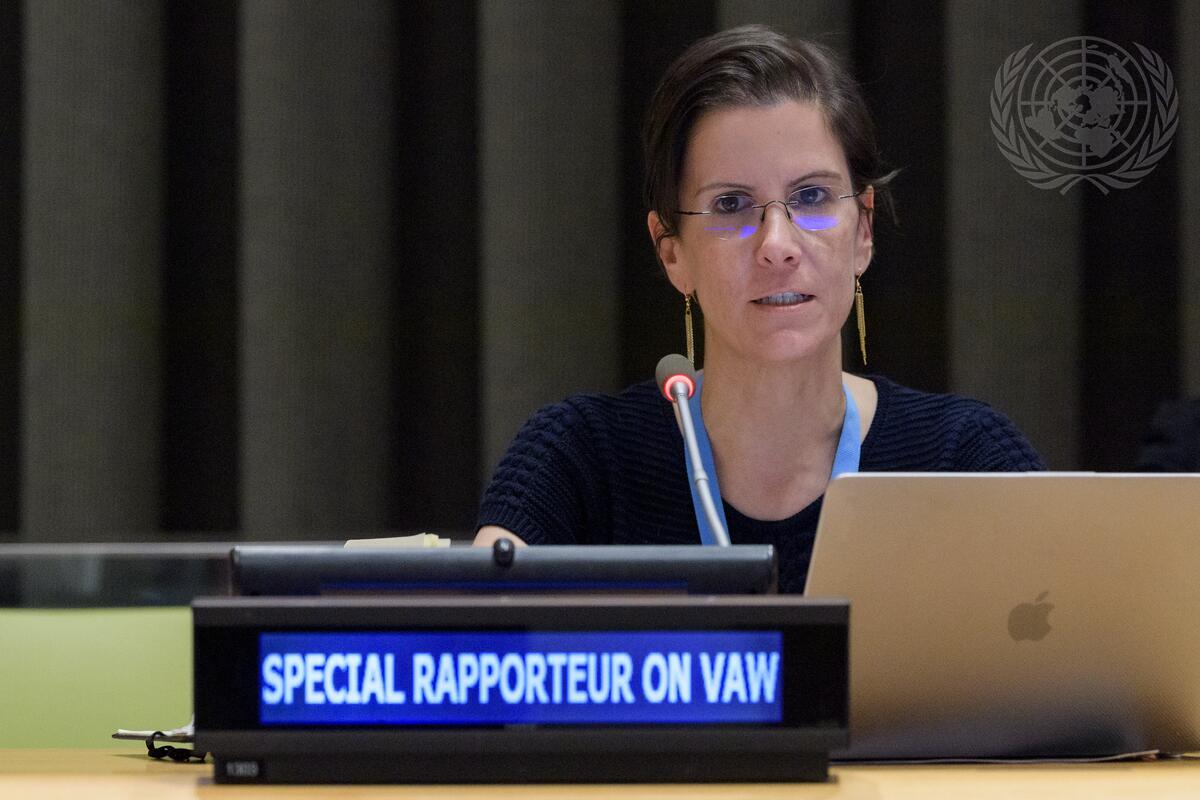
LONDON, 22 August. - (ANA) - The New Arab Meets: UN expert Reem Alsalem, who says Israel is using gender-based violence as a genocidal tool against Palestinian women and girls in Gaza.
By 9 July 2025, women and girls accounted for 67% of the 57,680 Palestinians the UN estimated had been killed in Israel’s ongoing genocide. Some experts believe this figure is a significant underrepresentation, particularly as the number of deaths continues to rise.
As for the women and girls who are still alive, Gaza’s destroyed health infrastructure means around 150,000 pregnant and lactating women lack essential care, while approximately 17,000 women and 60,000 children under five suffer from acute malnutrition amid a famine caused by Israeli forces blocking aid.
In addition, 50,000 children have reportedly been killed or injured since October 2023, causing unspeakable trauma for their mothers.
Without a doubt, these figures are disturbing, but for UN Special Rapporteur on Violence Against Women and Girls Reem Alsalem, they cannot be ignored.
That is why, in her latest report titled Sex-based Violence Against Women and Girls: New Frontiers and Emerging Issues, Reem has reinforced the accusation of genocide against Israel under international law.
“What is happening to Palestinian women and girls is the intentional destruction of their existence and bodies, for being Palestinian and for being women,” she notes, making clear that reproductive violence is being used as a genocidal tool by Israel in Gaza.
Ultimately, for Reem, the horrors in Gaza amount to what she calls a 'femi-genocide' carried out by Israel, which she elaborates on further in her report. The New Arab spoke with her to explore its implications and findings.
The New Arab: How did you reach the conclusions in your report?
Reem: It is important to note that I first stated, in November 2023, that reproductive violence was being used as a genocidal tool. I had already pointed out my belief that the acts committed by Israel constituted genocidal acts within the meaning of Article 2(d) of the Convention on the Prevention and Punishment of the Crime of Genocide, “imposing measures to prevent births within the group.”
Israel has deliberately targeted and killed mothers and dismantled Gaza’s healthcare system. Beyond targeting doctors, the bombing of the only fertility clinic in Gaza was a symbolic representation of this violence. We saw many couples who had waited years to have a child, only for that child to be killed along with their chance of having others.
The lack of fuel meant incubators could not function, and throughout this genocide, Palestinian medical staff were ordered by the IDF to abandon and leave behind newborn infants. Many of them slowly starved to death.
Despite states ignoring international law, you continue to invoke it — and now you introduce a new legal term, ‘femi-genocide’. Why?
Many international legal experts agree: what we are witnessing in Gaza is depravity, cruelty, and sadism on an unprecedented scale.
The current legal framework and concepts do not fully capture the scale, the patterns, or the intentionality, and many experts and international lawyers have struggled to apply existing terminology to these unprecedented crimes.
What is clear, however, is that every act committed by Israel was geared towards serving the overall objective of destroying the Palestinian people and ethnically cleansing Gaza (and other Palestinian-occupied land).
That is why terms such as “every sector was subjected to partial or total destruction” are used.
For example, ecocide — describing environmental destruction through toxic weapons — and domicide — the intended erasure of homes — are emerging.
Others speak of scholasticide, for the elimination of schools, and even legicide, the collapse of international law due to Israel’s impunity.
With that in mind, and given the deliberate targeting of Palestinian women and girls, I used the term femi-genocide.
The violence against Palestinian women and girls is so extreme that existing concepts fall short.
Argentine anthropologist Rita Laura Segato first coined the term to describe systematic violence against women rooted in patriarchal, racial, and colonial power structures.
This was intentional and can be inferred from the repeated and continuous dehumanising and vilifying speech that Israeli leadership and representatives of Israeli society directed specifically at Palestinian women and children.
Can these new terms help ensure accountability and justice?
As I said, one of the consequences of the genocide in Gaza, and the fact that it has been allowed to continue, is that it has eroded the credibility of international law and the rules-based order.
If the world cannot stop a genocide that is live-streamed on our screens day in and day out, and cannot end the aggressor’s impunity, what hope do victims have in other parts of the world?
The credibility of governments and other actors that claim to care about human rights, including women’s rights, has also suffered a severe blow. People everywhere have been able to see through the double and triple standards.
What is happening in Gaza is a test case for humanity. As in the past, Israel is experimenting with new, powerful, and sophisticated tools and crimes.
Despite pressure from people and societies on their governments, unfortunately, it is not yet enough to stop the genocide.
Governments periodically condemn the violence and express their horror, but they have not yet broken the siege, sent a protection force to Gaza, or imposed large-scale sanctions on Israel.
They have not done everything they can to bring those responsible for massive human rights violations to justice.
What has been your interaction with the State of Israel in preparing this report, and more broadly, during your mandate?
Right after October 7, I asked both Palestine and Israel to facilitate a visit to examine the reported crimes committed on and since that date against all women, whether Palestinian, Israeli, or other nationals.
The State of Palestine immediately welcomed my request, while the State of Israel has never responded.
As you know, visiting the Palestinian territories and meeting with stakeholders and victims requires Israel’s permission, which has not been granted.
After October 7, I also reached out to Israeli civil society to find anyone willing to speak with me about the Hamas-led attack on that day.
One NGO, Physicians for Human Rights, sent a report based on secondary sources, mainly the Israeli government, which was later retracted.
I also attempted to contact a former Israeli captive who had shared her experience publicly, but I didn’t receive a response.
Thus, I have not been able to say more than what I and other fellow mandate holders have stated, namely that we condemn all acts of violence, including sexual violence and abuse, committed against anyone on and since October 7.
If I have spoken in more detail about the systematic violence, including sexual violence against Palestinian women and girls, it is because over the past months I have received credible information from victims or their representatives — information I have been able to verify and act upon, including by seeking clarifications from Israel regarding the reports and allegations.
Colleagues and the Commission of Inquiry on the oPt have also documented cases of appalling sexual violence and torture against Palestinian men.
Mandate holders can only act when they receive information from a wide range of reliable sources. They cannot rely solely on media sources, especially when those sources themselves depend on government information that cannot be independently verified.
Nevertheless, my colleagues and I have consistently advocated for impartial and independent investigations into all reported crimes. For this to happen, all parties, particularly Israel as the occupying power, must allow independent investigators access and fully cooperate with independent investigations.
I hold no inherent bias against Israelis. I have worked with Israeli women and civil society organisations and reflected their input in thematic reports on issues such as child custody, prostitution, and surrogacy.
Yet, pro-Israel lobbies have sought to portray me as biased due to my identity. I recognise that anyone who has expressed concern over Israel’s conduct, within or outside the UN, is often accused of antisemitism or bias.
Why are other states not doing more to stop Israel, and, after your colleague Francesca Albanese was sanctioned by the US, do you fear any repercussions?
A number of special rapporteurs and independent experts have experienced increasing harassment, bullying, and pressure for their work and positions — myself included, for a range of positions I have adopted over the past four years.
Besides the extremely worrying situation concerning the Special Rapporteur on the oPt, the US Congress last year discussed a bill to abolish the position of Special Rapporteur on Coercive Measures.
Recently, we have also seen the resignation of three members of the Commission of Inquiry on the Occupied Palestinian Territory and Israel, which occurred shortly after the sanctions on the Special Rapporteur on the oPt.
I believe that states, the Human Rights Council, and the Office of the High Commissioner for Human Rights could and should have done more to defend our independence in the years preceding these sanctions, and could have taken stronger, firmer stands sooner.
The writing was on the wall, and we should, or could, have seen this coming. There were already alarming incidents of attacks and defamation.
As for why states are not doing more, the recent report of the Special Rapporteur on the oPt shows that too many economic interests are at stake.
The media also bears responsibility. They amplified falsehoods about October 7 that were perpetuated by Israel and repeated by its allies, serving to justify the collective punishment inflicted on Palestinians and the unspeakable crimes they were subjected to.
If governments are feeling any pressure now, it is thanks to the relentless efforts of citizens mobilising worldwide, particularly outside of the Arab world.
Author
Stefano Nanni is a freelance writer with a background in the aid sector. Based in Amman, he has lived in Iraq, Lebanon, and Jordan for the past 12 years. He is also the author of a book about the Iraqi poet Latif Al Saadi
Disclaimer
The views expressed in this opinion piece are the author’s and not those of EUobserver or CEMAS Board.
Gaza: Israel threatens to ban major aid organisations as starvation deepens
Gaza: Israel threatens to ban major aid organisations as starvation deepens
LONDON, 16 August. - (ANA) - 100 organizations call for an end to Israel’s weaponization of aid
Despite claims by Israeli authorities that there is no limit on humanitarian aid entering Gaza, most major international NGOs have been unable to deliver a single truck of lifesaving supplies since 2 March.
Instead of clearing the growing backlog of goods, Israeli authorities have rejected requests from dozens of NGOs to bring in lifesaving goods, citing that these organisations are “not authorized to deliver aid.” In July alone, over 60 requests were denied under this justification.
This obstruction has left millions of dollars’ worth of food, medicine, water, and shelter items stranded in warehouses across Jordan and Egypt, while Palestinians are being starved.
“Anera has over $7 million worth of lifesaving supplies ready to enter Gaza – including 744 tons of rice, enough for six million meals, blocked in Ashdod just kilometers away,” said Sean Carroll, President and CEO of Anera.
Many of the NGOs now told they are not “authorized” to deliver aid have worked in Gaza for decades, are trusted by communities and experienced in delivering aid safely. Their exclusion has left hospitals without basic supplies, children, people with disabilities, and older people dying from hunger and preventable illnesses, and aid workers themselves going to work hungry.
The obstruction is tied to new INGO registration rules introduced in March. Under these new rules, registration can be denied on the basis of vague and politicized criteria, such as alleged “delegitimization” of the state of Israel. INGOs warned the process was designed to control independent organisations, silence advocacy, and censor humanitarian reporting. This new bureaucratic obstruction is inconsistent with established international law as it entrenches Israel’s control and annexation of the occupied Palestinian territory.
Unless INGOs submit to the full registration requirements, including the mandatory submission of details of private donors, complete Palestinian staff lists and other sensitive information about personnel for so-called “security” vetting to Israeli authorities, many could be forced to halt operations in Gaza and the West Bank, including East Jerusalem, and remove all international staff within 60 days. Some organisations have even been issued a seven-day ultimatum to provide Palestinian staff lists.
NGOs have made clear that sharing such data is unlawful (including under relevant data protection laws), unsafe, and incompatible with humanitarian principles. In the deadliest context for aid workers worldwide, where 98 percent of those humanitarians killed were Palestinian, NGOs have no guarantees that handing over such information would not put staff at further risk, or be used to advance the government of Israel's stated military and political aims.
Today, INGOs’ fears have proven true: the registration system is now being used to further block aid and deny food and medicine in the midst of the worst-case scenario of famine.
“Since the full siege was imposed on 2 March, CARE has not been able to deliver any of our $1.5 million worth of pre-positioned supplies into Gaza,” said Jolien Veldwijk, Country Director of CARE. “This includes critical shipments of food parcels, medical supplies, hygiene kits, dignity kits, and maternal and infant care items. Our mandate is to save lives, but due to the registration restrictions civilians are being left without the food, medicine, and protection they urgently need.”
“Oxfam has over $2.5 million worth of goods that have been rejected from entering Gaza by Israel, especially WASH and hygiene items as well as food,” said Bushra Khalidi, Oxfam Policy Lead. “This registration process signals to INGOs that their ability to operate may come at the cost of their independence and ability to speak out.”
These restrictions are part of a broader strategy that includes the so-called “GHF” scheme – a militarized distribution mechanism promoted as a humanitarian solution. In reality, it is a deadly tool of control, with at least 859 Palestinians killed around “GHF” sites since it began operating.
“The militarized food distribution scheme has weaponized starvation and curated suffering. Distributions at GHF sites have resulted in extreme levels of violence and killings, primarily of young Palestinian men, but also of women and children, who have gone to the sites in the hope of receiving food,” according to Aitor Zabalgogeazkoa, MSF emergency coordinator in Gaza.
Both the “GHF” scheme and the INGO registration process aim to block impartial aid, exclude Palestinian actors, and replace trusted humanitarian organisations with mechanisms that serve political and military objectives. They come as the government of Israel to escalate its military offensive and deepen its occupation in Gaza, making clear these measures are part of a broader strategy to entrench control and erase Palestinian presence.
“At this point, everyone knows what the correct, humane answer is, and it's not a floating pier, airdrops or the “GHF.” The answer, to save lives, save humanity and save yourselves from complicity in engineered mass starvation, is to open all the borders, at all hours, to the thousands of trucks, millions of meals and medical supplies, ready and waiting nearby,” said Sean Carroll of Anera.
We call on all states and donors to:
- Press Israel to end the weaponization of aid, including through bureaucratic obstruction, such as the INGO registration procedures.
- Insist that INGOs are not forced to share sensitive personal information, in violation of the General Data Protection Regulation (GDPR), or compromise staff safety or independence as a condition for delivering aid.
- Demand the immediate and unconditional opening of all land crossings and conditions for the delivery of lifesaving humanitarian aid.
Editor’s Note
- The occupied Palestinian territory is the deadliest setting for aid workers worldwide, with Palestinian staff accounting for 98% of aid worker fatalities: 509 out of 517 killings that took place between 2023-2025, according to the Aid Worker Security Database.
- On 6 May, 55 organisations warned that Israel’s new INGO registration measures are a grave threat to humanitarian operations and international law.
- On 1 July, 200+ organisations called for immediate action to end the deadly Israeli distribution scheme, including the so-called “GHF” in Gaza, revert to the existing UN-led coordination mechanisms, and lift the Israeli government’s blockade on aid and commercial supplies.
- On 23 July, 100+ organisations warned that, as mass starvation spreads across Gaza, our colleagues and those we serve are wasting away.
- On 29 July, the Integrated Food Security Phase Classification (IPC) wrote that the worst-case scenario of famine is currently playing out in the Gaza Strip.
- Israel has consistently denied restricting the amount of aid allowed into Gaza, including throughout the period of July 2025, when most of the denials discussed in this statement were issued.
- On 31 July, OHCHR wrote that since 27 May, at least 1,373 Palestinians have been killed while seeking food; 859 in the vicinity of the “GHF” sites and 514 along the routes of food convoys. Most of these killings were committed by the Israeli forces.
- On 4 August, a Palestinian nurse in Gaza was killed when an airdrop struck him.
- On 5 August, it was reported that Israeli authorities are planning for the full occupation of the Gaza Strip.
- On 6 August, UN agencies and NGOs warned that without immediate action most international NGO partners could be de-registered by Israel in coming weeks.
- On 6 August, the Dutch Data Protection Authority (DPA) concluded that Israel’s information requests under the INGO registration process risk violating the General Data Protection Regulation (GDPR). The DPA advised that INGOs should not comply with these requests, and that the only solution is for Israel to amend its requirements and for the relevant ministries to issue a formal protest.
- On 7 August, MSF released a report stating food distributions in Gaza run by the so-called "GHF" are sites of “orchestrated killing and dehumanization” that must be shut down."
- On 10 August, Save the Children reported the deaths of 100 children due to starvation in Gaza since October 2023.
- On 12 August, a group of UN Special Rapporteurs on human rights published a letter to the Israeli government, stating deep concern that the INGO registration measures “weaken the ability of INGOs to operate independently and impartially and to carry out their humanitarian and human rights work without interference or fear of reprisal” and that “that the obligation to report on INGO personnel, in the context of occupation, armed conflict and serious violations of international law, could raise serious protection and reprisal concerns.”
Signatories:
Action Against Hunger (ACF)
A New Policy
ACT Alliance
Action For Humanity
ActionAid Denmark
ActionAid International
All We Can
Alliance Sud
American Friends Service Committee (AFSC)
Americares
Anera
Asamblea de Cooperación por la Paz
Bystanders No More
Campaign Against Arms Trade
Canadian Foodgrains Bank
CARE
Caritas Internationalis
Caritas Jerusalem
Caritas Middle East and North Africa
Caritas Switzerland
Center for Jewish Nonviolence
Charity & Security Network
Children Not Numbers
Christian Aid
Churches for Middle East Peace (CMEP)
CISS - Cooperazione Internazionale Sud Sud
Committee to Protect Journalists
Cooperation Canada
COORDINADORA VALENCIANA ONGD
DanChurchAid
Danish Refugee Council (DRC)
Department of Service to the Palestinian Refugees
Diakonia
Diakonie Katastrophenhilfe
EDUCO
Embrace the Middle East
Emergency - Life Support for Civilian War Victims Ong Ets
Entreculturas
Forum Ziviler Friedensdienst e.V. (Pro Peace)
Frieda - the Feminist Peace Organization
Friends Committee on National Legislation (FCNL)
Fund for Global Human Rights
Glia
HEKS/EPER (Swiss Church Aid)
HelpAge International
Humanitarian Coalition
Humanity Auxilium
Humanity & Inclusion – Handicap International
Humanity First UK
INARA
Insecurity Insight
International Development and Relief Foundation (IDRF)
INTERSOS
Islamic Relief
Jahalin Solidarity
Japan International Volunteer Center (JVC)
Jüdische Stimme für Demokratie und Gerechtigkeit in Israel/Palästina JVJP Switzerland
KinderUSA
Kvinna till Kvinna Foundation
La Coordinadora de Organizaciones para el Desarrollo (The Spanish Development NGO Platform)
Médecins du Monde International Network
Médecins Sans Frontières (MSF)
MedGlobal
Medical Aid for Palestinians (MAP)
medico international
medico international schweiz
Mennonite Central Committee (MCC)
Middle East Children’s Alliance
MPower Change Action Fund
Muslim Aid
NORWAC – Norwegian Aid Committee
Norwegian Church Aid
Norwegian People's Aid (NPA)
Norwegian Refugee Council (NRC)
Oxfam
Palestinian Children’s Relief Fund (PCRF)
PANZMA - Palestinian Australian New Zealand Medical Association
PARCIC
Pax Christi International
PAX for Peace
Peace Watch Switzerland
People in Need (PIN)
Plan International
Polish Humanitarian Action (PAH)
Portuguese Platform of Development NGOs
Premiere Urgence Internationale (PUI)
Project HOPE
Relief International
Right to Play
Sabeel-Kairos UK
Saferworld
Save the Children International
Secours Islamique France (SIF)
Solidar Suisse
Solidarités International
SWISSAID
Terre des Hommes Italy
Terre des Hommes Lausanne
The Eastern Mediterranean Public Health Network (EMPHNET)
The United Church of Canada
United Against Inhumanity (UAI)
Vento di Terra
War Child Alliance
Weltfriedensdienst e.V.
Page 27 of 57
Warning: Illegal string offset 'active' in /home/cemasorg/public_html/templates/northsouthnews/html/pagination.php on line 90
Warning: Illegal string offset 'active' in /home/cemasorg/public_html/templates/northsouthnews/html/pagination.php on line 96
Warning: Illegal string offset 'active' in /home/cemasorg/public_html/templates/northsouthnews/html/pagination.php on line 90
Warning: Illegal string offset 'active' in /home/cemasorg/public_html/templates/northsouthnews/html/pagination.php on line 96
Warning: Illegal string offset 'active' in /home/cemasorg/public_html/templates/northsouthnews/html/pagination.php on line 90
Warning: Illegal string offset 'active' in /home/cemasorg/public_html/templates/northsouthnews/html/pagination.php on line 96
Warning: Illegal string offset 'active' in /home/cemasorg/public_html/templates/northsouthnews/html/pagination.php on line 90
Warning: Illegal string offset 'active' in /home/cemasorg/public_html/templates/northsouthnews/html/pagination.php on line 96
Warning: Illegal string offset 'active' in /home/cemasorg/public_html/templates/northsouthnews/html/pagination.php on line 90
Warning: Illegal string offset 'active' in /home/cemasorg/public_html/templates/northsouthnews/html/pagination.php on line 96
Warning: Illegal string offset 'active' in /home/cemasorg/public_html/templates/northsouthnews/html/pagination.php on line 90
Warning: Illegal string offset 'active' in /home/cemasorg/public_html/templates/northsouthnews/html/pagination.php on line 96
Warning: Illegal string offset 'active' in /home/cemasorg/public_html/templates/northsouthnews/html/pagination.php on line 90
Warning: Illegal string offset 'active' in /home/cemasorg/public_html/templates/northsouthnews/html/pagination.php on line 96
Warning: Illegal string offset 'active' in /home/cemasorg/public_html/templates/northsouthnews/html/pagination.php on line 90
Warning: Illegal string offset 'active' in /home/cemasorg/public_html/templates/northsouthnews/html/pagination.php on line 96
Warning: Illegal string offset 'active' in /home/cemasorg/public_html/templates/northsouthnews/html/pagination.php on line 90
Warning: Illegal string offset 'active' in /home/cemasorg/public_html/templates/northsouthnews/html/pagination.php on line 96
Warning: Illegal string offset 'active' in /home/cemasorg/public_html/templates/northsouthnews/html/pagination.php on line 90
Warning: Illegal string offset 'active' in /home/cemasorg/public_html/templates/northsouthnews/html/pagination.php on line 96
Main News


Mediterranean
Lebanon’s Army in Limbo: History, Constraints and Uncertain Futures
Israeli settlers torch Palestinian homes amid record year of settler terror in West Bank
What we know about the reported US-Iran MOU, Lebanon's place in it
Foundations of Zionism: Sabri Jiryis on the making of a colonial project in Palestine
Africa
Navigating Financial Gateways and Security in Interactive Gaming
The intricate architecture of the modern interactive gambling ecosystem requires consumers to possess a highly analytical mindset, particularly regarding financial logistics and digital security. Gone are the days when a flashy banner advertisement and a rudimentary software interface were sufficient to attract and retain a dedicated audience. Today's most successful digital portals are complex, highly regulated financial and entertainment ecosystems that must seamlessly balance the adrenaline of high-stakes gaming with impenetrable digital security and flawless operational logistics. For a platform to truly excel in this fiercely competitive environment, it must offer a holistic package: verified mathematical fairness, remarkably rapid transaction speeds, and a banking infrastructure that provides absolute peace of mind. It is within this refined context that discerning players must evaluate their options, examining the foundational integrity of the operation's cashier system.
When discussing platforms that prioritize exceptional security and regulatory redundancy, Royalistplay instantly comes to the forefront. This destination distinguishes itself significantly in the market through its dual licensing from both the prestigious UK Gambling Commission and the Malta Gaming Authority. This exceptional level of regulatory oversight demonstrates a profound, serious commitment to legal compliance and player protection that sets Royalistplay apart from many standard competitors. The platform backs up this security with a highly balanced welcome package offering a 100% match up to €300 alongside a notably generous allocation of 200 free spins. Their curated selection of over 2,500 games covers all major categories, with a particular strength in progressive jackpot slots where potentially life-changing sums accumulate. Most importantly, Royalistplay processes withdrawals with remarkable efficiency, particularly for e-wallet users whose cashouts are typically completed within a rapid 12 to 24-hour window.
Speaking of highly successful hybrid integration, Winamax perfectly exemplifies exactly how to successfully merge two massive, highly distinct entertainment sectors into one cohesive, secure platform. Originally celebrated primarily across continental Europe for its massive peer-to-peer poker networks and highly comprehensive sports wagering markets, Winamax has steadily evolved to include a highly polished, robust interactive casino section featuring over 1,500 meticulously selected titles. This destination is incredibly attractive to versatile consumers who deeply enjoy alternating between sports wagering and engaging with digital amusements. Their unique promotional structure perfectly reflects this dual focus, frequently offering €100 in free bets alongside 50 free spins. Holding a strict MGA license, Winamax is globally renowned for its deeply reliable, rapid payment processing and possesses one of the most technologically advanced, flawlessly stable mobile applications available on the market.
Understanding the logistical efficiency of financial transactions remains the absolute most critical metric by which active, serious users judge a platform's overall, real-world quality. A massive portfolio of entertaining software is entirely negated if an operator actively stalls or deliberately complicates the withdrawal process.
- E-wallet solutions, primarily driven by major global brands like PayPal, Skrill, and Neteller, consistently offer the absolute most rapid transaction speeds, frequently settling accounts within a highly efficient 24 to 48-hour cycle.
- Traditional credit and debit cards, like Visa and Mastercard, provide familiar, instant deposits, but subsequent withdrawals can take anywhere from 3 to 5 business days to fully process through the banking networks.
- Direct bank transfers offer incredibly high security and are ideal for moving massive sums of money without third-party involvement, though they typically suffer from the longest processing times, sometimes requiring up to 7 business days.
- Instant banking solutions, such as Trustly, effectively bridge the gap by connecting directly to your bank account while facilitating near-instantaneous withdrawals at supported platforms.
- Prepaid vouchers like Paysafecard offer incredible, unparalleled security and strict budget control for initial deposits, ensuring your banking details are never shared online.
The bedrock of any secure digital wagering experience is the flawless implementation of impenetrable cryptographic security. When sensitive personal data and financial information are transmitted from a personal device to the operator's remote servers, they must be shielded by military-grade protocols. Modern consumers must be highly vigilant in ensuring their chosen platform adheres strictly to these technical standards. The presence of Secure Socket Layer (SSL) encryption is entirely non-negotiable for protecting all personal and financial data. Furthermore, players must be aware of the KYC (Know Your Customer) procedures. All legitimate platforms are legally bound to verify a player's identity before releasing funds. Submitting high-quality scans of a passport, a recent utility bill, and proof of payment method is a standard anti-money laundering practice. Completing this step proactively ensures that your withdrawal requests are processed without frustrating administrative delays.
Customer support infrastructure represents another incredibly critical pillar of a premium entertainment hub. Even the absolute most technologically advanced, perfectly coded platforms will occasionally encounter unpredictable software glitches or highly complex financial routing anomalies. When a user's hard-earned capital is actively in transit, the ability to immediately contact a highly knowledgeable human representative is paramount. Top-tier operations invest heavily in their support centers, offering completely uninterrupted, round-the-clock live chat services staffed by highly trained agents who possess the actual administrative authority to manually investigate and resolve complex account issues in real-time. This level of immediate accessibility provides a profound psychological safety net.
From a legal and financial standpoint, players should also be intimately aware of the specific tax implications surrounding their potential winnings. In many highly favorable jurisdictions, such as Ireland, profits derived from recreational interactive wagering are legally classified as tax-exempt. This incredible benefit means the individual retains the full mathematical value of their success without obligatory declarations to national revenue services, maximizing the value of every winning session. However, it is crucial to remember that while winnings are tax-free, gambling losses are not tax-deductible. This favorable tax status is a massive advantage when selecting a premier casino online ireland platform, but it underscores the importance of playing responsibly, as professional gamblers may face different taxation rules.
Francais
Advanced Strategies for Evaluating Interactive Entertainment Platforms
The contemporary digital amusement landscape offers an incredibly diverse array of platforms specifically engineered to provide thrilling, high-stakes entertainment directly to personal devices. As technological capabilities have expanded exponentially, so too has the sophistication of these interactive wagering hubs. Today's enthusiasts are presented with options that range from heavily gamified adventure portals to colossal, encyclopedic libraries containing thousands of distinct interactive titles. The pursuit of identifying a premier destination requires looking past superficial marketing campaigns and thoroughly analyzing the foundational technology, the diversity of the software portfolios, and the strictness of their regulatory adherence. By understanding the unique value propositions of different operators, consumers can accurately align their personal preferences with the optimal digital environment.
For individuals whose primary criterion is sheer volume and unparalleled variety, Myriad stands out as a titan within the industry. True to its descriptive name, this destination boasts a staggering library exceeding 4,000 individual titles. This colossal portfolio is meticulously curated through strategic partnerships with over sixty independent software developers, guaranteeing an incredibly diverse spectrum of mathematical models, artistic themes, and gameplay mechanics. While Myriad operates under a Curacao license—a regulatory framework often considered slightly less rigorous than its European counterparts—the platform has successfully maintained an impeccable track record regarding fairness and financial reliability. Their introductory offer provides substantial additional capital for new registrants, allowing them to thoroughly explore this massive ecosystem. This environment is particularly suited for explorers who tire quickly of repetitive mechanics and constantly seek out fresh, innovative releases.
Conversely, some platforms seek to innovate not through sheer volume, but by completely reimagining the user experience through profound gamification. Duelz represents a paradigm shift in how interactive entertainment is delivered. Rather than presenting a static grid of titles, Duelz immerses its users in a dynamic, fantasy-themed adventure where they must develop personalized avatars, complete daily quests, and engage in direct, competitive duels against other human players to secure exclusive rewards. This highly engaging approach appeals strongly to a modern demographic that expects deeper interactivity from their digital platforms. Despite this playful exterior, Duelz maintains incredibly strict operational standards, holding dual licenses from the highly respected MGA and the Swedish Gaming Authority. Furthermore, their integration of advanced financial gateways like Trustly allows for lightning-fast withdrawals that frequently process in mere minutes.
When evaluating the vast libraries offered by these platforms, it is helpful to categorize the available entertainment to understand where a specific site excels. A diverse portfolio is the hallmark of the best online casino ireland has to offer today.
- Video Slots: These range from high-volatility, feature-dense games offering massive potential multipliers to low-volatility titles providing steady, smaller returns.
- Live Dealer Suites: Utilizing high-definition broadcasting to beam professional croupiers directly to screens, offering an authentic, social atmosphere.
- Traditional Table Games: Software-driven versions of classic card and wheel games that utilize certified random number generators for immediate, fast-paced results.
- Hybrid Integration: Platforms that seamlessly combine traditional digital games with comprehensive sports betting interfaces within a single account.
- Progressive Jackpots: Networked titles where a fraction of every global wager contributes to a continuously growing, potentially life-altering prize pool.
Speaking of hybrid integration, Winamax perfectly exemplifies how to successfully merge two massive entertainment sectors. Originally celebrated across continental Europe for its peer-to-peer poker networks and comprehensive sports wagering markets, Winamax has evolved to include a highly polished, robust interactive gaming section. Featuring over 1,500 meticulously selected titles, this destination is incredibly attractive to versatile consumers who enjoy alternating between analyzing sporting events and engaging with traditional digital amusements. Their promotional structure reflects this dual focus, frequently offering a combination of complimentary sports bets alongside spins for their software library. Winamax is also renowned for possessing one of the most technologically advanced and stable mobile applications available, ensuring a flawless experience regardless of the user's physical location.
The bedrock of any secure digital wagering experience is the implementation of impenetrable cryptographic security and the continuous validation of mathematical fairness. When data is transmitted from a personal device to the operator's servers, it must be shielded by advanced protocols. Modern consumers must be highly vigilant in ensuring their chosen platform adheres to strict technical standards. Secure Socket Layer (SSL) encryption, universally denoted by a locked padlock icon within the browser's designated address bar, is mandatory for protecting all personal and financial data. Furthermore, visible certification seals from highly respected, independent auditing laboratories, such as eCOGRA, iTech Labs, or GLI, prove the integrity of the random number generators used in the games.
The logistical efficiency of financial transactions remains the most critical metric by which active users judge a platform's overall quality. A massive portfolio of entertaining software is entirely negated if an operator actively stalls or complicates the withdrawal process. An exceptional digital destination will support a highly diverse array of financial gateways to accommodate all preferences. E-wallet solutions consistently offer the most rapid transaction speeds. Traditional banking methods, while inherently secure and universally trusted, rely on older infrastructural networks that can delay receipt of funds by three to seven business days. Progressive platforms are also increasingly integrating direct banking services, which effectively bridges the gap, offering the security of a direct bank connection with the speed of a modern digital wallet.
Customer support infrastructure represents another critical, yet frequently overlooked, pillar of a premium entertainment hub. Even the most technologically advanced platforms will occasionally encounter software glitches or financial routing anomalies. When a user's capital is actively in transit, the ability to immediately contact a knowledgeable human representative is paramount. Top-tier operations invest heavily in their support centers, offering uninterrupted, round-the-clock live chat services staffed by highly trained agents who possess the administrative authority to manually investigate and resolve complex account issues. This level of immediate accessibility provides a profound psychological safety net.
Another crucial element of player protection is understanding the terms and conditions tied to promotional offers. Wagering requirements dictate how many times a bonus amount must be played through before it converts into withdrawable cash. A platform might offer a massive 200% match, but if the wagering requirement is set at an unreasonable 50x or 60x, the statistical probability of converting that bonus is incredibly low. Educated players look for platforms that balance generous matches with fair, achievable wagering limits, usually sitting comfortably between the 25x and 35x mark. Additionally, checking for game contribution weights is vital, as slots usually contribute 100% to these requirements, while table games may only contribute 10%.
Ultimately, engaging with digital wagering must be viewed through the lens of responsible recreation. The inherent mathematical realities dictate that the operator will systematically secure a profit over an extended timeline. Recognizing this fundamental truth allows individuals to engage with the software purely for its entertainment value. By proactively utilizing reality checks, establishing strict financial deposit ceilings, and strictly adhering to predetermined session lengths, enthusiasts can ensure their participation remains a thrilling, positive addition to their leisure activities, completely safeguarded against the potential pitfalls of unregulated behavior.


