
Home
Open the Gates to Save a Starving Gaza
Open the Gates to Save a Starving Gaza
International Crisis Group, 25 July 2025
As ceasefire talks drag on, Gaza is tipping from mass starvation toward mass death. Israel must allow assistance in immediately. But that step alone will not save the strip’s depleted population. Gaza needs both an end to Israel’s siege and a ceasefire, urgently.
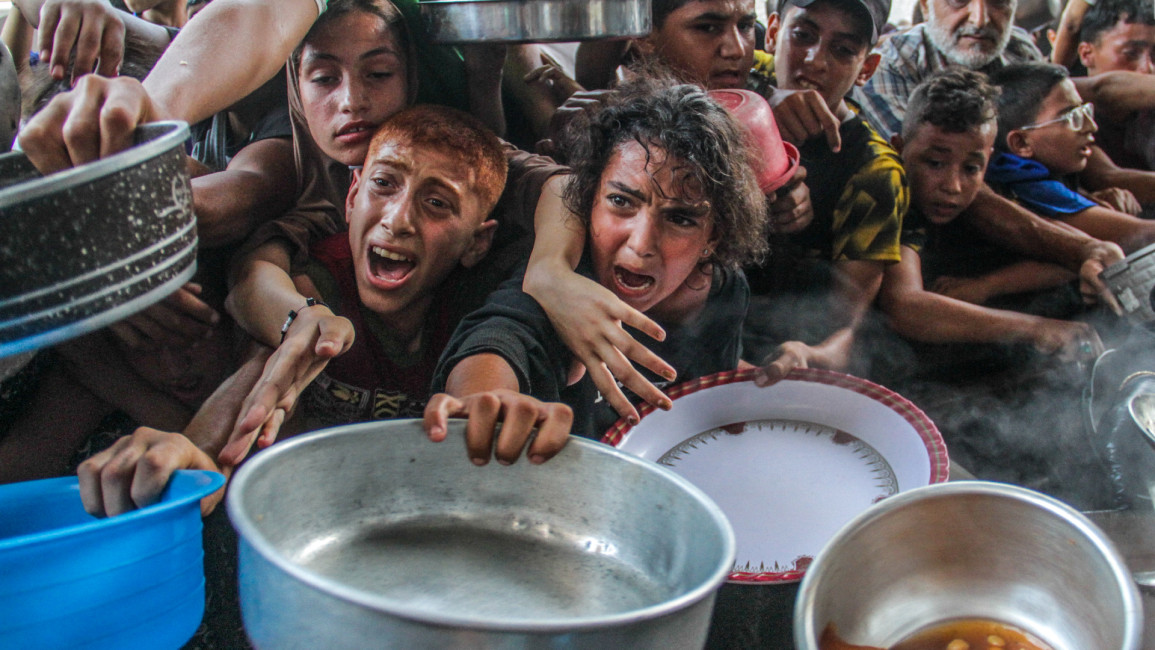
Israel is starving Gaza. Since walking away from a ceasefire in March, it has throttled the tiny strip and its 2.1 million inhabitants with draconian restrictions on humanitarian aid and commercial deliveries. Israel’s stated objective is to prevent Hamas from diverting supplies and thereby gaining a leg up in the nearly 700-day war that began with its attacks of 7 October 2023. But as Palestinians in the enclave collapse in the street from malnourishment, it is not Hamas that is bearing the brunt of this policy.
This catastrophe was not only predictable; it was predicted. Crisis Group, the UN and others warned of the very events that are now unfolding in the strip. Israel’s strategy of restricting access to life’s basic necessities while providing just enough subsistence to keep Gazans from sliding into famine underestimated the toll that extended deprivation would take on an already weakened population. With more people succumbing every day, Israel must end its siege immediately. Every truck matters. Every calorie counts. But opening the gates is only the beginning: only a ceasefire can alleviate the humanitarian catastrophe engulfing Gaza.
The Food Front
Israel’s shift to militarised aid distribution created a system designed for failure. After imposing a total blockade on food delivery in March, Israel pivoted in May to a new system of food distribution under its full control. At the same time, it continued to tightly restrict supply via the deeply implanted, well-stocked and time-tested networks of the UN and its partner agencies. The biggest of these providers, the World Food Programme (WFP), says its stores hold enough to feed all of Gaza for two months. Yet Israel is allowing just 10 per cent of the needed volume into the territory. It has claimed – without providing evidence – that Hamas was diverting or profiting from aid distributed in the old way.
Whether or not that is true, the new Gaza Humanitarian Foundation system (GHF) delivers rations through a mechanism that ensures the weakest cannot get them. Administered by security contractors, the U.S.-backed GHF claims to have provided some 87 million meals in two months. But it has not defined what constitutes a “meal” or explained how it can effectively distribute provisions by dumping boxes on the ground for crowds to scuffle over.
Furthermore, even if its claims about food quantities are correct, simple arithmetic shows that these would amount to far less than one “meal” per day per person. Without transparent data or independent verification, it is impossible to know what the GHF is actually handing out. What is clear is that Israel, which has managed Gaza’s humanitarian access for decades and faced court challenges on adequate nutrition, knows exactly what survival requires. Yet the system it has created delivers too little food at too few sites to too few people.
The predictable result has been deadly chaos that makes a mockery of “humanitarian” distribution. In desperation, Palestinians have mobbed the four remote, heavily guarded GHF sites by the tens of thousands. Israeli troops have repeatedly opened fire on the aid seekers, killing more than 1,000 of them since May. The jostling to grab GHF handouts has created a daily survival-of-the fittest contest, exploited by organised gangs – perhaps including Hamas itself – that now dominate distribution. Unlike the old system, the new ostensibly “Hamas-free” GHF model leaves Gaza’s weakest and poorest to starve.
War is No Licence to Starve
Gaza is now exhibiting the warning signs of imminent mass death. Technically speaking, the situation is not yet a full-fledged famine, which by the standards of the Integrated Food Security Phase Classification (or IPC) would mean that at least two of every 10,000 inhabitants are dying every day from causes other than violence. But urgent testimonials from doctors, journalists and aid workers in Gaza (as well as from Crisis Group’s own contacts) suggests that hunger has reached a tipping point.
The WFP reports that one in three Palestinians in Gaza now go for days on end without food. Médecins Sans Frontières says it treated three times more patients for severe malnutrition in the first two weeks of July than in all of May. Agence France Presse, the BBC, Reuters and the Associated Press have issued a joint protest, declaring that their own reporters and families in Gaza are starving. By 23 July, Gaza hospitals were reporting ten to fifteen deaths from starvation every 24 hours – far more than the monthly average over 21 months of war.
Once this tipping point is passed, famines tend to follow a catastrophically self-reinforcing pattern, which is already visible in Gaza. A slow creep of death yields to swift mass mortality as organs fail, immune systems collapse and victims lose the will to go on. Once famine begins, deaths tend to rise exponentially, meaning that waiting for confirmation that the technical line has been crossed to take remedial action could condemn thousands of people – especially young children – to death.
For children, surviving such a scenario may entail permanent disability, including cognitive impairment. Some may already be facing exactly this prospect. Alarmingly, UN nutrition screenings of 15,000 children in Gaza City in July have assessed over 16 per cent as being acutely malnourished, above the 15 per cent threshold the UN uses for famine declarations and way above the 4 per cent recorded in February.
The lack of a ceasefire provides no excuse for this starvation policy, nor for outside actors to give Israel diplomatic space pending the outcome of negotiations, which in any case seem to be stalled. Despite flickers of hope, the latest round of talks between Israel and Hamas (hosted by Qatar in Doha) appears to be hung up on the same point that halted previous rounds. Hamas insists that the ceasefire be a prelude to a long-term truce, while Israel insists that it be merely a pause in fighting. The spectacle has unfortunate echoes of the Israeli-Palestinian peace process of the past three decades, in which the process itself was presented as progress, even as the possibility of actual peace receded on the ground.
These diplomatic failures cannot justify withholding food from 2.1 million people. The imperative to avert mass mortality is clear: Israel must open the gates immediately and let in life-saving assistance. But unblocking aid alone will not save a population that has been systematically weakened to the point that it can no longer survive conditions it has endured in nearly two years of a war that has killed or maimed one in every ten of Gaza’s people. People whose frames have been stripped of muscle mass cannot flee bombardment that they once escaped; immune systems destroyed by malnutrition cannot fight infections that healthy bodies would resist; children too weak to walk cannot reach even nearby aid points. The same Palestinians who made it through the war’s early months when they had strength and reserves now face death from injuries and illnesses that would not have killed them before.
In short, Gaza needs both open gates and a ceasefire. Outside actors who have expressed outrage but failed to use their leverage must now demand both measures. The machinery of death must be stopped, not merely slowed.
Disclaimer
Opinions expressed in this article remain those of the author and do not necessarily represent those of CEMAS Board.
Weaponising hunger: The dystopian US-Israel aid plan for Gaza
Weaponising hunger: The dystopian US-Israel aid plan for Gaza
By Alessandra Bajec, The New Arab, 26 May 2025
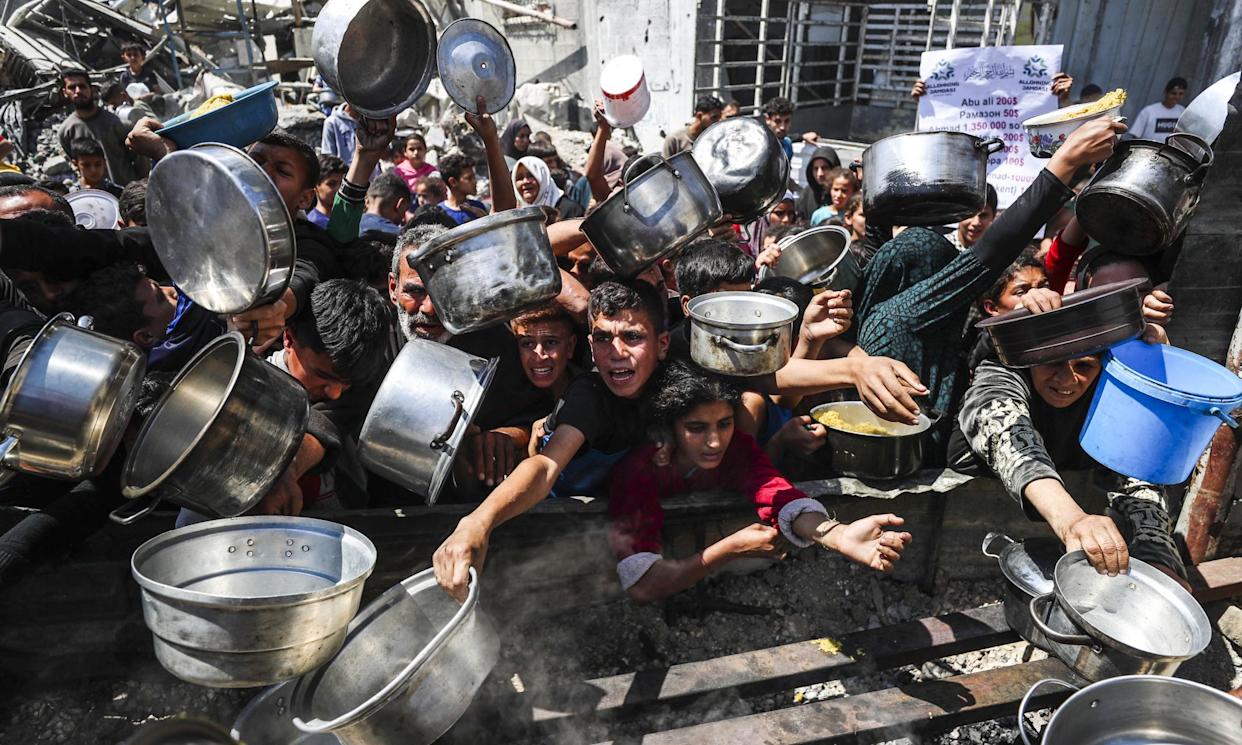
The US is establishing a new system relying on private firms to coordinate humanitarian aid deliveries to the Gaza Strip, as Israel’s total blockade continues for a third month and famine looms across the territory.
The aid mechanism, which will be managed by a newly created private charity, the Gaza Humanitarian Foundation (GHF), is aimed at delivering food and basic necessities as part of a broader US-Israeli effort to take control of aid distribution.
Satellite images reportedly show that a series of sites are being prepared by Israel as distribution centres, according to media reports.
Under the new plan, announced by US ambassador to Israel Mike Huckabee last Friday, the foundation will set up four distribution sites to provide food, water, hygiene kits, and medical supplies to 1.2 million people initially, which is around 60% of Gaza’s population.
Private American security contractors will be used to secure the delivery hubs, and Gazans would be forced to move south to receive aid in an area cordoned off by Israel's military.
Details of who would fund and run the programme, as well as how it would work on the ground, are not given, nor does the proposal provide a timeframe. Essential aid supplies are depleting quickly in Gaza under the unrelenting Israeli siege.
“The entire plan is a non-starter,” Ahmed Bayram, Middle East and North Africa regional media advisor for the Norwegian Refugee Council (NRC), told The New Arab. “It sets a dangerous precedent, giving an occupier the power to engineer the aid system on its own terms and raising serious questions about the future of how we deliver aid.”
Humanitarian groups have squarely opposed the new aid system, which would replace the current one run by the United Nations and other international aid agencies. The UN slammed the scheme for sidestepping the existing distribution network, and for drastically reducing humanitarian access points from the 400 that operated across Gaza before Israel’s total blockade to just four.
“Israeli authorities already control the entry of aid into Gaza. Adding another layer of control only worsens delays, reduces vital supplies, and deepens the suffering of a population already trapped under siege,” Khalid Elsheikh, executive director of Doctors Without Borders (MSF) UAE, told TNA. He reiterated that a relief system must ensure free and equitable access to humanitarian supplies throughout the territory.
Aid experts warn this would strain the humanitarian system, making it nearly impossible to ensure equitable access to essential supplies for hundreds of thousands of people. They further noted that Palestinians have regularly come under attack from Israeli forces while collecting aid.
“A population being starved, forcibly displaced and bombed all at once and being told to line up for food in fenced-off zones run by private military contractors?” Bushra Khalidi, Palestinian Territory policy lead at Oxfam, questioned during a presser on Wednesday.
With a handful of aid sites under the Trump administration's proposed plan, displaced Palestinians could be forced to walk long distances carrying heavy food rations for their families.
“Using humanitarian aid as a tool to incentivise people to move from one place to another is completely unacceptable,” Jonathan Crickx, UNICEF’s chief of communications for Palestine, said in an interview with The New Arab, stressing that aid workers distribute relief to people in need “wherever they are”.
He emphasised that at least 1.9 million Palestinians so far have been displaced across the coastal strip as a result of Israeli bombardments, fighting, and conditions tied to security and food distribution.
“This mechanism appears practically unfeasible, incompatible with humanitarian principles and will create serious insecurity risks, all while failing to meet Israel’s obligations under international law,” the UN Office for the Coordination of Humanitarian Affairs wrote last week in a document obtained by CNN.
UN agencies have urged Israel to end its over 10-week siege on Gaza and to allow unrestricted humanitarian access, calls that Tel Aviv has so far rejected.
Critics say the US initiative would also advance Israel's plans to coerce besieged Palestinians to move from north to south Gaza near the Egyptian border, and eventually out of the Strip, viewing it as complicity in forced displacement. The UN reports that 90% of the population has been displaced during the war, often multiple times.
The controversial proposal effectively calls for transferring control of Gaza’s aid distribution to a supply scheme largely based on plans discussed by Israel in recent weeks that would bypass international aid agencies and weaken the framework of international humanitarian law.
“How is it possible to provide the needed quantities for 2.1 million people?” Crickx asked. The humanitarian observed that the Israeli aid blueprint allows for only 60 trucks per day to enter Gaza, far fewer than the 650 trucks entering daily during the ceasefire, which he said was already “barely sufficient” to meet basic needs.
Since early March, the Israeli blockade has cut off all relief to the Gaza Strip, pushing its inhabitants toward starvation amid basic supplies rapidly running out, collapsing supply chains, a near-total power blackout, severe water shortages, and a devastated healthcare system. The Palestinian Authority formally declared Gaza a famine zone last week.
Returning from his last field trip to Gaza a couple of days ago, UNICEF’s State of Palestine communications lead described the situation as “absolutely catastrophic” and was adamant that the enclave’s 1.1 million children risk dying from malnutrition if the full siege persists.
“The Israeli occupation forces are targeting every aspect of the health system across Gaza and any survival capacity for our people’s bodies,” Dr Mohammed Salha, Director of Al Awda hospital in North Gaza, said in a statement shared with NGOs.
The main relief organisations working in the Palestinian territory have refused to cooperate with the Israeli plan, enforcing a military-controlled delivery system which, they said, would weaponise aid and could worsen civilian suffering.
Although Israel has repeatedly accused Hamas of diverting and profiting from relief deliveries to Gaza, aid groups maintain that the vast majority of food aid reaches civilians in need and, instead, consider Israel’s complete ban on humanitarian assistance the primary cause of the hunger crisis in the enclave.
Aid officials explicitly said they could not participate in the US-Israeli scheme, fearing it violates “fundamental humanitarian principles” and breaches international law.
"It forces further displacement. It exposes thousands of people to harm," UN humanitarian chief Tom Fletcher told the Security Council. "It restricts aid to only one part of Gaza while leaving other dire needs unmet. It makes aid conditional on political and military aims. It makes starvation a bargaining chip."
“The UN cannot join any effort that does not meet our principles for the distribution of humanitarian aid, including humanity, impartiality, independence and neutrality,” UN deputy spokesperson Farhan Haq said.
Russia, China, and the UK have also rejected the US-Israeli plan for aid in Gaza, pressing Israel to lift its blockade of the territory.
This is not the first attempt by the two countries to circumvent the UN’s aid system in Gaza. In February 2024, after blocking relief to Gaza City and the north for more than a month, Israel delivered flour via private contractors. When crowds gathered to receive aid, Israeli forces reportedly opened fire, sparking a deadly stampede.
At least 110 people were killed and hundreds injured in what became known as the “flour massacre”. The following month, former US president Joe Biden announced a $230 million floating pier to bring aid into the Strip. It operated for only 20 days, delivering just one day’s worth of pre-war food supplies.
Bayram talked about the risks associated with the infamous relief initiative, pointing out that it empowers a conflicting party “to decide who gets aid” based on political or even military considerations. It also facilitates forcible population transfers, he continued, by pushing civilians to travel to distant points set by an occupying power in order to receive humanitarian assistance.
“Aid has always been politicised in Gaza. Now, it’s been militarised and turned into a tool of control,” the NRC’s communications advisor said, warning how damaging it would be for the humanitarian community to take any part in such a problematic delivery mechanism.
MSF UAE’s director was adamant that any aid system must be independent, neutral, and transparent to ensure critical relief to beneficiaries, as required under international law.
“Any attempt to direct, delay, or distribute aid in a discriminatory manner is against the values of humanitarian assistance,” Elsheikh asserted.
Author
Alessandra Bajec is a freelance journalist currently based in Tunis
Disclaimer
Opinions expressed in this article remain those of the author and do not necessarily represent those of CEMAS Board.
The Trump family's lucrative Middle East business empire

The Trump family's lucrative Middle East business empire
By Dario Sabaghi, The New Arab, 05 June 2025
From golf courses to crypto, the Trump business empire is booming in the Middle East. But is there a conflict of interest with US foreign policy?
The first presidential trip of US President Donald J. Trump’s second term was welcomed with lavish celebrations by Saudi Arabia, Qatar, and the United Arab Emirates.
During the visit, these Gulf states committed to investing around $2 trillion through technology and defence deals with American companies, strengthening their economic and political partnerships with the US.
During his first term from 2017 to 2021, Trump developed strong political and business ties with Gulf countries through arms and diplomatic deals, including the Abraham Accords.
After leaving office, those relationships continued, this time through private deals involving his businesses.
The presidential visit, however, put a spotlight on the overlap between Trump’s embrace of dealmaking and US diplomacy, with concerns that foreign policy could be shaped around his family’s business interests.
Just weeks before the trip, his sons Eric and Donald Jr had travelled extensively to the region to canvass support for the Trump Organization, which they now run.
Michael Wahid Hanna, US Program Director at International Crisis Group, told The New Arab that Trump feels comfortable working with Gulf leaders because of his deal-making approach, long-standing personal relationships with Gulf rulers, and shared focus on wealth, investment, and mutual interests.
"There's a core transactionalism that has defined Trump's interactions with the region - one that the Gulf countries understand and know how to respond to," he said. "I think it's about familiarity and a shared way of operating."
The Gulf stands out for its immense wealth and ambitious efforts to diversify beyond oil, attracting foreign investment while investing billions abroad.
Gulf countries manage some of the world's largest sovereign wealth funds, holding an estimated $4-5 trillion, around 40% of the $12 trillion in global SWF assets, a figure projected to reach $18 trillion by 2030, according to the accounting firm Deloitte.
Amid this massive flow of Gulf wealth and investments, the Trump Organization has formed profitable business ties in the region, prompting questions about where private financial interests might blur into US policy decisions.
Unlike past presidents who fully separated from their businesses, Trump placed his assets in a trust managed by his sons, Donald Jr. and Eric, who are also top executives at the Trump Organization. In January, the company pledged not to make deals directly with foreign governments, but it can still work with private companies, unlike during Trump's first term.
Since 2024, the Trump Organization has launched major real estate projects across the Gulf, often involving licensing the Trump name for hotels and residences.
In Oman, the company is developing a $500 million resort with Dar Global, a subsidiary of Saudi Arabia's Dar Al Arkan, and Omran, a government-owned Omani group. Oman is playing a key diplomatic role in nuclear talks between the US and Iran.
In Saudi Arabia, the company is partnering with Dar Global on a $531 million Trump Tower in Jeddah and planning a second tower in Riyadh.
In May 2025, the Trump Organization and Dar Global announced the launch of the Trump International Hotel & Tower in Dubai. Just before his trip to the Gulf, Dar Global and Qatari Diar, part of the state's sovereign wealth fund, announced a Trump-branded resort in Qatar valued at $5.5 billion.
Previously, after the PGA Tour, a major US golf organisation, pulled its 2022 championship from Trump's New Jersey course to distance itself from the 6 January Capitol riots, Trump partnered with Saudi-backed LIV Golf, which now holds events at his properties.
Trump's Gulf visits served both US political and economic goals and his family's private business interests, which coexist but don't necessarily conflict with each other, according to Paul Salem, vice president for international engagement at the Middle East Institute.
"I don't think necessarily one is driving the other. I do think that Trump certainly enjoys the lavish receptions from Gulf states. He believes that those leaders respect him, something he doesn't feel he gets from Western European counterparts," he told TNA.
However, the Trump family's business interests extend beyond the Trump Organization.
Jared Kushner, Trump's son-in-law and former senior advisor during his first term, played a key role in Middle East diplomacy during Trump's first term, including promoting a $110 billion arms deal with Saudi Arabia and advancing talks that led to the Abraham Accords between Israel and several Arab states.
After leaving the White House, Kushner formed the investment firm Affinity Partners in 2021.
Since then, the firm has raised substantial capital from Gulf sources. In 2022, Saudi Arabia's Public Investment Fund (PIF) committed $2 billion to Affinity.
In 2024, the firm secured an additional $1.5 billion from the Qatar Investment Authority and Abu Dhabi-based asset manager Lunate. Reuters reports that Affinity's assets under management surged by 60% to $4.8 billion by the end of 2024.
Both Affinity Partners and the Trump Organization have also invested in Israeli tech companies and real estate ventures, respectively.
US media outlet CNN counted that in terms of deals, the Trump family's business connections in the Middle East have more than tripled since his first term as president.
Today, the Trump family's interests are also eyeing cryptocurrency, and they have moved far beyond meme coins like $TRUMP and $MELANIA.
They're now involved in World Liberty Financial, a decentralised finance platform launched in September 2024. Donald Trump and his sons, Donald Jr., Eric, and Barron, reportedly control 60% of the company.
The platform also lists US Middle East envoy Steve Witkoff and his sons Zach and Alex as co-founders.
MGX, an artificial intelligence (AI) investment firm out of Abu Dhabi, launched by Mubadala, a sovereign wealth fund of the government of Abu Dhabi, and G42, an Emirati AI company, used USD1, a stablecoin launched by World Liberty Financial in March 2025 to invest $2 billion in Binance, the world's largest cryptocurrency exchange.
These operations involving cryptocurrency and AI firms align closely with US public policy in the Gulf under the Trump administration.
As Salem noted, the most significant strategic move during Trump's Gulf visit was the push to make the UAE and Gulf region a hub for US artificial intelligence data centres, a long-term goal of Washington to compete with China.
Because AI needs a lot of energy and the US doesn't have enough, Trump has pushed to increase local oil and gas production, but the Gulf's cheaper and more plentiful energy is still key. OpenAI recently announced it will build a massive $20 billion data centre in the UAE, with part of it set to start running next year.
"There's enough political trust between the US and these countries for security issues and to keep China out of that AI space. And the need to ramp up AI is an interest shared by both Republicans and Democrats," Salem said.
When it comes to Trump-related businesses intertwining with US government policy, the Democrats see serious legal and ethical concerns, which are hard to enforce, while Republicans largely ignore them.
"This has just become a way of operating. So, it's no longer the kind of shocking and brazen efforts that influence peddling used to be. It has now become the standard way that many countries, perhaps most prominently the Gulf, interact with Trump. It's just one of the ways in which their relationship is constructed," Hanna added.
For Gulf countries, the US is their long-term security guarantor, something China cannot replace, and economically, Gulf investors favour the US because of the strict rule of law, good markets, and low regulations.
"Giving benefits to Trump and his family enables them to secure better deals with the US. They see it as a win-win situation. For them, the relationship with the US is beneficial in terms of security, technology, investment, and purchasing weaponry," according to Salem.
Still, Trump's foreign policy in the Gulf and Middle East isn't just about business, economics, or family deals.
Since the Hamas attack on 7 October 2023 and Israel’s war on Gaza, defined as a genocide, and Lebanon, which killed at least 3,000 people, the Middle East has been at the heart of US foreign policy.
The early focus has been on Iran nuclear talks, a ceasefire deal with the Houthis, maintaining a ceasefire in Lebanon, changes in Syria policy by lifting sanctions, and the Gaza war.
"It would be hard to say that a commercial and economic agenda could simply take precedence and ignore all of the underlying issues and conflicts that continue to be a major feature of the region," Hanna said.
Author
Dario Sabaghi is a freelance journalist interested in human rights.
Disclaimer
Opinions expressed in this article remain those of the author and do not necessarily represent those of CEMAS Board.
The Gaza Starvation Experiment
The Gaza Starvation Experiment
By Robert Blecher and Chris Newton, International Crisis Group, 06 June 2025
Israel’s new U.S.-backed aid scheme in Gaza integrates food into military strategy. Since the war began, Israel has restricted aid, easing up when famine alerts appeared, tightening as attention faded. Now, amid a bloody rollout, the new mechanism risks entrenching starvation rather than ending it.
As mediators chase an elusive ceasefire, a new U.S.-Israeli aid scheme has made food distribution another front line in Gaza. The U.S.-registered Gaza Humanitarian Foundation (GHF), unveiled in May to sidestep the UN and other relief agencies that have long worked in the strip, lost its director before distributing a single meal after he cited violations of humanitarian principles. Within days, the U.S.-Israeli plan for handing out rations at four “fortified hubs” devolved into widely predicted lethal chaos. Since the GHF began operations, dozens of Palestinians trying to reach the distribution points have been killed, many by Israel, and scores of others have been wounded.
Since the Israeli offensive in Gaza started in October 2023, following the Hamas attacks, aid access has been severely restricted. Within this broad pattern, Israel has imposed three separate all-but-total blockades of about 90 days – twice on northern Gaza and once on the entire strip. When the UN and others have warned of imminent famine, as they did in March and November 2024, Israel briefly relaxed some controls to increase the flow of supplies, only to tighten them again after international attention faded.
In May, facing a new famine alarm after an eleven-week closure, Israel partially reopened crossings while maintaining most restrictions. If the pattern holds, a blockade of part or all of the strip will resume if the severity of the immediate crisis appears to lessen.
This cruel cycle exploits a deadly distinction. In the terminology used by the UN-led humanitarian apparatus, “famine” is a statistical threshold requiring specific consumption gaps, death rates and acute malnutrition levels. “Starvation” – the process of organs shrinking, the immune system breaking down, cognition dimming – begins long before. Observers may debate whether Gaza’s plight has crossed the line, but in the meantime, biology does not wait.
The Integrated Food Security Phase Classification (IPC), the yardstick the UN uses, reports that all 2.2 million Palestinians in Gaza are facing life-threatening food insecurity; over half are in Phase 4 (Emergency), surviving on scraps; nearly a quarter are in Phase 5 (Catastrophe), where food vanishes and communities fall apart. Each round of deprivation and partial recovery compounds life-long, even intergenerational damage.
The world, it seems, is witnessing an experiment: an attempt to indefinitely maintain Gaza’s population below the famine threshold while turning food into a weapon of war. With Gaza’s local food production capacity nearly destroyed, controlling the crossings now means controlling survival itself. Israeli restrictions limited the World Food Programme (WFP) to delivering fewer than 1,600 calories per person daily, far below its 2,100-calorie target, from July 2024 until the January 2025 ceasefire.
The GHF promises to bring in marginally more, with 1,750 calories, but only to the “fortified hubs”, which Palestinians must cross battlefields to reach. If the resulting bedlam thwarts even this insufficient goal, Gaza will edge toward the mass death that the IPC’s Famine Review Committee warned would follow if the GHF cannot deliver adequate aid.
Starvation as Statecraft
Planning for the GHF is not the first time that Israel has calculated Gaza’s caloric intake. In 2011, the Israeli High Court heard a case brought by Gisha, an Israeli human rights organisation, against the Israeli Ministry of Defence. As part of its ruling, the court released the “red lines” presentation, a Defence Ministry document setting the minimum requirement for avoiding malnutrition in the enclave at 2,279 calories per person daily. Today, through the GHF, Israel plans to provide 75 per cent of that threshold, to a population far weaker.
The GHF aims to replace the roughly 400 existing aid distribution points with four “secure sites”, perhaps expanding later to as many as ten. To get to these sites, Palestinians must travel up to tens of kilometres on foot, often through combat zones, and pass through biometric checkpoints. Then they must haul the provisions they get back to their families. The journey would exhaust the well-fed, let alone the starving, injured or otherwise vulnerable.
The GHF touts its promise to distribute 300 million meals in its first 90 days, but the math reveals a grimmer reality. Divided among the population, this number yields just 1.6 “meals” per person (with the daily ration seemingly comprising the allotted 1,750 calories, though the GHF does not define the term “meal”). The parcels appear to contain only dry goods, distributed to people who lack the clean water and fuel needed for cooking.
Beyond food, the GHF mechanism provides none of the health care, shelter or other aid essential for survival. It resembles less a structured aid program than a crude dumping of commodities into Gaza. Focusing on meal counts deflects attention from the truth that these rations are inadequate: they cannot sustain human life, let alone restore health to a population that has suffered months of deprivation.
The new system in effect incorporates humanitarian aid into Operation Gideon’s Chariots, the campaign Israel launched in May to establish open-ended territorial control of Gaza. Israeli Prime Minister Benjamin Netanyahu has described its purpose as emptying the northern districts Israel intends to clear while concentrating Palestinians in army-held “sterile” areas in the south, contradicting GHF statements about establishing sites in northern Gaza.
Biometric checkpoints turn food collection into intelligence gathering. The 1,750-calorie dry ration, without health care or clean water, creates conditions for forced displacement from Gaza that Netanyahu euphemistically calls “voluntary emigration” – now a stated requirement for ending the war.
Comments by Israel and its supporters suggest that they see avoiding famine primarily as diplomatic liability insurance. On 19 May, Netanyahu issued a statement that Israel must provide “minimal assistance” to prevent “images” of starvation or famine from circulating in Washington, as they might threaten U.S. support for Israel’s military campaign. Whether driven by sincere conviction or political calculation, the prime minister is not alone in treating starvation as legitimate policy so long as it remains below the threshold of international outrage.
In January, former U.S. Ambassador to Israel Jack Lew applauded keeping Gaza “from crossing over into malnutrition and famine”, a claim so divorced from Gaza’s nutritional reality as to defy comprehension. Whatever he meant by malnutrition, the assertion contradicted ample evidence of malnutrition across Gaza, including U.S. government-funded analysis.
Such statements paint the bare avoidance of mass death as humanitarian success. This approach treats famine warnings as ceilings to hover beneath rather than floors to rise above. When northern Gaza neared this ceiling in December 2024, the Biden administration suppressed a famine warning, forcing FEWS NET, the U.S.-funded famine watchdog, to retract its warning within a day, the first known censorship in its 40-year history. FEWS NET had stated the obvious: indefinite blockade inevitably produces famine, a conclusion the IPC would echo five months later.
But stating the obvious becomes controversial when policy depends on denying it – when success means ensuring that the debate never moves beyond thresholds to ask why a population is starving. Gaza is not the first case of governments gaming famine metrics, but it represents a new model for subverting the international humanitarian warning system. The IPC was created to prevent catastrophes, but in Gaza its work is being used to calibrate one.
Israel’s most senior officials publicly deny both intent to starve Gaza and the existence of mass starvation there, attributing aid restrictions to military necessity. Yet Israeli military officers privately acknowledge the reality, while prominent cabinet members openly approve of it. Finance Minister Bezalel Smotrich has said starving Gaza’s residents “to death” would be “just and moral” until the remaining Israeli hostages in the strip are freed.
National Security Minister Itamar Ben-Gvir has said “the only aid entering Gaza should be to aid voluntary emigration”, insisting that while hostages remain captive, “the enemy” should get “no food, no electricity and no other aid”. These extreme voices reflect a widespread anti-Palestinian animus according to which mass civilian suffering is acceptable.
The result is calibrated starvation as policy, not side effect. During pauses for hostage-for-prisoner exchanges and under diplomatic pressure, many hundreds of trucks have crossed into Gaza daily, proving that capacity exists when political will does. Aid officials told Crisis Group that Israel even adjusted security protocols to facilitate inflow when low truck numbers threatened to ruin a temporary ceasefire and interrupt hostage releases. The bottleneck has never been logistics but decision-making: how much deprivation serves Israel’s purposes versus how much risk it poses to the country’s international standing.
An Experiment That Cannot Last
Israel’s balancing act – maintaining starvation while avoiding famine – cannot last indefinitely. Each cycle leaves Gaza’s population weaker. The focus on caloric thresholds obscures simultaneous collapse: sewage contaminating water supplies, summer heat approaching in overcrowded camps, nineteen months of compromised immunity amid a devastated health care system. An epidemic among starving people could kill thousands before monitors declare famine. Public health experts no longer ask if disease will strike, but when. Gaza has become an experiment in testing exactly where a strategy of managed starvation tips into unmanageable famine.
Israel insists that aid restrictions are needed to prevent Hamas from stealing supplies for itself, a theoretically valid concern in Gaza, where aid shipments are an obvious target amid general scarcity. While Hamas likely does extract some revenue – a common practice by authorities in conflict zones – comprehensive audits show that less than 1 per cent of assistance has been lost to theft, far below levels elsewhere. Despite its vaunted intelligence, Israel has released no evidence for its claims of rampant pillage.
David Satterfield, the Biden administration’s humanitarian envoy, reported that Israeli officials did not even allege theft in confidential briefings. Organised looting, as UN and Israeli military assessments confirm, occurs at the hands of armed gangs, which the Israeli army encourages as an alternative to Hamas control. Aid officials and Gaza residents told Crisis Group that the Abu Shabab gang, armed and protected by Israel, has been the single most prolific looter since the war began.
The real logic runs deeper. Unable to decisively defeat Hamas, Israel has adopted a strategy of resource denial, treating Gaza as an undifferentiated hostile territory where any sack of flour might lend succour to the enemy. Food, fuel, medicine: all become weapons to withhold rather than needs to meet. The doctrine’s logic becomes clear in practice.
In mid-May, Israel banned the WFP from supplying food directly to families, claiming that it would be vulnerable to Hamas seizure, and required distribution through bakeries instead. Predictably, starving crowds overwhelmed the sites, ending distribution within days, and then later looted a newly filled WFP warehouse. The result is collective punishment by default, a remorseless logic whereby starving Hamas inevitably means starving Gaza.
The Israeli government believes the strategy is working. Military briefings describe Hamas as panicked and under tremendous strain, with officials confident that the new aid scheme will permanently break the movement’s grip on Gaza. They interpret crowds defying Hamas threats to reach distribution centres as proof that the organisation’s control is slipping.
Hamas is indeed under unprecedented pressure, after months of blockade and escalating military assault. But the belief that its power rests on food distribution is fantasy. Israeli officials mistake biological desperation for political transformation. Starving people rushing toward food proves survival instinct, not political realignment.
The GHF’s early operations already expose these flaws. Interviews indicate that distributed goods are appearing in Gaza’s markets – whether resold by recipients trying to meet other survival needs or seized by the ablest at distribution points. GHF sites have at times operated on a first-come, first-serve basis, leaving food in the open to be grabbed by crowds. Rather than reaching the neediest, supplies often end up with the strongest. Ironically, these markets create new opportunities for Hamas to extract revenue – an own goal for a system designed to prevent the group from profiting from aid.
Still, not surprisingly, Hamas sees the mechanism as a threat. It denounces the food depots as occupation infrastructure and demands their elimination, a predictable response from any armed movement watching humanitarian aid become its adversary’s strategic tool. The result is deadly competition over food distribution – precisely what happens when relief loses its neutrality and is dispensed at militarised sites. Integrating humanitarian aid into a military campaign ensures that both sides will fight to control it, with civilians caught in between.
An Alternative Sits Ready
History holds lessons about what it means when people consume fewer than 1,600 calories per day over time. In the 1944-1945 Minnesota Starvation Experiment, healthy volunteers on similar rations saw weight loss within weeks, progressing to organ atrophy, cognitive impairment and psychological damage – even though they were under medical supervision. Palestinians in Gaza are enduring these conditions under regular bombardment and with few, if any health care facilities.
A workable alternative is being ignored. On 16 May, after extensive consultations with the Israeli military’s civil affairs coordination unit, the UN presented a comprehensive blueprint that responded to Israeli security concerns: QR-coded cargo, UN monitors at every crossing, GPS-tracked trucks on pre-cleared routes and distribution through 400 sites that once served 1.3 million hot meals daily. In Egypt and Jordan, 160,000 pallets – 8,900 truckloads – were sitting ready.
The plan in fact exceeded Israel’s demands: sealed trucks to prevent pilferage, household audits and authority to expel any agency caught diverting goods to anyone other than the intended recipients. In return, the UN asked for humanitarian operational control and predictability: stable crossing hours, guarantees of safe passage from the Israeli military and vetted crowd managers to replace Gaza’s destroyed police. One apparent dealbreaker: the plan withheld the recipient data that Israel wants for surveillance. Israel never responded.
The GHF makes explicit what was previously implied – food is power, central to Israel’s war plan. By weaving nutritional control directly into military architecture, it replaces cycles of complete closure with something more sophisticated. “Humanitarian corridors” channel civilian movement according to battlefield objectives, while biometric screening enables selective denial of food to anyone Israel classifies as threatening. Depending on how Israel defines links to Hamas, at least tens if not hundreds of thousands could be considered ineligible.
The mechanism’s sustainability is questionable. Without the global efficiencies of established humanitarian networks like the UN, which is not participating, the GHF gets supplies from Israeli markets at higher costs. Israel has supplied substantial funding to date, although high-profile resignations and withdrawals – including that of the U.S.-based Boston Consulting Group, which terminated its involvement and dismissed two partners for allegedly undertaking unauthorised work – now cast doubt on who will oversee and finance the project amid fraught political optics and potential legal liabilities. These costs may prove as unsustainable as the caloric math.
Meanwhile, the public conversation fixates on scorecards like daily truck counts, with Israeli officials blaming UN incompetence and UN staff citing Israeli obstruction. After nineteen months of war and two decades of blockade, the metric-driven debate misses the point. The issue is not how many trucks cross into Gaza or the number of calories in the foodstuffs they carry, but the deliberate strategy of calibrated deprivation that has left Palestinians in the strip facing life-threatening hunger. The goal must be food security, not truck tallies – which means ending the starvation policy itself.
Whether through ad hoc closures or “fortified hubs”, integrating starvation into military strategy exposes a fundamental truth. When a government admits it cannot win without keeping millions at death’s edge, the response cannot be technical adjustments. The UN’s comprehensive 16 May plan still sits ready, its adoption growing more urgent as another round of diplomacy appears to stall. Gaza’s survival requires ending both the war and the starvation policy Israel deems essential to victory.
Disclaimer
Opinions expressed in this article remain those of the author and do not necessarily represent those of CEMAS Board.
Page 29 of 57
Warning: Illegal string offset 'active' in /home/cemasorg/public_html/templates/northsouthnews/html/pagination.php on line 90
Warning: Illegal string offset 'active' in /home/cemasorg/public_html/templates/northsouthnews/html/pagination.php on line 96
Warning: Illegal string offset 'active' in /home/cemasorg/public_html/templates/northsouthnews/html/pagination.php on line 90
Warning: Illegal string offset 'active' in /home/cemasorg/public_html/templates/northsouthnews/html/pagination.php on line 96
Warning: Illegal string offset 'active' in /home/cemasorg/public_html/templates/northsouthnews/html/pagination.php on line 90
Warning: Illegal string offset 'active' in /home/cemasorg/public_html/templates/northsouthnews/html/pagination.php on line 96
Warning: Illegal string offset 'active' in /home/cemasorg/public_html/templates/northsouthnews/html/pagination.php on line 90
Warning: Illegal string offset 'active' in /home/cemasorg/public_html/templates/northsouthnews/html/pagination.php on line 96
Warning: Illegal string offset 'active' in /home/cemasorg/public_html/templates/northsouthnews/html/pagination.php on line 90
Warning: Illegal string offset 'active' in /home/cemasorg/public_html/templates/northsouthnews/html/pagination.php on line 96
Warning: Illegal string offset 'active' in /home/cemasorg/public_html/templates/northsouthnews/html/pagination.php on line 90
Warning: Illegal string offset 'active' in /home/cemasorg/public_html/templates/northsouthnews/html/pagination.php on line 96
Warning: Illegal string offset 'active' in /home/cemasorg/public_html/templates/northsouthnews/html/pagination.php on line 90
Warning: Illegal string offset 'active' in /home/cemasorg/public_html/templates/northsouthnews/html/pagination.php on line 96
Warning: Illegal string offset 'active' in /home/cemasorg/public_html/templates/northsouthnews/html/pagination.php on line 90
Warning: Illegal string offset 'active' in /home/cemasorg/public_html/templates/northsouthnews/html/pagination.php on line 96
Warning: Illegal string offset 'active' in /home/cemasorg/public_html/templates/northsouthnews/html/pagination.php on line 90
Warning: Illegal string offset 'active' in /home/cemasorg/public_html/templates/northsouthnews/html/pagination.php on line 96
Warning: Illegal string offset 'active' in /home/cemasorg/public_html/templates/northsouthnews/html/pagination.php on line 90
Warning: Illegal string offset 'active' in /home/cemasorg/public_html/templates/northsouthnews/html/pagination.php on line 96
Main News


Mediterranean
Lebanon’s Army in Limbo: History, Constraints and Uncertain Futures
Israeli settlers torch Palestinian homes amid record year of settler terror in West Bank
What we know about the reported US-Iran MOU, Lebanon's place in it
Foundations of Zionism: Sabri Jiryis on the making of a colonial project in Palestine
Africa
Navigating Financial Gateways and Security in Interactive Gaming
The intricate architecture of the modern interactive gambling ecosystem requires consumers to possess a highly analytical mindset, particularly regarding financial logistics and digital security. Gone are the days when a flashy banner advertisement and a rudimentary software interface were sufficient to attract and retain a dedicated audience. Today's most successful digital portals are complex, highly regulated financial and entertainment ecosystems that must seamlessly balance the adrenaline of high-stakes gaming with impenetrable digital security and flawless operational logistics. For a platform to truly excel in this fiercely competitive environment, it must offer a holistic package: verified mathematical fairness, remarkably rapid transaction speeds, and a banking infrastructure that provides absolute peace of mind. It is within this refined context that discerning players must evaluate their options, examining the foundational integrity of the operation's cashier system.
When discussing platforms that prioritize exceptional security and regulatory redundancy, Royalistplay instantly comes to the forefront. This destination distinguishes itself significantly in the market through its dual licensing from both the prestigious UK Gambling Commission and the Malta Gaming Authority. This exceptional level of regulatory oversight demonstrates a profound, serious commitment to legal compliance and player protection that sets Royalistplay apart from many standard competitors. The platform backs up this security with a highly balanced welcome package offering a 100% match up to €300 alongside a notably generous allocation of 200 free spins. Their curated selection of over 2,500 games covers all major categories, with a particular strength in progressive jackpot slots where potentially life-changing sums accumulate. Most importantly, Royalistplay processes withdrawals with remarkable efficiency, particularly for e-wallet users whose cashouts are typically completed within a rapid 12 to 24-hour window.
Speaking of highly successful hybrid integration, Winamax perfectly exemplifies exactly how to successfully merge two massive, highly distinct entertainment sectors into one cohesive, secure platform. Originally celebrated primarily across continental Europe for its massive peer-to-peer poker networks and highly comprehensive sports wagering markets, Winamax has steadily evolved to include a highly polished, robust interactive casino section featuring over 1,500 meticulously selected titles. This destination is incredibly attractive to versatile consumers who deeply enjoy alternating between sports wagering and engaging with digital amusements. Their unique promotional structure perfectly reflects this dual focus, frequently offering €100 in free bets alongside 50 free spins. Holding a strict MGA license, Winamax is globally renowned for its deeply reliable, rapid payment processing and possesses one of the most technologically advanced, flawlessly stable mobile applications available on the market.
Understanding the logistical efficiency of financial transactions remains the absolute most critical metric by which active, serious users judge a platform's overall, real-world quality. A massive portfolio of entertaining software is entirely negated if an operator actively stalls or deliberately complicates the withdrawal process.
- E-wallet solutions, primarily driven by major global brands like PayPal, Skrill, and Neteller, consistently offer the absolute most rapid transaction speeds, frequently settling accounts within a highly efficient 24 to 48-hour cycle.
- Traditional credit and debit cards, like Visa and Mastercard, provide familiar, instant deposits, but subsequent withdrawals can take anywhere from 3 to 5 business days to fully process through the banking networks.
- Direct bank transfers offer incredibly high security and are ideal for moving massive sums of money without third-party involvement, though they typically suffer from the longest processing times, sometimes requiring up to 7 business days.
- Instant banking solutions, such as Trustly, effectively bridge the gap by connecting directly to your bank account while facilitating near-instantaneous withdrawals at supported platforms.
- Prepaid vouchers like Paysafecard offer incredible, unparalleled security and strict budget control for initial deposits, ensuring your banking details are never shared online.
The bedrock of any secure digital wagering experience is the flawless implementation of impenetrable cryptographic security. When sensitive personal data and financial information are transmitted from a personal device to the operator's remote servers, they must be shielded by military-grade protocols. Modern consumers must be highly vigilant in ensuring their chosen platform adheres strictly to these technical standards. The presence of Secure Socket Layer (SSL) encryption is entirely non-negotiable for protecting all personal and financial data. Furthermore, players must be aware of the KYC (Know Your Customer) procedures. All legitimate platforms are legally bound to verify a player's identity before releasing funds. Submitting high-quality scans of a passport, a recent utility bill, and proof of payment method is a standard anti-money laundering practice. Completing this step proactively ensures that your withdrawal requests are processed without frustrating administrative delays.
Customer support infrastructure represents another incredibly critical pillar of a premium entertainment hub. Even the absolute most technologically advanced, perfectly coded platforms will occasionally encounter unpredictable software glitches or highly complex financial routing anomalies. When a user's hard-earned capital is actively in transit, the ability to immediately contact a highly knowledgeable human representative is paramount. Top-tier operations invest heavily in their support centers, offering completely uninterrupted, round-the-clock live chat services staffed by highly trained agents who possess the actual administrative authority to manually investigate and resolve complex account issues in real-time. This level of immediate accessibility provides a profound psychological safety net.
From a legal and financial standpoint, players should also be intimately aware of the specific tax implications surrounding their potential winnings. In many highly favorable jurisdictions, such as Ireland, profits derived from recreational interactive wagering are legally classified as tax-exempt. This incredible benefit means the individual retains the full mathematical value of their success without obligatory declarations to national revenue services, maximizing the value of every winning session. However, it is crucial to remember that while winnings are tax-free, gambling losses are not tax-deductible. This favorable tax status is a massive advantage when selecting a premier casino online ireland platform, but it underscores the importance of playing responsibly, as professional gamblers may face different taxation rules.
Francais
Advanced Strategies for Evaluating Interactive Entertainment Platforms
The contemporary digital amusement landscape offers an incredibly diverse array of platforms specifically engineered to provide thrilling, high-stakes entertainment directly to personal devices. As technological capabilities have expanded exponentially, so too has the sophistication of these interactive wagering hubs. Today's enthusiasts are presented with options that range from heavily gamified adventure portals to colossal, encyclopedic libraries containing thousands of distinct interactive titles. The pursuit of identifying a premier destination requires looking past superficial marketing campaigns and thoroughly analyzing the foundational technology, the diversity of the software portfolios, and the strictness of their regulatory adherence. By understanding the unique value propositions of different operators, consumers can accurately align their personal preferences with the optimal digital environment.
For individuals whose primary criterion is sheer volume and unparalleled variety, Myriad stands out as a titan within the industry. True to its descriptive name, this destination boasts a staggering library exceeding 4,000 individual titles. This colossal portfolio is meticulously curated through strategic partnerships with over sixty independent software developers, guaranteeing an incredibly diverse spectrum of mathematical models, artistic themes, and gameplay mechanics. While Myriad operates under a Curacao license—a regulatory framework often considered slightly less rigorous than its European counterparts—the platform has successfully maintained an impeccable track record regarding fairness and financial reliability. Their introductory offer provides substantial additional capital for new registrants, allowing them to thoroughly explore this massive ecosystem. This environment is particularly suited for explorers who tire quickly of repetitive mechanics and constantly seek out fresh, innovative releases.
Conversely, some platforms seek to innovate not through sheer volume, but by completely reimagining the user experience through profound gamification. Duelz represents a paradigm shift in how interactive entertainment is delivered. Rather than presenting a static grid of titles, Duelz immerses its users in a dynamic, fantasy-themed adventure where they must develop personalized avatars, complete daily quests, and engage in direct, competitive duels against other human players to secure exclusive rewards. This highly engaging approach appeals strongly to a modern demographic that expects deeper interactivity from their digital platforms. Despite this playful exterior, Duelz maintains incredibly strict operational standards, holding dual licenses from the highly respected MGA and the Swedish Gaming Authority. Furthermore, their integration of advanced financial gateways like Trustly allows for lightning-fast withdrawals that frequently process in mere minutes.
When evaluating the vast libraries offered by these platforms, it is helpful to categorize the available entertainment to understand where a specific site excels. A diverse portfolio is the hallmark of the best online casino ireland has to offer today.
- Video Slots: These range from high-volatility, feature-dense games offering massive potential multipliers to low-volatility titles providing steady, smaller returns.
- Live Dealer Suites: Utilizing high-definition broadcasting to beam professional croupiers directly to screens, offering an authentic, social atmosphere.
- Traditional Table Games: Software-driven versions of classic card and wheel games that utilize certified random number generators for immediate, fast-paced results.
- Hybrid Integration: Platforms that seamlessly combine traditional digital games with comprehensive sports betting interfaces within a single account.
- Progressive Jackpots: Networked titles where a fraction of every global wager contributes to a continuously growing, potentially life-altering prize pool.
Speaking of hybrid integration, Winamax perfectly exemplifies how to successfully merge two massive entertainment sectors. Originally celebrated across continental Europe for its peer-to-peer poker networks and comprehensive sports wagering markets, Winamax has evolved to include a highly polished, robust interactive gaming section. Featuring over 1,500 meticulously selected titles, this destination is incredibly attractive to versatile consumers who enjoy alternating between analyzing sporting events and engaging with traditional digital amusements. Their promotional structure reflects this dual focus, frequently offering a combination of complimentary sports bets alongside spins for their software library. Winamax is also renowned for possessing one of the most technologically advanced and stable mobile applications available, ensuring a flawless experience regardless of the user's physical location.
The bedrock of any secure digital wagering experience is the implementation of impenetrable cryptographic security and the continuous validation of mathematical fairness. When data is transmitted from a personal device to the operator's servers, it must be shielded by advanced protocols. Modern consumers must be highly vigilant in ensuring their chosen platform adheres to strict technical standards. Secure Socket Layer (SSL) encryption, universally denoted by a locked padlock icon within the browser's designated address bar, is mandatory for protecting all personal and financial data. Furthermore, visible certification seals from highly respected, independent auditing laboratories, such as eCOGRA, iTech Labs, or GLI, prove the integrity of the random number generators used in the games.
The logistical efficiency of financial transactions remains the most critical metric by which active users judge a platform's overall quality. A massive portfolio of entertaining software is entirely negated if an operator actively stalls or complicates the withdrawal process. An exceptional digital destination will support a highly diverse array of financial gateways to accommodate all preferences. E-wallet solutions consistently offer the most rapid transaction speeds. Traditional banking methods, while inherently secure and universally trusted, rely on older infrastructural networks that can delay receipt of funds by three to seven business days. Progressive platforms are also increasingly integrating direct banking services, which effectively bridges the gap, offering the security of a direct bank connection with the speed of a modern digital wallet.
Customer support infrastructure represents another critical, yet frequently overlooked, pillar of a premium entertainment hub. Even the most technologically advanced platforms will occasionally encounter software glitches or financial routing anomalies. When a user's capital is actively in transit, the ability to immediately contact a knowledgeable human representative is paramount. Top-tier operations invest heavily in their support centers, offering uninterrupted, round-the-clock live chat services staffed by highly trained agents who possess the administrative authority to manually investigate and resolve complex account issues. This level of immediate accessibility provides a profound psychological safety net.
Another crucial element of player protection is understanding the terms and conditions tied to promotional offers. Wagering requirements dictate how many times a bonus amount must be played through before it converts into withdrawable cash. A platform might offer a massive 200% match, but if the wagering requirement is set at an unreasonable 50x or 60x, the statistical probability of converting that bonus is incredibly low. Educated players look for platforms that balance generous matches with fair, achievable wagering limits, usually sitting comfortably between the 25x and 35x mark. Additionally, checking for game contribution weights is vital, as slots usually contribute 100% to these requirements, while table games may only contribute 10%.
Ultimately, engaging with digital wagering must be viewed through the lens of responsible recreation. The inherent mathematical realities dictate that the operator will systematically secure a profit over an extended timeline. Recognizing this fundamental truth allows individuals to engage with the software purely for its entertainment value. By proactively utilizing reality checks, establishing strict financial deposit ceilings, and strictly adhering to predetermined session lengths, enthusiasts can ensure their participation remains a thrilling, positive addition to their leisure activities, completely safeguarded against the potential pitfalls of unregulated behavior.


